
Best bitcoin mixer: how to choose one
Published: September 14, 2026
There is no best bitcoin mixer for everyone, and a list that crowns one rarely says how the winner was picked. This guide works the other way: instead of a ranking, it gives the checks worth running on any mixer before it gets a single coin of yours. We run notrace.exchange, so treat it as a guide written by an operator — every check below can be run on us as well, and next to each one is our own answer.
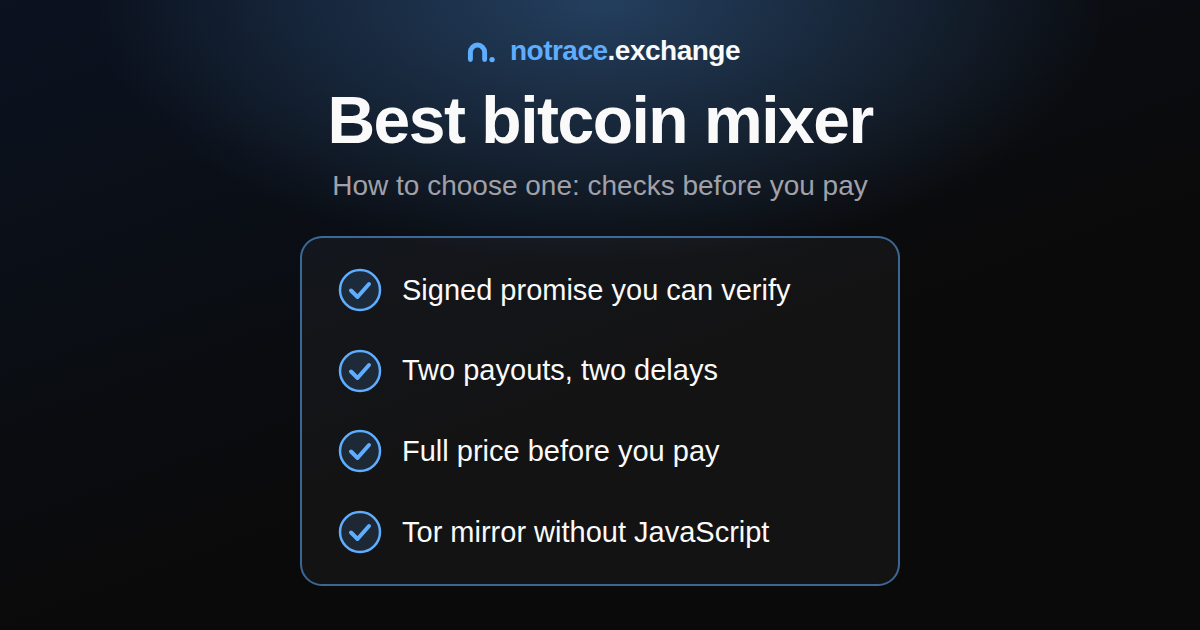
Why there is no single best bitcoin mixer
Two different tools go by the same name. A mixing service takes your coins and later pays out other coins from its own funds: for as long as the mix runs you trust it with the money, and in return nobody else has to take part. A wallet with built-in CoinJoin mixing works the opposite way. The coins never leave your keys, your transaction is joined with other people's in shared rounds, and how private it ends up depends on how many people join a round and who coordinates it.
Neither wins in every case. If you would rather not hand coins to anyone even for an hour, a mixing wallet is the honest answer. If you want the payout in another coin, at addresses you pick and after delays you set, a service is. The checks below are written for services, because that is where the trust goes.
Check 1: a promise you can verify without the website
Anything on a mixer's website can be edited after you pay. A document signed with the operator's key cannot: change one character and the signature stops verifying. A legit bitcoin mixer can hand you exactly that before you pay — what you send, the least you receive and where it goes, signed with a key whose fingerprint was public before your order existed.
Every order on notrace.exchange comes with such a letter, signed with our PGP key. It states what you send, the least you receive in total, both receiving addresses, both delays and how the payout divides between them. The key and the way to check a letter are on the PGP page; the fingerprint is 3B12 2BBB DC0B C8CB 90D8 A7FA 5D3C D31A 3A22 A5D6.
Check 2: how the payout leaves
One transfer back, a few minutes after the deposit, for nearly the same amount, separates very little: the size and the timing still point to you. Look at what the service lets you decide about the payout — how many transfers there are and when each one leaves.
Here the payout always leaves as two transfers to two different addresses, each with its own delay. On 14 September 2026 the delay for each could be set from zero to 6 hours in one-hour steps. It is counted from the moment the deposit settles, and a small random spread is added so nothing leaves at a round time. A single-address payout is not offered at all; the FAQ explains why.
Check 3: the full price before you pay
Mixers price themselves in many ways: a percentage, a network charge on top, a fee for every extra payout address, a minimum fee on small amounts. The figure worth comparing is the one left at the end — how much reaches your addresses for what you send, with every cost already taken out, shown before you commit.
Our service fee on 14 September 2026 was 0.5%, and it is the only thing we add. The amount in the calculation already has the network costs of both outgoing transfers deducted, and the guaranteed minimum is on screen before the order exists. The current fee is always in the FAQ.
Check 4: what it keeps about you
"No logs" is the most repeated promise in this market and the hardest to test. A better question is what exactly is stored, and for how long. An answer with a period and a list tells you something; an answer with a slogan does not.
Ours: the order itself — its addresses, amounts and times. An order created on the clearnet site also records the connecting IP address, which on 14 September 2026 was erased after 30 days. An order created over Tor carries no IP at all. Service logs exist so the site can be run and repaired, and they rotate on their own. The FAQ says this in the same words.
Check 5: registration and documents
A mixer that asks for an account, an email address or a phone number has started a record about you before the first coin arrives. Find out what an order actually requires.
Here, nothing about you: no registration, no email and no documents. You create an order and come back to it by its link, which makes the link worth saving — it is the only way back.
Check 6: a Tor mirror and a way to spot a clone
Clones are the oldest trap around mixers: a copy of a known site on a lookalike address that takes deposits and returns nothing. Two habits help. Use a mirror you can reach over Tor, ideally one that works with JavaScript switched off, so the page cannot run code in your browser. And confirm the address against something an impostor cannot forge.
Our onion mirror opens in Tor Browser on the Safest level, where JavaScript is off:
notracemxdnjycucwtrywh5n3eu3immfijvsoparxbvas5msb5557vqd.onion
The same address is printed in the footer of this site and in every signed letter. A clone can copy a page. It cannot produce a letter that verifies against our key.
Check 7: speed and limits
The time a mix takes is two things added together: confirmation of the deposit on its own network, and the delays you chose. On Bitcoin the first part is the slow one; on Solana it takes moments. If a service promises bitcoin back in seconds, ask what it does before your deposit confirms.
Limits deserve a look too. The minimum should be visible before you start — here it sits under the amount field and depends on the coin. There is no fixed maximum: a large amount is capped by the liquidity that direction has at that moment, and the calculation tells you when you are above it. Trying a service for the first time? Send something close to the minimum and wait for both transfers.
Check 8: where the link is broken
A deposit is a public transaction, and so is every payout. What a mixer decides is everything in between: whether the link from one to the other is recorded anywhere public, and whether the payout mirrors the deposit closely enough to be matched by amount and time. Ask any service how it handles both.
On notrace.exchange every order is settled on a private settlement layer, so the link between your deposit and your payout is not written to the public blockchain, and the payout leaves as two transfers to two addresses, each after its own delay. Take the payout in another coin, and its asset and amount differ from the deposit as well. And while a delay runs, the funds for that transfer are held by us; section 8 of the terms puts it exactly that way.
How to read reviews and "best" lists
A list of the best bitcoin mixers is only as good as its upkeep. See when it was last updated and whether the services on it still open. Look for a sponsored label: places in such lists are often sold, and a paid place is an advertisement, not a verdict. Compare the addresses in the list with the ones each service publishes itself, since a list is a handy place to slip in a clone. And give more weight to a review that describes an actual mix — which coin, how much, how long each transfer took, whether both arrived — than to one that only names a winner.
Where to start
Each coin has its own page, which opens the form in that coin with its live minimum: the bitcoin mixer, the Ethereum mixer, Solana and USDT on Ethereum. The crypto mixer on the home page lets you pick any supported coin on either side. To see one order from the first click to the second payout, including the four commands that check a letter, read the step-by-step guide.