
How long does a bitcoin transaction take?
Published: October 28, 2026
Also available in:EspañolРусский繁體中文
How long does a bitcoin transaction take? Usually about ten minutes to the first confirmation and close to an hour to six, as long as the fee is not too low. The exact time is a matter of chance: blocks come at uneven intervals, and the recipient decides how many confirmations to wait for. On 28 October 2026 we read the last 1,008 bitcoin blocks, almost a week, and the fees in the latest ones.
What the time is made of
- The queue. A new transfer first waits in the mempool, the public queue of unconfirmed transactions. Miners take the ones that pay the most per byte, so the fee decides how long it waits there.
- The block. A block is found every ten minutes on average, but at random: sometimes a minute after the previous one, sometimes an hour. The first block that includes your transfer is its first confirmation.
- Confirmations. Every block on top adds one more. A wallet shows a transfer as soon as it reaches the mempool; exchanges and services usually credit it after one to six confirmations, and each sets its own number.
What we measured
On 28 October 2026, 13:50–14:00 UTC, blocks 972,554–973,562 through the public explorers blockstream.info and mempool.space:
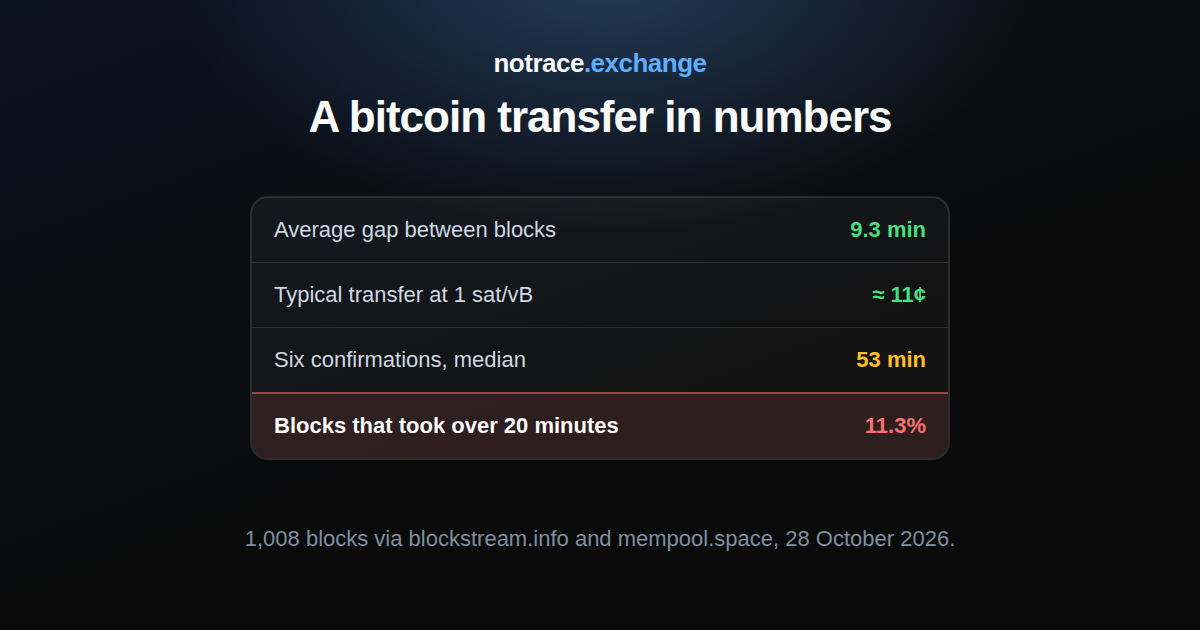
- 1,008 blocks took 155.8 hours: one every 9.27 minutes on average, or 155 a day instead of the planned 144. Mining power grows faster than the difficulty catches up with it, and the same pace moves the date of the next halving;
- the median gap was 6.2 minutes. By the blocks' own timestamps, 9.2% came within a minute of the previous one, 11.3% took more than 20 minutes and 4.1% more than half an hour; the longest gap was 68.7 minutes;
- from a random moment, the wait for the next block averaged 9.2 minutes — about the whole average gap, not half of it. Long gaps cover more of the clock, so a transfer is more likely to land in one;
- six confirmations took a median of 53 minutes: one time in ten under 30 minutes, one time in ten over 85 minutes, and 0.5% of the time over two hours;
- the 15 latest blocks were full but cheap: their median fee rates were 0.12–2.3 satoshi per virtual byte, and the cheapest transaction in them paid 0.11. A typical transfer (one input, two outputs, about 141 vbytes) at 1 sat/vB cost 141 satoshi, about 11 cents at $80,419 per bitcoin;
- 50,316 transactions were waiting in the mempool, 20.3 million vbytes, roughly 20 blocks' worth. On average they paid 0.15 sat/vB.
In other words, on a quiet day the fee barely matters, and the time is set by chance and by the number of confirmations.
Why a transfer gets stuck
- The fee is too low. The fee rate is an auction for room in the next block. A rate that was enough an hour ago may not be enough now, which is why a wallet estimates it at the moment of sending. Bitcoin Core forgets a transaction that has stayed unconfirmed for two weeks; the coins never left the sender's address.
- It can be sped up. If the wallet marked the transfer as replaceable, the sender can resend it with a higher fee (Replace-by-Fee). The recipient can also spend the incoming coins with a high fee, and the miner then takes both transactions together (CPFP).
- The recipient waits longer. Six confirmations take about an hour even with a good fee, and a service that wants more takes longer.
Faster networks
- Ethereum: a block every 12 seconds.
- Tron: a block every 3 seconds, one reason USDT is often sent there (TRC-20 vs ERC-20).
- Solana: a slot every 0.21 seconds by our measurement of 27 October.
Speed changes nothing about what can be seen: on any of these networks the transfer is public.
FAQ
Can a bitcoin transaction be cancelled? Once it is in a block, no. Before that, only by replacing it with a higher-fee transaction that sends the coins elsewhere, if the wallet allows it.
Can others see my transfer before it is confirmed? Yes. The mempool is public: any explorer shows the transaction, its addresses and amount within seconds (is bitcoin traceable).
What is a confirmation? A block that includes the transaction or sits on top of it. Each block is tied to the previous one by its hash, so changing an old transaction would mean redoing every block after it.
Where we stand
The notrace.exchange form takes BTC, and a deposit counts once the Bitcoin network confirms it.
- After that the payout leaves as two transfers to two addresses of yours, each with its own delay of 0 to 6 hours. The total time is the network's plus the delays you choose. If you want the coin and the amount to change too, choose a payout in another coin.
- While a delay runs, the funds are held by the service: section 8 of the terms says so.
- Before you pay, the order offers a letter signed with our PGP key stating what you send and the least you will receive.
- Our fee on 28 October 2026 was 0.5%; the current figure is on the FAQ page.
The Bitcoin mixer page opens the form in BTC with the live minimum. More about the coin itself: what is bitcoin.