
Custodial vs non-custodial, and privacy
Published: September 29, 2026
Also available in:EspañolРусский繁體中文
A custodial wallet is one where somebody else holds the private keys: an exchange account, a broker, a payment app, most things with a password reset. A non-custodial wallet is one where you hold the keys, and nobody — including the company that wrote the software — can move your coins or stop you from moving them. That is the whole distinction, and every page on the subject gets it right.
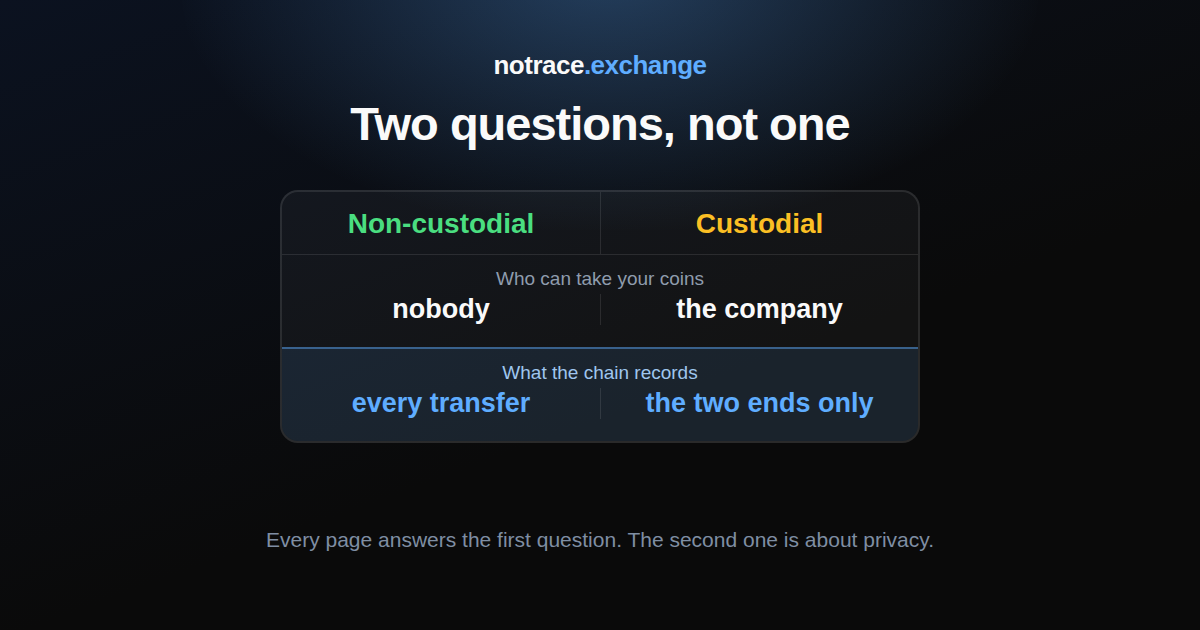
What those pages leave out is that this choice does something the others do not. Custody is the only decision in this family that changes what the blockchain records about you. Hot or cold storage does not change it. Holding a seed phrase instead of one private key does not change it. Which address you hand out does not change it. Custody does — and not in the direction most people assume. We run notrace.exchange, a mixing service that is deliberately custodial for a few hours, so this is the half we have had to think about carefully.
What the two words actually mean
Custodial means the keys are held by a service on your behalf. Your balance is an entry in that company's database saying you are owed a certain amount. When you press send, the company decides whether to sign a transaction, and it can decline, delay, freeze or lose it. In return you get a password reset, support staff and somebody to call.
Non-custodial means the keys are on your device, and the software is a tool rather than a counterparty. Nobody can freeze the balance and nobody can restore your access either. The trade is stated bluntly in the slogan the whole subject is built around: not your keys, not your coins.
Almost everything written about the pair — including the pages ranking for it — is an expansion of those two paragraphs, plus a list of wallets. It is correct as far as it goes.
The comparison everybody makes, and why it is right
The standard list is about who can take the coins away from you, and it is worth repeating because it is true:
- A custodian can fail. Bankruptcy, seizure, a compromised hot wallet, or a policy change; your claim is against a company, not against the chain.
- A custodian can freeze. Withdrawals get suspended for reasons that have nothing to do with you personally.
- Self-custody transfers the entire failure surface to you. A lost seed phrase is final. There is no support queue, and that is the same property that makes it safe.
- Recovery is the mirror image of control. Any mechanism that can restore your access can also be used against you, which is why non-custodial wallets do not offer one.
None of that is in dispute, and if the only thing you came for is which one is safer against theft, the answer is the usual one: a custodian is a single point of failure, and your own key is a single point of responsibility.
The half that is missing: what the chain records
Here is where every version of this comparison stops, and it stops before reaching something that matters.
When you hold your own keys, every payment you make is a transaction on a public ledger. Amounts, timing, and the addresses on both sides are permanent and visible to anybody who cares to look, forever. A non-custodial wallet does not change that; it was never supposed to. What a wallet address gives away on its own is covered in what a wallet address is and who sees it.
When a custodian holds the coins, that stops being true for one part of the journey. Moving value between two customers of the same company is a row in a database, not a transaction — nothing about it reaches the chain at all. The Bitcoin wiki's privacy article makes the same observation in its section on off-chain transactions: transfers that pass through custodial services need not appear in the block chain in the first place.
So custody genuinely changes the public record. It is the only thing in this article that does. But before anyone treats that as an argument, the same wiki is blunt about the price, in a sentence about exactly this kind of wallet: "Some bitcoin wallets are just front-ends that connects to a back-end server run by some company. This kind of wallet has no privacy at all, the operating company can see all the user's addresses and all their transactions, most of the time they'll see the user's IP address too."
Read the two facts together and the shape of the thing appears. Custody does not delete the record. It moves the record from a public ledger into one company's private one. Whether that is an improvement depends entirely on who that company is, what it keeps, and what it is obliged to hand over — and for the large regulated custodians the answer is documented: "Many exchanges require users to undergo Anti-Money Laundering and Know-Your-Customer (AML/KYC) checks, which requires users to reveal all kinds of invasive personal information such as their real name, residence, occupation and income. All this information is then linked with the bitcoin addresses and transactions that are later used."
That is the honest version of the privacy comparison, and it fits in one line: self-custody publishes your history to everyone, custody publishes it to one party who also knows your name.
What custody does not remove, no matter who holds the keys
The part that gets oversold is the boundary. Custody only takes the middle off the chain. The two ends stay exactly where they were.
The deposit that funds a custodial account is an ordinary on-chain transaction from an address of yours, and it is visible. The withdrawal out is another one. Both are as public as any other payment, and exchange deposit addresses are among the most thoroughly catalogued addresses in existence — identifying them is a routine part of chain analysis, not an exotic capability. How those observations get stitched into a person is the subject of is Bitcoin traceable.
So "I keep it on an exchange" removes the hops between accounts inside that company, and removes nothing about the coins arriving or leaving. Anyone reasoning about their own exposure should count those two transactions, because they are the ones that exist.
"Which wallet is not traceable?"
That question is not ours. It sits in Google's own "people also ask" block on this subject, in the Russian results, right next to the definitional questions — and not one of the ten pages ranking there answers it.
The answer is that no wallet type is. A wallet is software that signs transactions and displays balances. It does not decide what the ledger keeps, because the ledger is not part of the wallet. Choosing a non-custodial wallet, a hardware device, a fresh address for every payment or a longer seed phrase changes who can steal from you and how badly you are hurt if you lose a backup. It changes nothing about what has already been written, and nothing about what will be written when you next spend.
We checked that this is genuinely absent rather than assuming it. Of the pages ranking for the Russian phrasing of this question we could open — the weakest domain in the top ten and the strongest blog in the middle of it — neither discusses chain traceability, who observes transfers, or deanonymisation. The second mentions privacy once, as a table row saying custodial wallets require verification and non-custodial ones ask for little data. Which is true, and is about forms, not about the ledger.
One more thing our own measurement shows, taken on 29 September 2026 from Ahrefs: in Russian, searches for the word "non-custodial wallet" were almost nonexistent until late 2021, rose sharply through spring 2022, jumped again that October, and peaked around 4,800 a month in May 2024, settling near 900 this summer. The curve does not grow smoothly — it moves in steps. We are not going to attribute each step to a particular event, because we did not verify that, but a term that arrives in jumps is one people look up after something happened, not while choosing software.
Where we stand
notrace.exchange is custodial, on purpose, for a short window — and it is worth saying plainly rather than burying, because the whole article above is about what that means.
- The service holds the funds while your chosen delays run. Section 8 of the terms says it in those words: from the moment your deposit settles until the last transfer has left, the service is the custodian of those funds.
- That custody is the mechanism, not a side effect. The same section states that the link between your deposit and your payout is not written to the public blockchain.
- The two ends are still on the chain, exactly as described above. Your deposit arrives from an address of yours, and the payout leaves in two transfers to two addresses you give us, each with its own delay — on 29 September 2026 each delay could be set from zero to 6 hours.
- You are not asked for a seed phrase, a private key or an extended public key, and nothing here could use them. If any service asks, that is the end of the conversation — the reasoning is in seed phrase vs private key.
- Every order carries a letter signed with our PGP key, naming what you send, the least you will receive, both addresses and both delays.
- Our fee on 29 September 2026 was 0.5%, and it is the only thing added to the quote; the current figure lives on the FAQ page.
The limit is the one that applies to every article in this series: nothing removes what is already written in the chain, and no service can. What changes is whether coins leaving a known address can be followed forward.
Where to start
If you came for the difference, it is two questions, not one. Who can take the coins — that is what every page tells you, and self-custody wins it. What the chain keeps — that is the question underneath, and there custody is the only lever, at the price of one party knowing everything instead of everyone knowing some of it.
If the storage side is what you are working on, hot wallet vs cold wallet goes through the same two axes for devices. If you are deciding where to send coins from an address that is already known, the bitcoin mixer page opens the form with its current minimum, and the checks in how to choose a bitcoin mixer are worth running against us as well as against anybody else.