
TRC20 vs ERC20: which USDT network
Published: October 1, 2026
Also available in:Русский
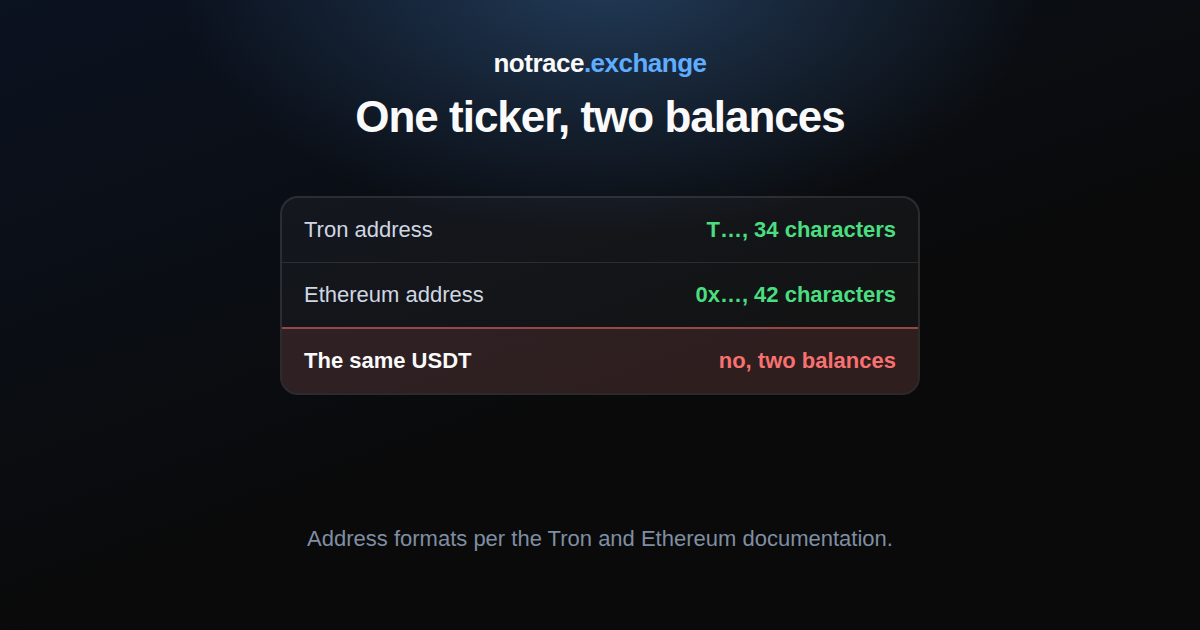
TRC-20 and ERC-20 are not coins and not two kinds of USDT; they are the standards by which tokens are issued on the Tron and Ethereum networks. USDT exists on both at once, and those are two separate balances with two different addresses: a token on Tron can be neither seen nor spent on Ethereum, and the other way round. So the word "USDT" in a send form is only half of the instruction. The other half is the network, and it is almost always the recipient who picks it, not you.
The usual answer to "which network is better" fits on one line: Tron is cheaper. We tested that on live transfers on 1 October 2026 and the result was less clear-cut, so every figure below carries a date and a method. For the coin itself — what stands behind USDT and who can freeze it — see what USDT is and who controls it.
What the letters mean
Tron's documentation defines TRC-20 as "a set of contract standards for issuing fungible token assets on TRON": any contract that implements the required functions and events counts as TRC-20 (documentation page). ERC-20 was proposed by Fabian Vogelsteller in November 2015; ethereum.org describes it as a token standard that implements an API for tokens within smart contracts. BEP-20 is the same idea on BNB Smart Chain. The point of a standard is that wallets and platforms can handle any token in the same way.
USDT is a contract written to such a standard, separately on each network. So USDT on Tron and USDT on Ethereum are different contracts with different records of who holds what. The genuine USDT on Tron is the contract TR7NHqjeKQxGTCi8q8ZY4pL8otSzgjLj6t, and on Ethereum it is 0xdAC17F958D2ee523a2206206994597C13D831ec7; when a token looks doubtful, compare the contract in an explorer rather than the name. Tether issues USDT on 14 networks in all, and we listed them in the previous article.
How to tell the addresses apart
A Tron address is 34 characters in Base58Check form and starts with the letter T, as the Tron documentation puts it. An Ethereum address is 42 characters: the 0x prefix and 40 hexadecimal digits (ethereum.org).
The difference is mostly cosmetic. The same Tron documentation describes how the address is built: take the last 20 bytes of the Keccak-256 hash of the public key and prepend the byte 0x41; those 20 bytes, in its words, are identical to the Ethereum address derived from the same public key. One key therefore gives both a T… address and a 0x… address. The balances, however, are different and live on different networks.
The harder case is another one. A 0x… address is the same on Ethereum, BNB Smart Chain, Base, Arbitrum and Optimism: Bitget Web3 Academy says so in a piece dated 31 August 2026, and adds that USDC on Ethereum is not the same as USDC on Base. So a 0x… address does not tell you the network; you choose it at the moment you send. If you are looking for "my TRC-20 address", pick USDT specifically on the Tron network in your wallet and the address will start with T.
What happens if you pick the wrong network
Between networks compatible with Ethereum the mistake looks like this: the transfer goes through and the tokens end up at the same address, but on another network. According to Blockscout's breakdown of 4 March 2026, such tokens can usually be recovered: "If a wallet controls the private key for an address, that address effectively exists on every EVM-compatible chain." The condition is a single one: you must hold the key to the recipient's address.
If the recipient is an address at a platform that credits only one network, it is worse: the same breakdown puts such deposits among the cases that need support to step in. Mixing up Tron and Ethereum in a send form is harder, because the address format differs and the field will, as a rule, refuse the wrong one.
Our rule is the same: the deposit has to arrive on the network chosen in the form, because USDT on another network is a different asset, not a different setting. If something went to the wrong place, first open the transaction in an explorer and check the network, the recipient address and the token contract.
What a transfer costs: a measurement on 1 October 2026
We did not take figures from other people's guides and measured it ourselves, between 16:17 and 16:22 UTC. For Tron we took the 16 latest confirmed USDT transfers and read what each one consumed. For Ethereum we took 16 transfer calls to the USDT contract from a single block (26,098,606) and the gas used in each receipt. Coin prices are those of 16:22 UTC: ETH at 2,683.07 dollars, TRX at 0.334.
Tron. A transfer consumed 64,285 units of energy in 11 cases out of 16, 130,285 in four and 92,024 in one. The doubled figure looks like a transfer to a recipient who had never held USDT, which is how the eco.com guide explains it, though we did not check each transaction for that. The network's price of energy at the time was 100 sun per unit (the getEnergyFee parameter), so 64,285 units come to 6.43 TRX, about 2.15 dollars, and 130,285 to 13.03 TRX, about 4.35.
Few senders paid that much. Six of the 16 paid nothing at all, and seven more were charged only for bandwidth — 0.345 TRX, about 12 cents. Three paid for energy by burning coins, and they lost 6.4, 9.6 and 13.4 TRX — roughly 2.15, 3.21 and 4.47 dollars. The rest used energy obtained another way: it can be stocked up in advance or rented. We did not find out who those senders were.
Ethereum. The gas for a USDT transfer ranged from 41,297 to 63,209 units, median 46,115. The effective gas price of these transfers ran from 9.75 to 18.74 gwei, median 10.75. That works out at 1.19 to 1.82 dollars, with the median transfer at 1.33.
The conclusion is a cautious one. For someone paying from an ordinary wallet with no energy in stock — burning TRX, that is — a transfer on Tron cost 2.15 dollars or more in that hour, against about 1.2 to 1.8 on Ethereum. Tron was cheaper only for those whose energy did not cost TRX. The common estimate — Ethereum at 3 to 30 dollars and more, Tron at 1 to 4 (so the eco.com guide, April 2026) — did not reproduce in that hour.
The caveats: this is one block and one minute, gas moves through the day, and the price of energy on Tron is a network parameter changed by a vote. So the method matters more than the final figure: you can estimate the cost at the moment you need it in two minutes from the same two parameters.
Where USDT sits and where it gets frozen
According to the analytics firm Messari, as Bitget cites it, at the end of the second quarter of 2026 there was 87.9 billion dollars of USDT on Tron, 47.6% of the issue, and 78.7 billion on Ethereum. Of the 184.6 billion total we mentioned in the previous article, Ethereum accounts for about 42.6%. Together the two networks hold roughly 90% of the issue, and the other twelve the remaining tenth.
Freezes tell a different story. According to BlockSec, as of 26 July 2026 the blacklist holds 6,901 addresses and 3.71 billion dollars on Tron against 2,696 addresses and 1.98 billion on Ethereum. That is 72% of the addresses and 65% of the amount for Tron, and 28% and 35% for Ethereum. With 47.6% of the issue, Tron's share of frozen dollars is noticeably larger. Tether names Tron too: in July 2026 more than 130 million dollars were frozen on four of its addresses (tether.io, 28 September).
The data do not explain why, and we are not going to guess. The dates and sources differ: the issue is as of 30 June and from Messari, the freezes as of 26 July and from BlockSec, so the two can be compared only roughly. One thing is plain: the network does not protect against a freeze. The contract has the blacklist function on both networks, and it belongs to the issuer.
What the chain shows
Tron and Ethereum are both public: any address and its whole history can be read in an explorer with a single lookup. What a stranger's address gives away on its own is covered in what a wallet address is. On our order page each of the two transfers gets a link to the explorer of its network, so you can check both yourself.
Where we stand
The USDT mixer page opens on Ethereum (ERC-20), but the form is wider than that. On 1 October 2026 the asset list has USDT on four networks — Ethereum, Polygon, Solana and Tron — and each is a separate asset with its own minimum and its own withdrawal cost. The minimum is currently about 30 USDT on all four, and the quote and the guaranteed minimum you receive are shown before you create the order.
- The deposit has to arrive on the network of the asset chosen on the left; both receiving addresses have to be addresses on the network of the asset chosen on the right.
- The right-hand side of the form is the full list of assets, and USDT on another network is a separate choice there, like another coin: as the form says, the quote then differs in both asset and amount.
- The payout leaves in two transfers to two addresses of yours, each with a delay; on 1 October 2026 each could be set from 0 to 6 hours in steps of one hour.
- While a delay runs, the funds are held by the service: section 8 of the terms states plainly that for that time the service is the custodian.
- Before you pay, the order offers a letter signed with our PGP key, and our fee on 1 October 2026 was 0.5%; for the current figure see the FAQ.
- A freeze by the issuer after a payout is a property of the token, and we can neither influence it nor undo it.
Where to start
Ask the recipient which network they expect the USDT on, and do not guess it from the address: a T… address leaves no doubt, a 0x… address has several possible answers. For a first transfer use a small amount, and open the transaction in the explorer of the right network before sending the rest. And if you are choosing which network to send from, compare the cost at that very moment: in our measurement the advantage of Tron went not to those who pay themselves but to those who already had energy.