
What is USDT and who controls it
Published: October 1, 2026
Also available in:EspañolРусский
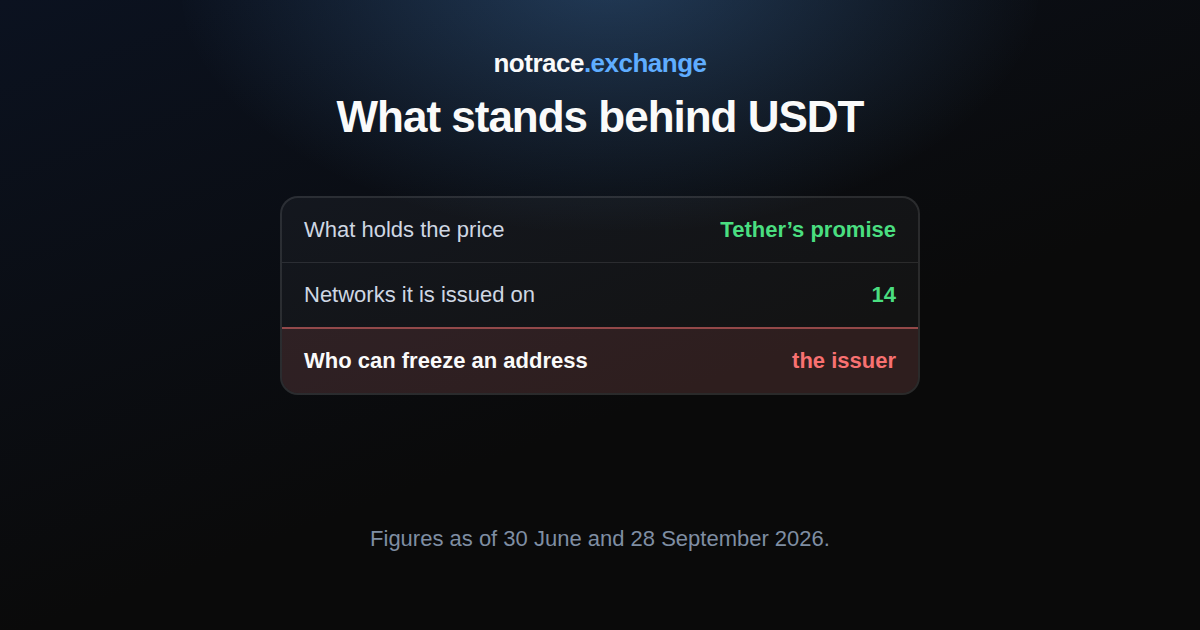
USDT is a token issued by a company called Tether, and by that company's promise it is worth one dollar. Technically it is a record in a smart contract on a particular blockchain: an address and a number. In substance it is not a dollar in an account but a liability of a private company, and almost everything that happens to USDT follows from that. On 30 June 2026 about 184.6 billion USDT were in circulation, which makes it the largest stablecoin there is.
We are not going to explain what a "stable coin" is in general; that is how every guide to this query begins. The more useful part is three consequences that make USDT behave differently from bitcoin or ether: what holds its price, how many networks it lives on, and what the issuer can do to your address. We run notrace.exchange, a mixing service with a page for USDT, so the figures below come from primary sources rather than summaries, and each one carries a date and a link.
Why so many people ask
According to Ahrefs on 1 October 2026, "what is usdt" is searched about 10,000 times a month in the United States and "usdt meaning" about 8,200 — and the first of those has stayed between 8,000 and 12,000 for two years, without spikes. In Spanish, "que es usdt" is searched about 6,500 times a month in Venezuela, 3,500 in Argentina and 1,500 in Colombia. At that volume USDT is not a curiosity but an everyday thing, and the answer to "what is it" decides how people treat their own money.
What you are actually holding
The USDT contract was issued by Tether Limited, a subsidiary of Tether Holdings Limited, which is based in the British Virgin Islands; as of January 2025 the company's headquarters moved to El Salvador, according to Wikipedia. The token is older than most of the networks it now lives on. It launched on 6 October 2014 as Realcoin on Bitcoin, on the Omni protocol, and was renamed Tether on 20 November the same year. The company itself now treats that issuance as retired: on its supported protocols page, which we opened on 1 October 2026, Bitcoin (Omni) sits under deprecated, next to Algorand, Vaulta (formerly EOS), Kusama AssetHub and Bitcoin Cash (SLP).
That is the first difference from bitcoin. Bitcoin has no issuer: its price is the outcome of trading, and the network promises nobody anything. USDT's price is held up by a promise, not by a property of the network. If the promise stopped being kept, the blockchain would not notice: the record in the contract would look exactly the same.
Why it costs a dollar, and how far to trust that
Tether publishes a reserve attestation every quarter. According to the second-quarter 2026 report, as relayed by Decrypt on 31 July, as of 30 June:
- about 184.6 billion USDT in circulation, up 446 million from the end of March;
- assets of about 187.75 billion dollars against liabilities of about 183.64 billion;
- assets exceeding liabilities by roughly 4.11 billion;
- most of the assets held in short-term US Treasuries, repurchase agreements and other liquid government-backed instruments; gold above 146 metric tons, up 14 tons in the quarter.
That is the issuer's own report, and we have not checked it — we have nothing to check it against. In relaying it we trust Decrypt exactly as far as any reader would.
There are reasons to ask whether it can be trusted, and they are documented. On 15 October 2018 the price briefly fell to 0.88 dollars. On 17 February 2021 iFinex settled the New York Attorney General's case by paying 18.5 million dollars without admitting wrongdoing. On 15 October 2021 Tether Limited paid 41.6 million dollars to the US Commodity Futures Trading Commission, which found it had misrepresented USDT as fully backed by dollars (all of this from the Wikipedia summary). We list the dates not as a verdict. They explain why the answer to "how stable is it" lives in the reports and the history, not in the word "stable".
One coin, fourteen networks
USDT is not one chain; it is the same token issued on several. On 1 October 2026 Tether's page lists 14 as current: Ethereum, Avalanche, BNB Smart Chain, Cosmos (via Kava), Celo, Kaia, Tron, Liquid, Solana, Polkadot AssetHub, Tezos, Near, Ton and Aptos.
These are separate records in separate contracts. USDT on Tron and USDT on Ethereum are two different balances, and one cannot be moved into the other by an ordinary transfer: it takes a bridge or a third-party service. So the word "USDT" in a send form is always incomplete, and a network goes with it. The address does not always tell you which. A Tron address starts with the letter T and is 34 characters long, while an address of the form 0x… with 42 characters is the same on Ethereum, BNB Smart Chain, Avalanche and the other Ethereum-compatible networks: you choose the network when you send, not the address.
Our USDT page opens on Ethereum (ERC-20): both receiving addresses are Ethereum addresses, and USDT on another network is not credited there — it is a different asset, not a different setting. The form lists USDT on other networks as separate assets: on 1 October 2026 that was Polygon, Solana and Tron alongside Ethereum, each with its own minimum and withdrawal cost. How to choose between Tron and Ethereum is in TRC20 vs ERC20: which USDT network; the details and limits are on the USDT mixer page.
Who can freeze USDT
This is the second consequence of a promise: the issuer wants to be able to stop the token, and the USDT contract can do that. According to a breakdown by the analysts at BlockSec, it has three functions, and only the owner address can call them — Tether's multisig. addBlackList bars an address from sending and receiving, removeBlackList restores that ability, and destroyBlackFunds burns the balance. By the same breakdown, no court order is needed for the freeze itself.
A freeze does not erase the record. The tokens stay on the address and in the total supply, still visible in an explorer; they simply do not move, until Tether burns them separately.
What is known about the scale, with dates and sources:
- on 23 April 2026 Tether announced that, with OFAC and US law enforcement, more than 344 million USDT had been frozen across two addresses (tether.io);
- on 28 September 2026 Tether wrote that a further 130 million or more had been frozen in July across four Tron addresses, about 550 million Iran-linked in 2026 in total, and more than 4.9 billion dollars across all its cooperation with authorities, of which more than 2.4 billion is connected to US authorities; the company also said it had aligned its wallet-freezing policy with the US Treasury's SDN list (tether.io);
- BlockSec, as of 26 July 2026: 9,597 blacklisted addresses holding 5.69 billion dollars, of which Tron has 6,901 addresses and 3.71 billion and Ethereum 2,696 addresses and 1.98 billion.
The two totals do not match: 4.9 billion from Tether and 5.69 billion from BlockSec. They are evidently counting different things — the result of cooperation with authorities over all time against the balance sitting on blacklisted addresses on one date — and we do not reconcile them. BlockSec names three sources of freezes: law-enforcement requests, sanctions lists and Tether's own monitoring for scam and phishing patterns. In 2025, by its figures, 3.6% of addresses were unfrozen, with a median of 18.2 days between freeze and removal. A freeze can be reversed, but that is the exception.
For a holder this comes down to one thing: USDT has a lever that bitcoin, ether and SOL do not have at all, and it belongs to the token, not to the wallet or the service. Whoever you trust with custody and whichever service you use, they cannot undo a freeze. Our USDT page says the same.
What the chain shows about a holder
An address on Ethereum or Tron is an account: the entire balance and the entire history sit on it, and a single lookup in an explorer reads both. USDT transfers are public events of the token's contract on whichever network they happen on, and a frozen balance stays visible in exactly the same way. What a stranger's address gives away on its own is covered in what a wallet address is; how the picture changes when you do not hold the keys is in custodial vs non-custodial wallets.
USDT and the dollar
A dollar in a bank account is a claim on a bank inside a regulated system. USDT is a token: its price on trading platforms wobbles around one and, as shown above, once fell to 0.88; it moves around the clock, and nobody can reverse a mistaken transfer on a blockchain. That is not a judgement, it is a difference worth remembering whenever someone writes "1 USDT = $1".
Where we stand
The USDT mixer page opens on Ethereum (ERC-20): both receiving addresses are Ethereum addresses, and USDT on other networks is a separate asset chosen in the form. There is no registration, no email and no documents.
- The payout leaves in two transfers to two addresses of yours, each with its own delay; on 1 October 2026 each delay could be set from 0 to 6 hours in steps of one hour.
- While a delay runs, the funds are held by the service. Section 8 of the terms says so plainly: from the moment your deposit settles until the last transfer has left, the service is the custodian of those funds.
- Before you pay, the order offers a letter signed with our PGP key: what you send, the least you receive, both addresses and both delays.
- Our fee on 1 October 2026 was 0.5%; it is the only thing added to the quote, and the current figure is always on the FAQ page.
- A freeze by the issuer after a payout is a property of the token. We cannot influence it and we cannot undo it.
Where to start
If the question is whether USDT is safe, read Tether's quarterly report and what independent analysts write about it, not the "explained simply" overviews. If the question is what to do with it, start from the network, not the coin: the address, the fee and what others will see about you all depend on it. And for anyone choosing where to send coins from an address that is already known, the checks in how to choose a bitcoin mixer are worth running against us as well as against anybody else.