
What is Bitcoin and how does it work
Published: October 14, 2026
Also available in:Español
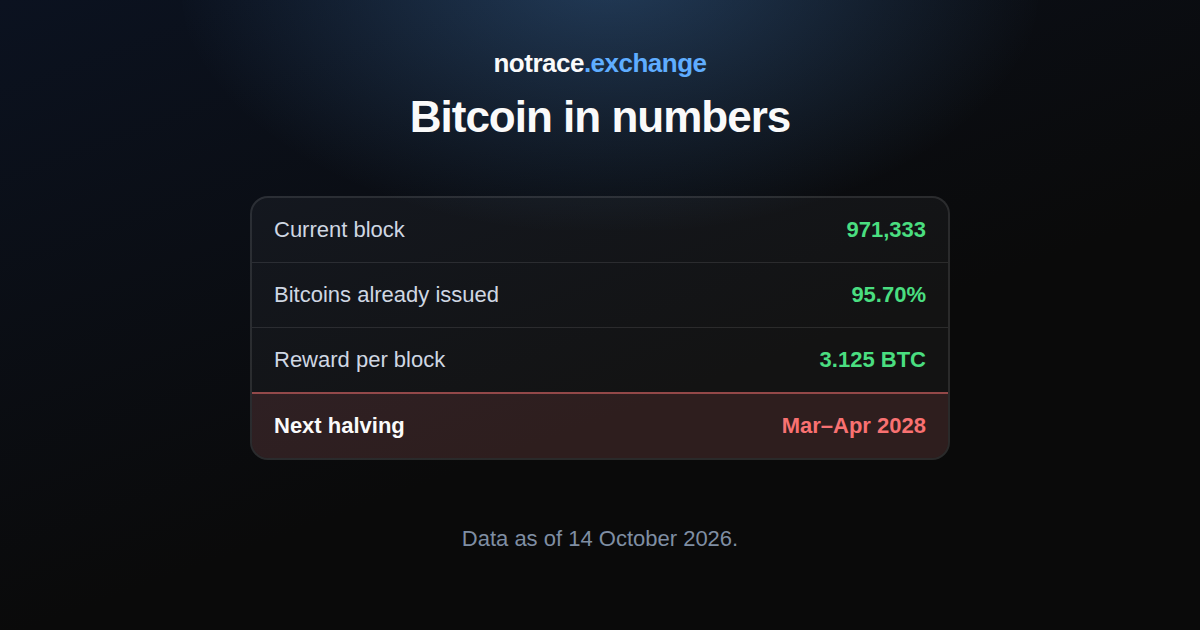
What is Bitcoin? It is digital money that works without a bank: thousands of computers keep the same ledger of payments and, roughly every ten minutes, add a new page to it called a block. Nobody issues it at will: new coins come with each block on a schedule fixed since 2009. We explain it with figures you can check yourself, taken on 14 October 2026 at 01:40 UTC.
Bitcoin, bitcoin and BTC
Capitalised, Bitcoin is the network and its rules; lowercase, bitcoin is the coin; BTC is the ticker you see on platforms. The smallest unit is the satoshi: one BTC is 100,000,000 satoshis, so nobody has to buy a whole coin.
The idea was published on 31 October 2008 by someone signing as Satoshi Nakamoto. The paper opens with: "A purely peer-to-peer version of electronic cash would allow online payments to be sent directly from one party to another without going through a financial institution" (bitcoin.pdf). The first block was created on 3 January 2009 (Bitcoin Wiki).
How a transfer works
- Your wallet signs the order with your private key. Without that key nobody else can move the coins at your address.
- The transfer spreads across the network and waits in a public queue, the mempool.
- A miner puts it in a block. For the network to accept that block, the miner has to find a number that gives the block a hash below a threshold. In return it collects the block reward and the fees.
- Every new block on top is one more confirmation. Undoing a confirmed transfer would mean redoing all that work.
The network retunes its difficulty every 2016 blocks to get back to ten minutes. Over the 1,637 blocks since the last retune the average was 9.47 minutes, about 152 blocks a day instead of 144, so at block 971,712 the difficulty will rise: mempool.space estimated by 5.6%. The network's hash power stood at about 1,000 EH/s: a thousand billion billion guesses per second.
How many bitcoins exist, and what the halving is
Every block brings new coins. It started at 50 BTC, and the amount is cut in half every 210,000 blocks: that is the halving. Today the reward is 3.125 BTC.
From the block height you can work out how much has been issued. At block 971,333, mined at 01:39 UTC:
- by the schedule, 20,097,918.75 BTC exist, 95.70% of the total;
- the total possible is 20,999,999.9769 BTC, slightly under 21 million because of rounding to satoshis (Bitcoin Wiki);
- about 902,081 BTC are still to be issued.
The fifth halving comes at block 1,050,000, which is 78,667 blocks away. At the current pace that is around 14 March 2028; with blocks of exactly ten minutes, around 12 April 2028. After that each block brings 1.5625 BTC. The same calculation, made ten days earlier, is in what is cryptocurrency.
What sending bitcoin costs today
The fee does not depend on the amount but on how much space the transfer takes in a block, measured in satoshis per virtual byte (sat/vB). On 14 October at 01:40 UTC, mempool.space recommended 1 sat/vB for every priority, the network minimum, with 77,566 transfers in the queue.
A typical transfer with one input and two outputs takes about 141 vB. At 1 sat/vB that is 141 satoshis, about 12 US cents with bitcoin at $83,207 on CoinGecko. When the network gets busy the rate goes up, so check it right before you send.
What anyone can see
Bitcoin addresses carry no names, but the ledger is public and nothing is ever erased. Every transfer shows the sending address, the receiving address, the amount, the time and the fee, and its identifier, the TXID, can be looked up in any explorer. Once an address is tied to a person even once, say by a withdrawal from a platform that asked for ID, its whole history is in view. How tracing works is in is Bitcoin traceable.
Quick answers
Who controls Bitcoin? No company. The rules live in the software that thousands of nodes run, and nobody can change them alone.
Can I lose it? Yes. Lose the key or the seed phrase and you lose access, with nobody to appeal to. See seed phrase safety.
Can I cancel a transfer? Not once it is confirmed. Check the full address before sending.
Where we stand
BTC is in our form. You send bitcoin and receive it back in two transfers to two addresses of yours, each with its own delay of 0 to 6 hours. If you want the coin and the amount to change too, choose a payout in another coin.
- While a delay runs, the funds are held by the service: section 8 of the terms says so.
- Before you pay, the order offers a letter signed with our PGP key stating what you send and the least you will receive.
- Our fee on 14 October 2026 was 0.5%; the current figure is on the FAQ page.
The bitcoin mixer page opens the form in BTC with the live minimum.