
What is cryptocurrency, in plain terms
Published: October 4, 2026
Also available in:EspañolРусский繁體中文
Cryptocurrency, in plain terms, is a record in a shared ledger that thousands of computers keep at the same time, and the only person who can change a line in it is the one who holds the key. There is no bank in this picture, no account in your name and no desk that reverses a mistaken transfer: there is a network, an address and a key. We run notrace.exchange, a mixing service, and we work with these records every day, so we explain cryptocurrency through what you can check yourself. Every figure below was taken on 4 October 2026, at about 10:00 UTC.
What cryptocurrency is
Every cryptocurrency has three parts.
- A network and its ledger. Computers keep identical copies of a list of transfers and add new ones by shared rules. That list is called a blockchain; how it is built and what can be read from it is shown on three real transfers in our article what is blockchain and what it shows.
- An address. A string that coins are sent to. You can show an address to anyone.
- A key. A secret number that authorises spending whatever sits at the address. Whoever holds the key is in control.
Bitcoin came first. Its description was published on 31 October 2008 and its first block was closed on 3 January 2009 (Bitcoin Wiki history). The description opens with the reason for the whole thing: "A purely peer-to-peer version of electronic cash would allow online payments to be sent directly from one party to another without going through a financial institution" (the original paper). The "crypto" part comes from cryptography: the right to move coins is proved by a digital signature, not by an ID document or a login. The records themselves are tied together by hashes; what those are and how they are computed is shown in what is a hash in blockchain.
"Crypto" in everyday speech means the same thing: any coins and tokens that live on such networks.
How cryptocurrency differs from money in a bank
- A transfer is not reversed. Once a record is in a block it does not change. A wrong address or a wrong network stays wrong.
- Access is not restored. Lose the key, or the phrase it is derived from, and the coins are lost with it. A network has no "forgot password" button.
- Balances and transfers are public. A record carries no name, but anyone can read the addresses, the amounts and the time.
- Nothing pins the price. It is set by supply and demand and moves by several percent in a day.
- The issuance rules are written in advance. For Bitcoin no single organisation can change them; for tokens it can be different, and the next section is about that.
Whether that makes it money is a separate argument. The European Central Bank's answer in its explainer on Bitcoin is no: "Bitcoin is a speculative asset", and it "is not issued by a central public authority".
Coin and token: who issues a cryptocurrency
The main dividing line inside cryptocurrency is whether somebody issued the thing and answers for it.
A coin is the native unit of a network. Bitcoins are created by the Bitcoin network itself on a schedule; ether appears by the rules of Ethereum. There is no company that could issue more or take some back.
A token is an entry in a program (a contract) that runs on top of someone else's network. The most common standard for such programs on Ethereum is ERC-20. A token usually has an issuer: a company that creates it and may keep special powers for itself.
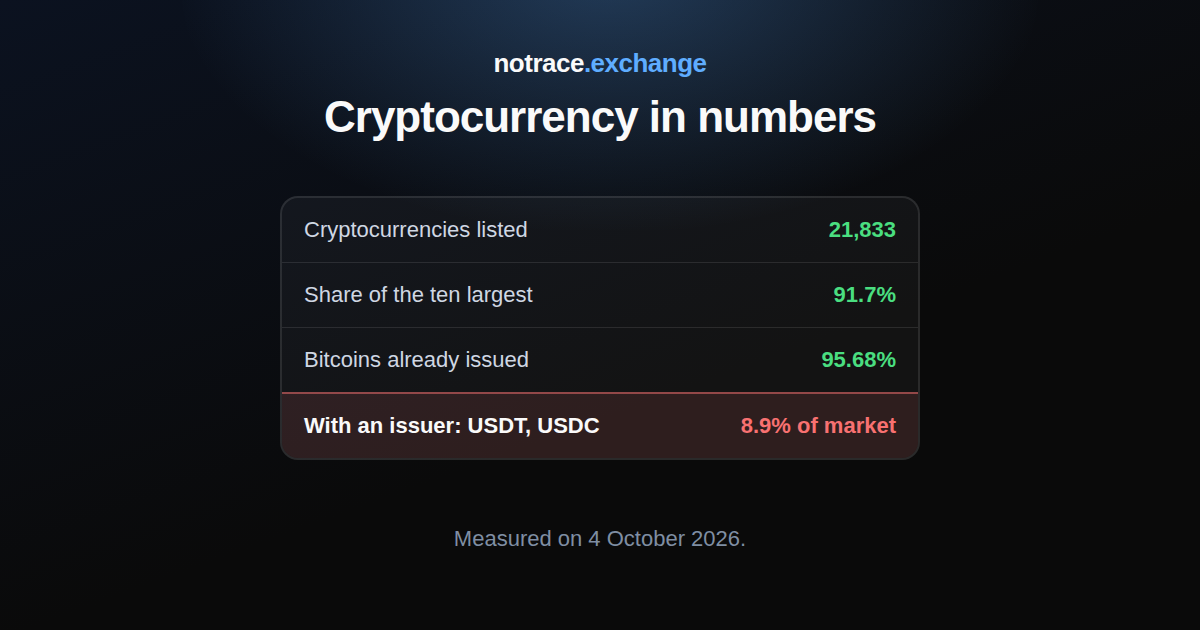
We looked at what that means for the market. According to CoinGecko on 4 October 2026, 09:58 UTC:
- 21,833 cryptocurrencies are listed, with a combined market value of 2.89 trillion dollars;
- the ten largest hold 91.7% of that sum, Bitcoin alone 59.2% and Ethereum 11.4%;
- seven of the ten are native coins of their own networks: Bitcoin, Ethereum, BNB, XRP, Solana, TRON and Zcash, together 81.9% of the market;
- two are dollar tokens issued by companies: USDT (6.4%) and USDC (2.6%), together 8.9%;
- the remaining place belongs to the Figure Heloc token (0.9%), which we have not examined.
So roughly one dollar in eleven on this market sits in tokens that have an issuer. For both USDT and USDC the issuer can freeze the tokens at a particular address: the function is written into the contracts themselves, and we covered it with dates and primary sources in what is USDT and who controls it and what is USDC and who can freeze it. The Bitcoin network has no such function.
The same token can be issued on several networks, and those are separate records in separate ledgers. This is where newcomers most often lose money; see TRC20 vs ERC20.
How many bitcoins exist: our calculation
Bitcoin's issuance rule is simple, and plain arithmetic is enough to check it. Each block creates new coins: 50 BTC at first, halved every 210,000 blocks, so the total will come to slightly less than 21 million (Bitcoin Wiki).
We took the number of the latest block on 4 October 2026, 09:55 UTC, and did the sum ourselves:
- block 969,826; four halvings are behind us and the reward is now 3.125 BTC per block;
- by the schedule, 20,093,209.375 BTC had been created by that block, which is 95.68% of the limit of 20,999,999.9769 BTC;
- 906,790.6 BTC are left to issue;
- the next halving comes at block 1,050,000, which is 80,174 blocks away: about a year and a half at the usual ten minutes per block.
CoinGecko showed 20,093,006 BTC in circulation in the same hour, about two hundred coins fewer than our figure: the schedule says how many coins could have been created, not how many are actually available.
Other cryptocurrencies have their own rules. Ether has no upper limit at all, and USDT is issued and retired by a company at its own decision.
What everyone can see
A transfer record on a public network consists of the sender's address, the recipient's address, the amount, the time and the fee. There is no name in it, but the history of every address is open in full and for good: paste the address into a block explorer, a site that displays these records. That is why cryptocurrency should not be treated as hidden by default: whoever learns your address once sees the balance and every past and future transfer.
How a chain of transfers is followed from record to record is covered in is Bitcoin traceable, and what a single address gives away on its own in what is a wallet address.
How long a transfer takes and what it costs
A transfer counts as done when the network has included it in a block. Networks produce blocks at different rates, and we measured them in the same hour:
- Bitcoin: the last 144 blocks took 11.7 minutes each on average and the last 2,016 blocks 10.05 minutes; 70,160 transactions were waiting in the queue;
- Ethereum: 1,000 blocks at 12.05 seconds each on average;
- Tron: 1,000 blocks at 3.00 seconds each on average.
The sender pays the fee, and it does not depend on the amount: on Bitcoin you pay for the size of the record in bytes. Over the last fifteen blocks the median rate ran from 0.3 to 2.3 satoshis per virtual byte, so an ordinary transfer of about 140 bytes cost between 4 and 27 cents at 85,248 dollars per BTC. A week later the figure may differ several times over: it is the price of block space in one particular hour. How the fee for a USDT transfer is worked out is measured separately in our article on USDT networks.
Where cryptocurrency is kept
Coins do not sit anywhere except in the network's records. What you keep is the key, and a wallet is the program or device that holds the key and signs transfers with it.
The question to ask about any wallet and any service is who holds the key. If you do, the storage is non-custodial; if a company does, it is custodial, and the record on the blockchain then reflects the company's decisions. The difference is set out in custodial vs non-custodial. The backup of a key usually looks like 12 or 24 words; who must never see them is the subject of seed phrase safety, and where the key physically lives is covered in hot wallet vs cold wallet.
You can buy and sell cryptocurrency on a trading platform or from another person; how a deal between two people works and where its risks are is explained in what is P2P in crypto.
Common questions
How much is one cryptocurrency worth? There is no single price: every coin has its own. On 4 October 2026, by CoinGecko, one bitcoin cost 85,248 dollars and one ether 2,702 dollars, while USDT and USDC stood at about one dollar because they are tokens pegged to the dollar.
Can cryptocurrency be turned into ordinary money? Yes, it is sold: on a trading platform, through a broker or directly to another person. The network takes no part in that; all it knows is coins moving from address to address.
Who controls a cryptocurrency? It depends on the coin. Bitcoin's rules are enforced by every node of the network, and it has no separate manager. A token with an issuer is controlled by the company that created it, within what the contract allows.
Can cryptocurrency be traced? Transfers on public networks are open, and they are followed from address to address. Whose address it is cannot be seen from the record itself; that is learned from other sources.
Where we stand
Six of the ten largest cryptocurrencies are in our form. On 4 October 2026 it accepted and paid out BTC, ETH, SOL and TRX, plus USDT on four networks and USDC on five.
- The payout leaves in two transfers to two addresses of yours, each with its own delay, from 0 to 6 hours in steps of one hour.
- While a delay runs, the funds are held by the service: section 8 of the terms states plainly that for that time the service is the custodian.
- Before you pay, the order offers a letter signed with our PGP key, and our fee on 4 October 2026 was 0.5%; the current figure is always on the FAQ page.
Four coins have a dedicated page that opens the form in that coin with its live minimum: the bitcoin mixer, Ethereum, Solana and USDT.
Where to start
Not with buying, but with reading. Open the explorer of any network and look at a stranger's transfer: the addresses, the amount, the fee, the block number. Then decide who will hold your key, and write the backup phrase on paper before the first coin arrives at the address. Make the first transfer a small one and check the network and the address twice: nobody will be there to reverse it.