
What is CoinJoin and how does it work
Published: September 15, 2026
Also available in:Español
CoinJoin is a Bitcoin transaction that several people build and sign together, so that an outside observer can no longer tell whose coins went where. Nobody hands their coins to anyone: each participant signs only their own input. This guide covers how a CoinJoin round works, which tools still run one in 2026, what the technique leaves visible and how it differs from a mixing service. We run notrace.exchange, a mixing service of the other kind, and the last section says plainly where the two differ.
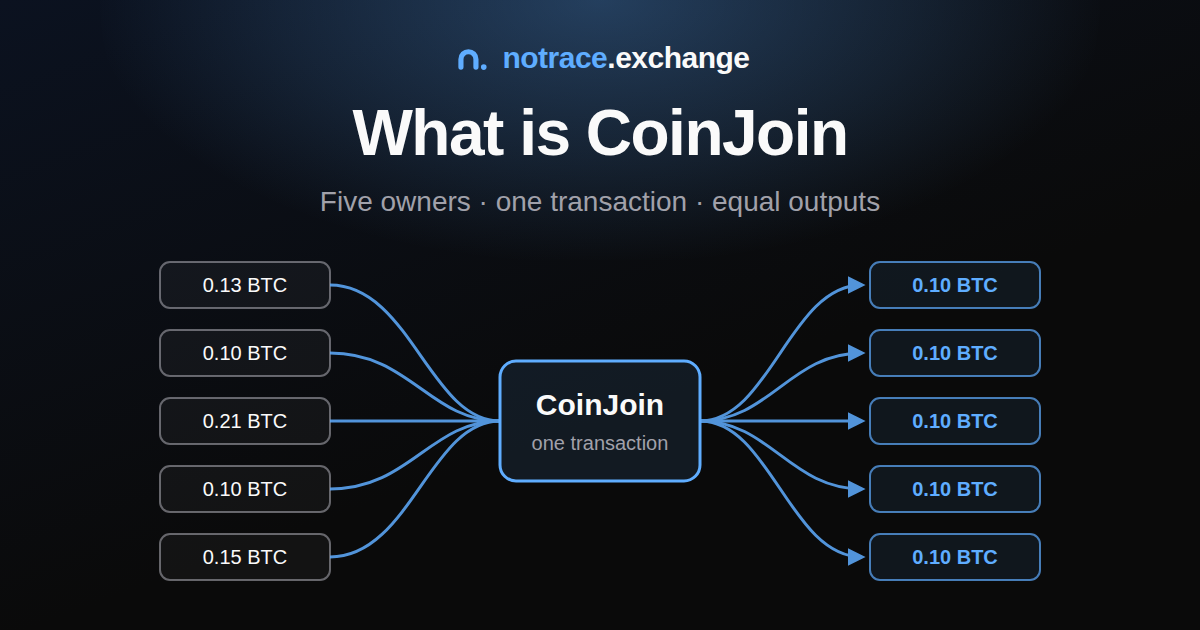
How a CoinJoin transaction works
An ordinary Bitcoin payment is easy to read. Its inputs usually belong to one wallet, so whoever looks at the chain learns that those coins had one owner, and the output that is not a round payment is often the change going back to the same person.
A CoinJoin breaks that assumption. Several people each bring an input, name an address they want to be paid to, and every output of the shared transaction carries the same amount. The chain then shows, say, five inputs from five owners and five outputs of 0.1 BTC each, with no field saying which output belongs to which input. Each participant checks that their own output is in the transaction before signing, so no one can be robbed along the way.
Someone has to gather the participants and assemble the transaction. In most tools that is a coordinator: a server that collects inputs and outputs and passes the unsigned transaction around. It never holds the keys, so it cannot take the coins, but it does see the round as it forms.
The idea is older than any of today's tools. Gregory Maxwell described it in August 2013 in a Bitcoin forum post titled CoinJoin: Bitcoin privacy for the real world, and pointed out that it needs no change to Bitcoin itself.
Where CoinJoin runs in 2026
The landscape changed sharply in 2024, when the companies behind the two best-known coordinators stopped running them. What is left in September 2026 looks like this.
Wasabi Wallet. zkSNACKs, the company that developed Wasabi, announced on 2 May 2024 that its coordinator would stop on 1 June 2024; a week earlier it had blocked users in the United States. The wallet kept working, and rounds moved to coordinators run by other people. A 2026 study presented at PoPETs by researchers from Masaryk University and The Alan Turing Institute found that Wasabi 2.x mixing had grown past its pre-shutdown level, with one coordinator, kruw.io, handling 99% of mixed inputs and an average round estimated at more than 70 simultaneous users.
Whirlpool. This was the CoinJoin inside Samourai Wallet, and it went offline with Samourai in April 2024. An anonymous fork called Ashigaru relaunched a Whirlpool coordinator on 23 June 2025. It is reachable over Tor only, has two pools of 0.25 BTC and 0.025 BTC, and charges a fixed fee of 5% of the pool size. The same PoPETs study describes the resumed Whirlpool as showing little activity.
JoinMarket. It has no central coordinator. People who leave coins available for rounds are called makers and earn a small fee; the person who starts a round is the taker and pays it. The original repository was archived on 27 April 2026 and says it is no longer recommended for use. Development continues in JoinMarket NG, a separate implementation that can take part in the same market.
What CoinJoin does not hide
CoinJoin removes one link — which input paid which output inside the round. Everything around the round stays on the chain, and most failures of CoinJoin privacy come from there.
- Change. If you bring 0.13 BTC to a round of 0.1 BTC outputs, the remaining 0.03 BTC comes back as change, and that change is tied to your input as clearly as any ordinary payment. Newer designs such as WabiSabi, published in 2021, allow outputs of different sizes and cut this down, but they need many similar inputs to work well.
- Spending mixed coins together. Two outputs from a round that are later spent in one transaction are shown to share an owner again. The round did its job; the next payment undid it.
- The size of the round. Your output hides among the other equal outputs and no more. Five participants give you four others to hide among.
- The shape of the transaction. Many equal outputs in one transaction are easy to spot. The PoPETs study was able to identify coordinators and follow their activity from the chain, and noted that large inputs in Wasabi 2.x rounds are still detectable by analysing liquidity.
None of this makes CoinJoin useless. It means the privacy it gives depends on how carefully the coins are handled before and after the round, not only on the round itself.
Is CoinJoin illegal?
The answer depends on the country, and this article is not legal advice. What can be stated as fact is this. Technically a CoinJoin is an ordinary Bitcoin transaction, signed by each participant with their own key. The cases that have reached court so far concerned the people who ran the services, not the technique.
In April 2024 the founders of Samourai Wallet were arrested in the United States. In 2025 they pleaded guilty to conspiring to operate a money transmitting business that transmitted criminal proceeds, and in November 2025 they were sentenced to five and four years in prison, according to the US Attorney's Office for the Southern District of New York. zkSNACKs stopped its coordinator in June 2024, weeks after that arrest, and had already cut off users in the United States.
CoinJoin vs a mixing service
Both are called mixers, and the difference is mostly about trust.
With CoinJoin your coins never leave your keys. The price is that you need a round with enough other people in it, the payout is the same coin in fixed amounts, and the change and every later spend are yours to manage. A careless spend after the round can undo it.
A mixing service takes the deposit and pays out from its own funds. For as long as the payout waits, you trust the service with the money. In return you do not need anyone else to show up, and the service can do what a round cannot.
Here is what that looks like on notrace.exchange:
- the payout always leaves as two transfers to two addresses you name, each with its own delay; on 15 September 2026 each delay could be set from zero to 6 hours;
- the payout can be in the same coin or in another one;
- every order is settled on a private settlement layer, so the link between the deposit and the payout is not written to the public blockchain;
- each order comes with a letter signed with our PGP key, stating what you send, the least you receive and both addresses.
While a delay runs, the funds for that transfer are held by us; section 8 of the terms says exactly that. Our fee on 15 September 2026 was 0.5%, and the current one is always in the FAQ.
Where to start
If you would rather keep your keys, a CoinJoin wallet is the honest choice, and the round size and the handling of change matter more than the wallet's name. If you want the payout split across addresses and time, or in another coin, the bitcoin mixer page opens the form with its live minimum. Before choosing any service, the checks in how to choose a bitcoin mixer apply to us as well, and the step-by-step guide follows one order from the first click to the second payout.