
Crypto scams: how to check them on-chain
Published: October 14, 2026
Also available in:繁體中文
A crypto scam is a scheme where someone, posing as an investment adviser, a new friend or a support agent, gets you to buy cryptocurrency and send it to them. The coin they ask for is often USDT: it arrives in minutes, crosses borders without friction and cannot be pulled back once sent. This article sticks to what you can check yourself; the on-chain figures were taken on 14 October 2026.
Four common schemes
- Fake investment platform. You get a website or an app where the balance keeps growing. Taiwan's futures exchange describes the pattern in its anti-fraud section: at first the scammers pay out small profits, and once the victim puts in a large sum they demand tax or a margin deposit, then shut the site or go silent (TAIFEX, our summary).
- Pig butchering. A relationship built over weeks on a dating app or social network, then an "opportunity" that leads to the same kind of fake platform.
- Fake support, fake wallets. Someone claiming to be a platform's or wallet's support asks for your seed phrase or tells you to install a "verification" tool. No legitimate service needs your seed phrase: see who asks for it.
- Address poisoning. A zero or tiny transfer from an address whose first and last characters match one you use, waiting for you to copy the wrong one from your history. Check the full address before sending, not just the ends (related: dusting attacks).
Paying to withdraw means it is a scam
A real platform takes its fee from your balance; it does not ask you to send a separate "tax", "deposit" or "unlock fee" first. The profits on a fake platform are numbers in the site's database, not on any blockchain.
A transfer that really happened always leaves a transaction hash, the TXID, that anyone can look up in an explorer (what is a hash). Ask for the TXID of the withdrawal they say was paid. If it cannot be found, or the amount and the address do not match, stop there.
The USDT blacklist is public: we counted 30 days
Tether, the issuer of USDT, can freeze specific addresses; a blacklisted address can no longer send USDT. Tether says it works with more than 340 law enforcement agencies in 70 countries and that the assets frozen exceed $5 billion (Tether, 28 September 2026).
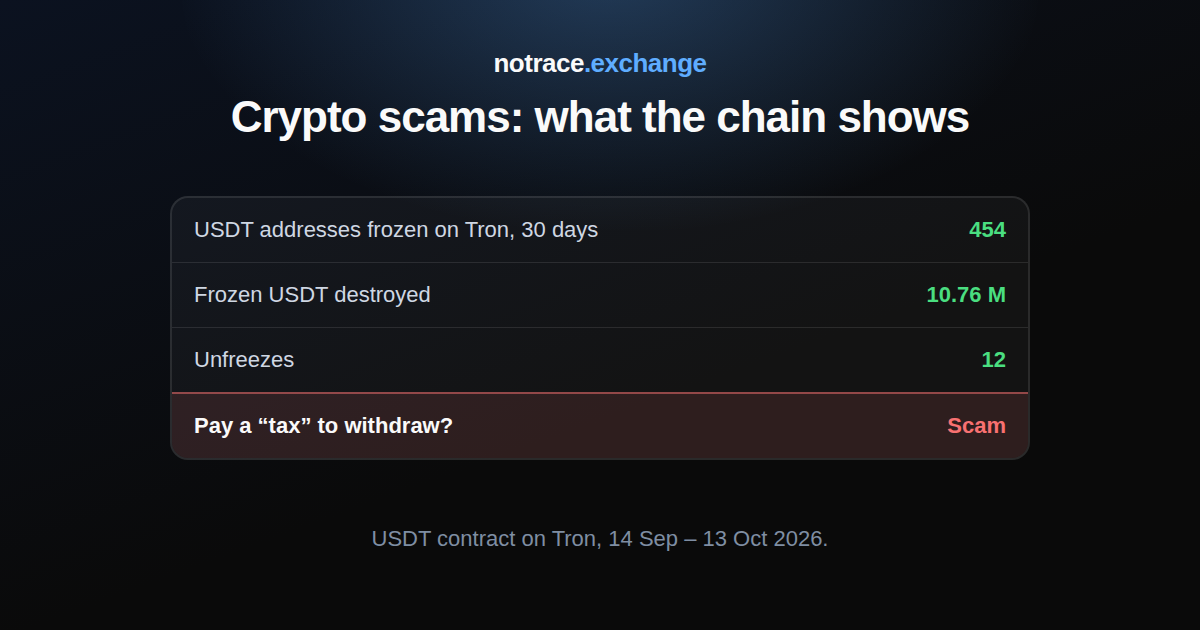
We read the events of the USDT contract on Tron directly, for 14 September to 13 October 2026:
- 454 addresses were added to the blacklist, with new additions on 26 of the 30 days, about 15 a day;
- addresses were removed from it only 12 times;
- frozen funds were destroyed 57 times, 10,755,608 USDT in total, the largest single burn 1.5 million.
After a burn Tether can issue the same amount anew, and the same press release describes a case of "freezing and reissuing".
Anyone can check whether an address is frozen: the USDT contract has a public isBlackListed function, which an explorer's read-contract tab will call for any address you paste. We tried it: an address added that day returned 1, a random address returned 0.
For a victim the point is time: while the money still sits in USDT at the receiving address, the police can still ask Tether to freeze it.
If you have been scammed
- Stop paying, whatever they say about one last payment unlocking the withdrawal.
- Report it to the police; in Taiwan that is the 165 anti-fraud hotline.
- Keep the evidence: the TXID of every transfer you sent, the receiving addresses, the site's URL and screenshots of the chat.
- Watch out for "recovery services": people who claim they can hack your money back for an upfront fee are usually the second scam.
Where we stand
Our service receives and pays out on-chain. The payout goes in two transfers to two addresses of yours, and each one has a TXID you can look up. Before you pay, the order offers a letter signed with our PGP key stating what you send, the least you will receive and the two addresses it goes to; you can verify the letter on the PGP page yourself, and a forged one fails. We never need your seed phrase either.
The full rules are in the terms, the common questions in the FAQ. For the basics, start with what is cryptocurrency.