
Crypto tumbler vs mixer: any difference?
Published: September 29, 2026
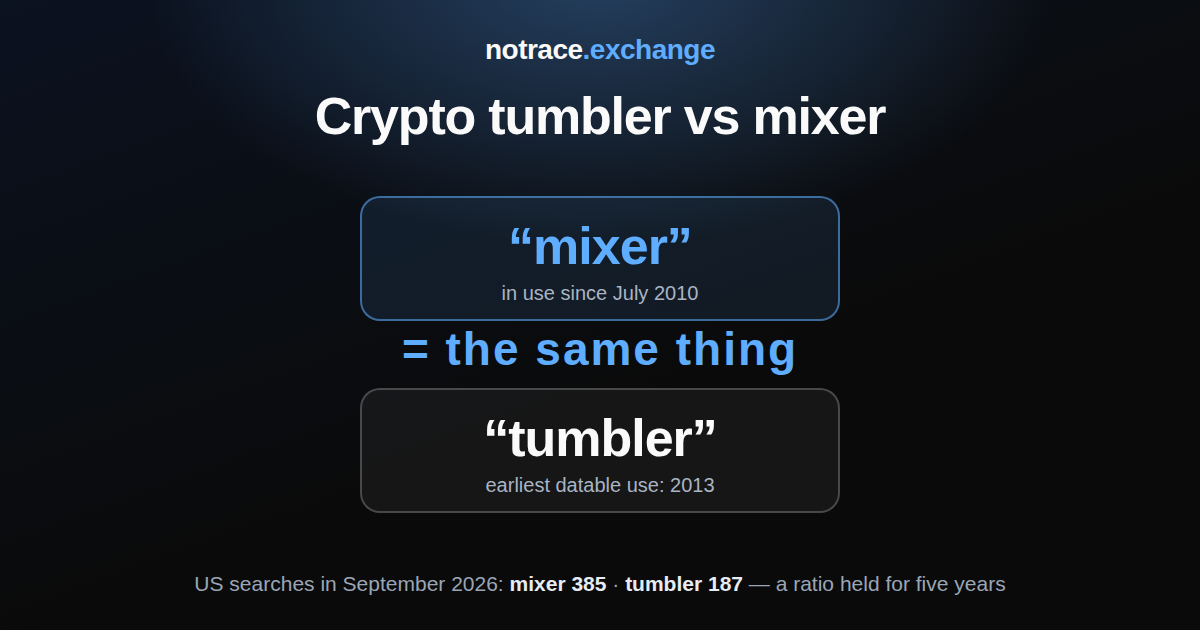
A crypto tumbler and a crypto mixer are the same thing. The two words have been used interchangeably for as long as both have existed, and no regulator, prosecutor or blockchain analysis firm treats them as two categories of service. If you are weighing up two services and one calls itself a tumbler while the other calls itself a mixer, you have learned nothing about either of them.
This article shows where that answer comes from, using the filings of the people who investigate these services. It then checks the one extra claim that gets repeated about these words, that "tumbler" is the older of the two, and finds it backwards. The rest is about what does differ between services, which is worth far more than the label on the front page. We run notrace.exchange, a mixing service, and the last section says plainly which kind we are.
The people who prosecute mixers use both words
In February 2020 the US Department of Justice charged the operator of Helix. The headline of the press release calls the service a bitcoin "mixer". The body of the same document says: "Helix functioned as a bitcoin 'mixer' or 'tumbler,' allowing customers, for a fee, to send bitcoin to designated recipients in a manner that was designed to conceal the source or owner of the bitcoin." Two words, one sentence, joined by "or". Further down the same page the US Attorney uses only the second one: "For those who seek to use Darknet-based cryptocurrency tumblers, these charges should serve as a reminder…". When the operator pleaded guilty in August 2021, the department repeated that sentence word for word.
It is not one careless release. When the Justice Department announced its cryptocurrency enforcement team in October 2021, it named its target as "virtual currency exchanges, mixing and tumbling services" — one doubled name for one category. The same phrase appears again in the Tornado Cash charging announcement of August 2023.
The financial regulator does the same and then adds a third name of its own. FinCEN's 2019 guidance on virtual currency opens the relevant section with: "Providers of anonymizing services, commonly referred to as 'mixers' or 'tumblers'". Both words are given as the informal names for a category whose official name, in that document, is neither.
The firms that trace this activity for a living agree. The Chainalysis glossary, checked on 29 September 2026, answers the question directly: "There is no functional difference—'mixer' and 'tumbler' are used interchangeably to describe services that obscure cryptocurrency transaction histories… All three refer to the same category of obfuscation tool." Merkle Science titles its explainer "Mixers and Tumblers". Freeman Law writes "a tumbler, also known as a mixer". Wikipedia keeps one article, whose opening sentence gives three synonyms in bold and to which Bitcoin mixer, Crypto mixer, Crypto tumbler and Mixing service all redirect. The Bitcoin Wiki puts it in a single parenthesis: "mixing services (also called mixers or tumblers)".
Which word came first
Chainalysis adds one line beyond the quote above: "'Bitcoin tumbler' is an older term that remains in common use". No source is given for it, and the dated record points the other way.
The earliest dated use of "mixer" in this sense we could find is a Bitcoin forum thread called Anonymity, opened by theymos on 7 July 2010 — about a year and a half before any such service was running. Describing how one might work, the post says: "If the mixer keeps no logs of who gets which coins, any investigation must stop here." It uses the word again a few lines later, recommending that coins be sent "through several external mixers". The word "tumbler" does not appear in it, and the post carries no edit marker.
On 30 April 2011 the Bitcoin Wiki gained an article titled Mixing service, created in a single edit whose summary reads "Create article for Mixing service." In 2013 the first academic study of these services, by Möser, Böhme and Breuker, used the phrase "mixing service" fifteen times and the word "tumbler" not once.
The earliest dated "tumbler" we could find is two years younger and comes from one place: Silk Road. The criminal complaint against Ross Ulbricht from September 2013 says the site "uses a so-called 'tumbler'", attributing the term to the site's own wiki, and the US Attorney's announcement of October 2013 repeats it. One qualification belongs here: full-text search on that Bitcoin forum requires an account, so this is the earliest use we could date, not proof that nobody wrote the word earlier.
What happened afterwards is easier to document. The two words ran level for a few years — FinCEN's 2019 guidance uses each exactly once, the Helix releases of 2020 and 2021 use both — and then one of them left official language. The Tornado Cash sanctions designation of August 2022 does not use "tumbler". Neither does the ChipMixer takedown announcement of March 2023, nor the Bitcoin Fog releases of 2024, nor the Samourai Wallet ones of 2024 and 2025. FinCEN's proposed rule on mixing from October 2023 uses "mixing" and "mixer" hundreds of times between them and "tumbler" not at all.
Among people searching, both words are fading together rather than one replacing the other. In the United States in September 2026, "bitcoin mixer" was searched about 385 times and "bitcoin tumbler" about 187, according to Ahrefs data we pulled on 29 September 2026. That ratio of roughly two to one has held for five years. Both are also about five times below their late-2021 peaks, and they rise and fall in the same months — in July 2025 both jumped at once. One event moves both words, which is its own small piece of evidence that there is one subject here and not two.
The one page that says they are different
One page in the search results disagrees, and it is worth naming because it ranks well. 101blockchains, checked on 29 September 2026, states: "While many casual conversations on cryptocurrency and mainstream media paint them as the same thing, crypto tumblers and mixers are significantly different from each other. Crypto tumblers and crypto mixers have unique technical architectures and work with different approaches." Its rule is that a tumbler is a centralised service that takes custody of your funds, while a mixer is the newer, broader word that also covers non-custodial ones.
The rule breaks on its own examples. ChipMixer and Helix were centralised and custodial, so by that definition they were tumblers — yet the Justice Department, Europol and FinCEN all call them mixers, including in the headline of the Helix charge. Tornado Cash is not custodial at all, and the sanctions designation called it a mixer too. The chronology is the wrong way round as well: the word this page calls "more modern" is the one traceable to 2010.
And the regulator specifically refused to tie the word to a mechanism. FinCEN's proposed definition covers obscuring the source, destination or amount of transactions "regardless of the type of protocol or service used". If the difference between a tumbler and a mixer were technical, that is exactly the sentence where it would have had to appear.
The distinction that page is reaching for is real. It is just not a distinction between two words — it is a distinction between how services are built, and that is worth setting out properly.
What actually differs
A custodial pool. The clearest official description is FinCEN's assessment against the operator of Helix from October 2020. A customer sent bitcoin to a wallet tied to their account, then filled in a withdrawal form giving "the amount to withdraw, a destination address, and the ability to set a time delay for the transactions"; the service moved the deposit to its own accounts and paid the customer from a different balance of its own, minus a fee. Note the date on that time-delay option: a feature list tells you little, because that one is from 2014.
A contract that holds nothing. In Van Loon v. Department of the Treasury, decided in November 2024, the Fifth Circuit described how a user deposits into a pool contract, receives a key that lets the same amount be withdrawn to an unrelated address, and that "the entire process occurs automatically — with no human intervention". The relayers that pay transaction costs "never have custody over users' Ether", and at least twenty of the contracts are irreversibly immutable. The court held that immutable contracts are not the property of a foreign national, so they could not be sanctioned, and the Treasury removed the listing on 21 March 2025.
A coordinator. Samourai Wallet's Whirlpool arranged rounds among its own users, after which, in the words of the November 2025 sentencing announcement, "the original source of particular Bitcoin holdings became obscured within the blockchain's transactional record". Users kept their keys throughout. They still paid fees, and $6,367,139.69 representing those fees was forfeited when the two founders were sentenced to five and four years. Keeping your keys removes the risk that someone takes your deposit. It does not remove the operator, the server or the fee.
None of the three removes the transactions themselves. A contract shows the deposit into the pool and the withdrawal out of it; a custodial service shows a deposit to one of its addresses and a payment from another; a coordinated round shows a transaction with many equal outputs. What is attacked in every case is the link between those records, never the records.
That is also why fixed amounts keep appearing. ChipMixer handed out pre-funded addresses it called chips, "in increments of 0.001 BTC up to 8.192 BTC", along with their private keys, so nothing had to be sent on the chain at all. Equal amounts are the whole point: the crowd of identical outputs is what a single output hides in. The Fifth Circuit made the limit plain — one user alone in a pool is trivially followed, thousands of users much less so. The cost is that your amount has to be broken into multiples of someone else's unit, and the crowd has to actually be there at the time.
What to check instead of the word
In 2021 five researchers — Pakki, Shoshitaishvili, Wang, Bao and Doupé — ran real money through five popular services three times each and wrote down what happened. Their results are the most useful checklist available, because they are measurements rather than reviews.
- The payout may simply not arrive. "We did not receive any output from CryptoMixer on Trials 2 and 3." In those same trials the researchers downloaded that service's signed letters of guarantee and verified them successfully. The signature was real. The money did not come.
- Deletion promises are checkable, and were wrong. "Although ChipMixer claims logs and session information is deleted in seven days, we found that our session tokens for all three trials were still valid after 16 days."
- A "no logs" promise has been disproved by seizure. Bestmixer claimed to erase all order history "completely and automatically in 24 hours". As the paper puts it: "This claim was proven false when authorities seized IP-addresses, transactions logs, wallet addresses, and chat messages that were stored on multiple Bestmixer servers."
- A signed promise sets accountability and nothing more. On the academic design that introduced signed warranties, the same paper notes: "Although accountability is achieved, the mixer can steal funds from its users and potentially leak permutations between inputs and outputs."
Their overall conclusion is worth quoting whole, because it describes most of this market: "Today's mixing services focus on presenting users with a false sense of control to gain their trust rather than employing secure mixing techniques."
So the questions that separate services are these. Who holds the money, and for how long? What does the service write down, and what is that claim worth if a server is seized? What happens if a payout does not arrive? Is the promise recorded in a form you can still check afterwards? None of those is answered by the word on the front page.
Where we stand
notrace.exchange is the custodial kind. We say so in the terms rather than implying otherwise: while a delay runs, the funds for that transfer are held by us, and section 8 states it in those words. What we do with that arrangement:
- the payout always leaves as two transfers to two addresses you name, each with its own delay; on 29 September 2026 each delay could be set from zero to 6 hours, and a transfer leaves no earlier than the delay you chose;
- the payout can be in the same coin or in another one — taking it in another coin is what changes the asset and the amount, because the same coin keeps both;
- each order comes with a letter signed with our PGP key, naming what you send, the least you will receive, both addresses and both delays;
- our fee on 29 September 2026 was 0.5% and it is the only thing we add to the quote; the current figure is always on the FAQ page.
The honest part is the rest. None of this is new: a service called MixTum was issuing PGP-signed letters, splitting payouts across two addresses and randomising delays of up to six hours back in 2018, and it appears in the study above. Nor does any of it remove the risk that comes with custody — as that study showed, letters can verify perfectly and the payout can still fail to arrive. A signature is evidence of what was promised. It is worth having, and it is not the same thing as a guarantee that a service will behave.
Where to start
If you want to keep your keys, the round-based approach is the honest choice and what CoinJoin is covers how it works and what it leaves visible. If you want the payout split across addresses and time, the bitcoin mixer page opens the form with its current minimum, and how to use a bitcoin mixer follows a single order from the first click to the second payout. Before trusting any service, including this one, the checks in how to choose a bitcoin mixer are the ones that matter — and what happened to Tornado Cash is a reminder that the name on a page and the people behind the domain are not the same thing.