Is Monero traceable? What the chain hides
Published: October 15, 2026
Also available in:EspañolРусский繁體中文
Is Monero traceable? Not the way Bitcoin is. A Monero transaction hides the amount, the receiver's address and which of 16 possible sources really paid, so nobody can follow the money with a block explorer. People who use Monero still get traced, but through what happens around the chain. On 15 October 2026 we read a full day of Monero blocks to see what each transaction does show.
What the chain hides
Monero's own site calls it "secure, private, untraceable" (FAQ). Three tools do the work:
- stealth addresses: each payment goes to a new one-time address, so the address you hand out never appears on the chain;
- ring signatures: each input is signed together with 15 decoys, outputs taken from earlier transactions, and an outsider cannot tell which of the 16 was spent;
- RingCT: amounts are hidden; the network checks that inputs and outputs add up without seeing them.
The ring has had 16 members since the network upgrade of 13 August 2022 (release notes).
One day of Monero blocks
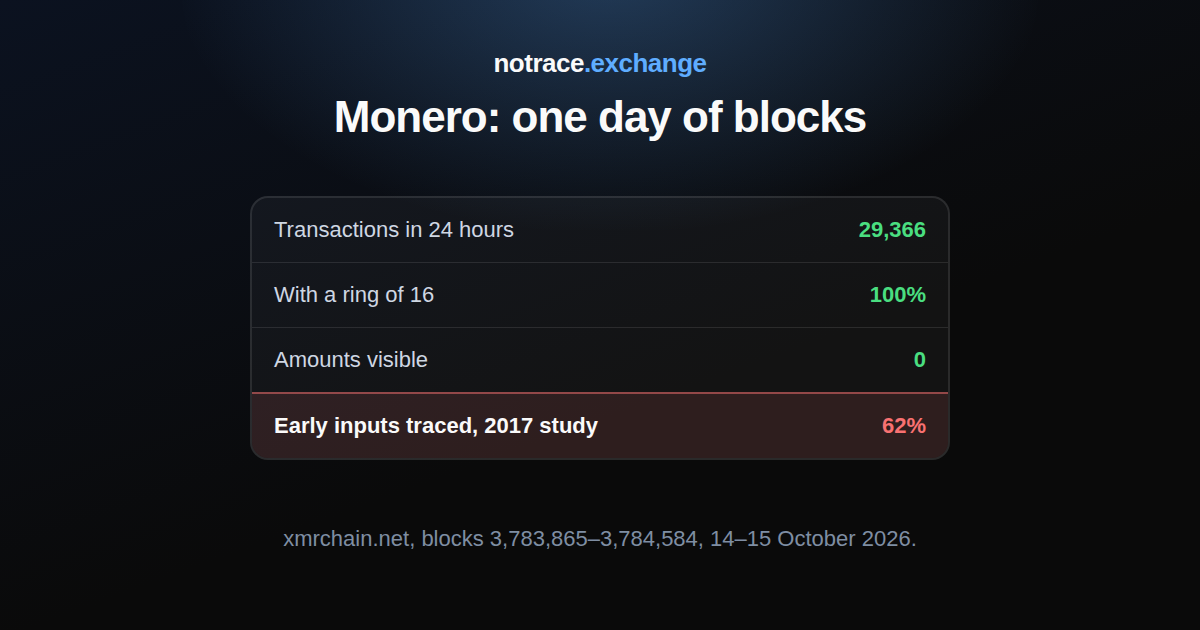
We read blocks 3,783,865 to 3,784,584 (from 12:52 UTC on 14 October to 12:49 on 15 October) through the public xmrchain.net explorer:
- 29,366 transactions, not counting miners' rewards. Every one had a ring of 16 and hidden amounts;
- the median fee was 0.0000445 XMR, about 2.4 US cents at $537.66 per XMR, for a transaction of 1,537 bytes;
- in a sample of 681 transactions, one from each block, 628 (92%) had two outputs, usually the payment and the change;
- the decoys reach far back: in the median ring the newest candidate was about 40 minutes old (21 blocks) and the oldest about seven months.
What stays in the open is the time, the fee, the size and how many inputs and outputs a transaction has. Each is a small clue. None of them names the receiver or the amount.
How Monero users get traced anyway
- Old history. A study first published in 2017 found that about 62% of early inputs with decoys could be traced by elimination, and that the real input was usually the newest one. Monero has changed its rules since, so this describes coins that moved before the changes.
- Exchanges. Buy XMR on a platform that knows your name and withdraw it to your wallet, and the platform keeps that link; a later deposit makes another. Such platforms are getting fewer. Binance delisted Monero on 20 February 2024, Kraken stopped it for clients in the European Economic Area on 31 October 2024, and from 10 July 2027 EU rules bar crypto service providers from accounts that allow "anonymity-enhancing coins" (Regulation 2024/1624, Article 79).
- The network. A wallet connected to someone else's node shows that node its IP address and when it sent a transaction. In September 2024 a leaked Chainalysis training video was reported to show Monero transactions traced together with IP addresses; people who studied it said the addresses came from nodes the firm ran. Chainalysis did not comment (Cointelegraph). A node of your own closes this gap.
- The device. A 2025 forensic study describes how to find a Monero wallet's keys in a computer's memory and decrypt the wallet files that hold its history (DFRWS).
- The edges. Coins usually come into Monero from a public chain and leave to one. If 0.5 BTC goes in and 0.5 BTC comes out an hour later, the hidden middle does not separate the two.
What changes next
Monero's developers are testing a replacement for rings, full-chain membership proofs (FCMP++): a spend would hide among every earlier output instead of 16. On 15 October 2026 it had not reached the main network. The network was on hard fork version 16, and every transaction we read used a ring of 16.
Quick answers
Is Monero untraceable? On the chain, mostly: amounts, receivers and the real input are hidden. Exchanges, nodes and devices can still link a payment to a person.
Is Monero more private than Bitcoin? By design, yes. Bitcoin shows every address and amount; see is Bitcoin traceable.
Monero or Zcash? Monero hides every transaction. Zcash hides only the shielded ones; see what is Zcash. The whole category is compared in what are privacy coins.
Where we stand
notrace.exchange does not work with Monero. The form takes BTC, ETH, SOL and TRX, and USDT and USDC on several networks.
- The payout leaves as two transfers to two addresses of yours, each with its own delay of 0 to 6 hours. If you want the coin and the amount to change too, choose a payout in another coin.
- While a delay runs, the funds are held by the service: section 8 of the terms says so.
- Before you pay, the order offers a letter signed with our PGP key stating what you send and the least you will receive.
- Our fee on 15 October 2026 was 0.5%; the current figure is on the FAQ page.
The bitcoin mixer page opens the form in BTC with the live minimum.