
What are privacy coins and how they work
Published: October 15, 2026
Also available in:EspañolРусский繁體中文
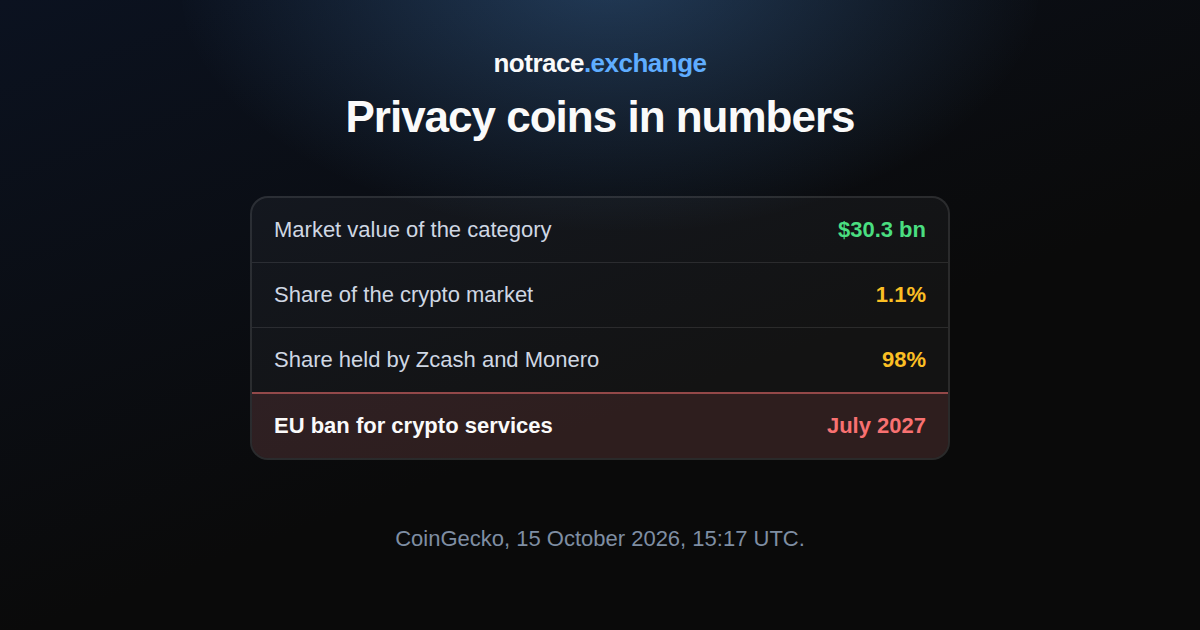
What are privacy coins? Cryptocurrencies whose blockchain itself hides the sender, the receiver or the amount of a transfer. On Bitcoin and Ethereum anyone can see all three. On 15 October 2026 privacy coins were worth $30.3 billion together, about 1.1% of the whole crypto market, and almost all of it sat in two coins.
How they differ from Bitcoin
On Bitcoin every transfer is written down in the open: addresses, amount, time. An address is not a name, but it can often be tied to a person through the exchange where the coins were bought or through the way they are spent; see is Bitcoin traceable. A privacy coin removes at least part of that record. Three methods are common:
- ring signatures and one-time addresses, as in Monero: each input hides among 16 possible ones, the receiver gets a new address, and the amount is hidden;
- zero-knowledge proofs, as in Zcash: the network checks a transfer without seeing addresses or amounts, but only inside its shielded pools;
- built-in mixing, as in Decred: coins of equal size are shuffled in rounds (CoinShuffle++), while amounts stay visible.
The market in numbers
According to CoinGecko at 15:17 UTC on 15 October 2026:
- the Privacy Coins category was worth $30.29 billion out of a $2.77 trillion market, or 1.1%, with $1.28 billion traded in 24 hours;
- Zcash stood at $19.58 billion (10th among all coins, up 339% in a year) and Monero at $10.20 billion (14th, up 64%); together they made 98% of the category;
- the third, Decred, was worth $0.27 billion, and the remaining twelve coins of the top fifteen about $0.3 billion between them.
So today, privacy coins mostly means two coins.
Always on or optional
The key difference is whether privacy is always on. In Monero every transaction is hidden: in the 24 hours to 15 October we counted 29,366 transfers, all with a ring of 16 and hidden amounts (is Monero traceable). In Zcash you have to choose it: shielded pools held 29.2% of the coins, and 18.4% of the day's transactions were fully shielded (what is Zcash).
It matters because you hide in a crowd. When most users of a coin pay in the open, the few hidden transfers stand out.
What they do not hide
- The exchange. Coins bought on a platform that knows your name leave a record of where you withdrew them.
- The network. The node your wallet connects to sees its IP address.
- The edges. If 1 BTC turns into privacy coins and the same 1 BTC comes back out an hour later, the hidden middle does not separate the two.
How to cut these links on any chain is covered in how to send crypto anonymously.
Where you cannot buy them
The list keeps growing. Binance delisted Monero on 20 February 2024, and Kraken stopped it for clients in the European Economic Area on 31 October 2024. From 10 July 2027, EU rules bar crypto service providers from accounts that allow "anonymity-enhancing coins" (Regulation 2024/1624, Article 79).
Quick answers
What is the most private cryptocurrency? By design, Monero, which hides every transaction. A shielded Zcash transfer hides in a larger crowd, but such transfers are a minority.
Is Bitcoin a privacy coin? No. Its transactions are public, and an address can be tied to a person.
Are there private stablecoins? Not among the largest: USDT and USDC transfers are visible on-chain, and the issuer can freeze the coins; see what is USDT.
Where we stand
notrace.exchange does not work with privacy coins. The form takes BTC, ETH, SOL and TRX, and USDT and USDC on several networks.
- The payout leaves as two transfers to two addresses of yours, each with its own delay of 0 to 6 hours. If you want the coin and the amount to change too, choose a payout in another coin.
- While a delay runs, the funds are held by the service: section 8 of the terms says so.
- Before you pay, the order offers a letter signed with our PGP key stating what you send and the least you will receive.
- Our fee on 15 October 2026 was 0.5%; the current figure is on the FAQ page.
The USDT mixer page opens the form in USDT with the live minimum.