What is Zcash and how private is it
Published: October 15, 2026
Also available in:EspañolРусский繁體中文
What is Zcash? A cryptocurrency launched on 28 October 2016 that can hide who paid whom and how much, using zero-knowledge proofs. The hiding is optional: Zcash also has transparent addresses that work like Bitcoin's, and most coins sit in them. The figures below are from 15 October 2026, from public trackers and from a day of blocks we read ourselves.
Zcash in brief
- It grew out of Zerocash, a research design from 2014, and was launched by a team led by Zooko Wilcox.
- It works much like Bitcoin: proof of work, a cap of 21 million coins and halvings. A block comes every 75 seconds and now issues 1.5625 ZEC; the next halving is due at block 4,406,400, around November 2028.
- On 15 October 2026, 16.99 million ZEC existed, 80.9% of the cap (ZecStats). ZEC traded at about $1,085, a market value of $18.4 billion (Blockchair).
Two kinds of address
- Transparent addresses start with "t". Everything is public: sender, receiver and amount, the way Bitcoin shows them.
- Shielded addresses (Sapling ones start with "zs", unified ones with "u1") hide all three. A zero-knowledge proof, a zk-SNARK, shows the network that a transaction is valid without revealing what is in it. The owner can give a viewing key to anyone who needs to see the history.
Moving coins from one kind to the other is called shielding (t to z) and deshielding (z to t). The transparent side of such a transaction is public, so one end and the amount crossing over are visible.
How much of Zcash is shielded
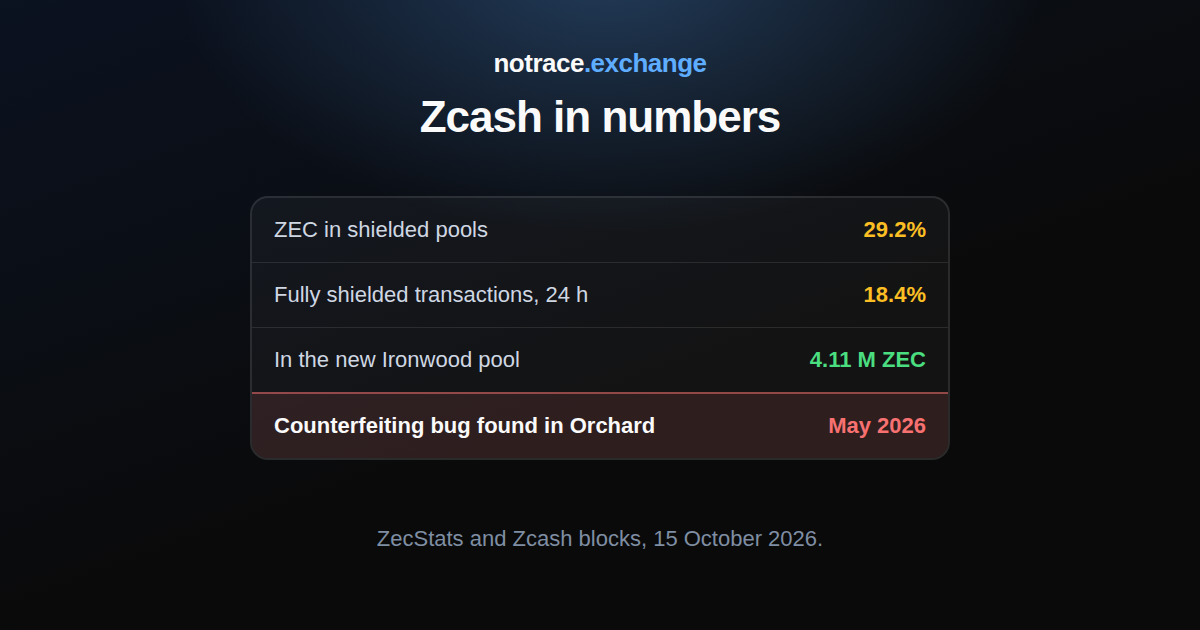
At 12:47 UTC on 15 October 2026, ZecStats counted 4.96 million ZEC in shielded pools, 29.2% of supply. The other 11.96 million sat in transparent addresses. For the older pools we checked its figures against the Zcash explorer, and they agree: Sapling 475,916, Orchard 350,755, Sprout 22,309. The newest pool, Ironwood, held 4.11 million.
We also sorted a day of transactions, blocks 3,517,520 to 3,518,671 (from 12:52 UTC on 14 October to 12:50 on 15 October), by their transparent parts:
- 6,415 transactions, not counting miners' rewards;
- 1,182 (18.4%) had no transparent part at all: no address or amount in them could be read;
- 3,379 (52.7%) had transparent inputs and outputs, as in Bitcoin; 246 of them also had a shielded part;
- 527 (8.2%) moved coins into a shielded pool and 1,327 (20.7%) out of one.
A shielded payment hides among everything else in its pool, not among 16 as in Monero. The boundary leaks, though. A 2018 study found that Zcash can be used privately, but that simple patterns, such as coins going in and out in matching amounts, shrink the crowd considerably.
The 2026 bug and the new pool
In late May 2026 Taylor Hornby of Shielded Labs found a flaw in Orchard, then the main shielded pool, that could have let someone create counterfeit ZEC inside it. Orchard was paused on 2 June and fixed the next day. On 28 July, at block 3,428,143, the Ironwood upgrade opened a new pool and made Orchard exit-only: coins leave it only through a turnstile that stops more ZEC from coming out than went in (Shielded Labs).
Shielded Labs believes the flaw was unlikely to have been exploited, but the shielded data could not show it. That is the cost of hidden amounts: a fault inside the pool is hidden too.
Zcash or Monero
- Monero hides every transaction. In Zcash privacy is a choice, and on 15 October 2026 it covered 29% of the coins and 18% of the day's transactions.
- A Monero spend hides among 16 candidates; a shielded Zcash spend, among everything in its pool. More on Monero in is Monero traceable, and on the whole category in what are privacy coins.
Quick answers
Is Zcash anonymous? Only shielded transactions hide the sender, receiver and amount. Transparent ones show all three.
Is Zcash traceable? Transparent transactions are, and so is the transparent side of shielding and deshielding. Fully shielded ones cannot be read on the chain.
Where we stand
notrace.exchange does not work with Zcash. The form takes BTC, ETH, SOL and TRX, and USDT and USDC on several networks.
- The payout leaves as two transfers to two addresses of yours, each with its own delay of 0 to 6 hours. If you want the coin and the amount to change too, choose a payout in another coin.
- While a delay runs, the funds are held by the service: section 8 of the terms says so.
- Before you pay, the order offers a letter signed with our PGP key stating what you send and the least you will receive.
- Our fee on 15 October 2026 was 0.5%; the current figure is on the FAQ page.
The bitcoin mixer page opens the form in BTC with the live minimum.