
What is slippage in crypto, in numbers
Published: October 17, 2026
Also available in:EspañolРусский繁體中文
What is slippage in crypto? It is the difference between the price you expect when you place a trade and the price you actually get. It comes from two places: the price moves before your trade goes through, and your trade is bigger than what is on offer at the best price. On 17 October 2026 at 12:05 UTC we measured both: on the bitcoin order books of Kraken and OKX, on Jupiter, the DEX aggregator of Solana, and in two and a half days of price history.
Where slippage comes from
- Depth. An order book lists sellers at rising prices. A market buy takes the cheapest first, and a large one eats into the dearer ones. A DEX pool has no list: a formula moves the price as you buy. This part is also called price impact.
- Time. Between the quote and the fill the market keeps moving: milliseconds on a centralized exchange, a block or more on a blockchain. When the price moves in your favour, that is positive slippage.
What we measured
Order books at 12:05 UTC, with the best bitcoin ask on Kraken at $81,469.30:
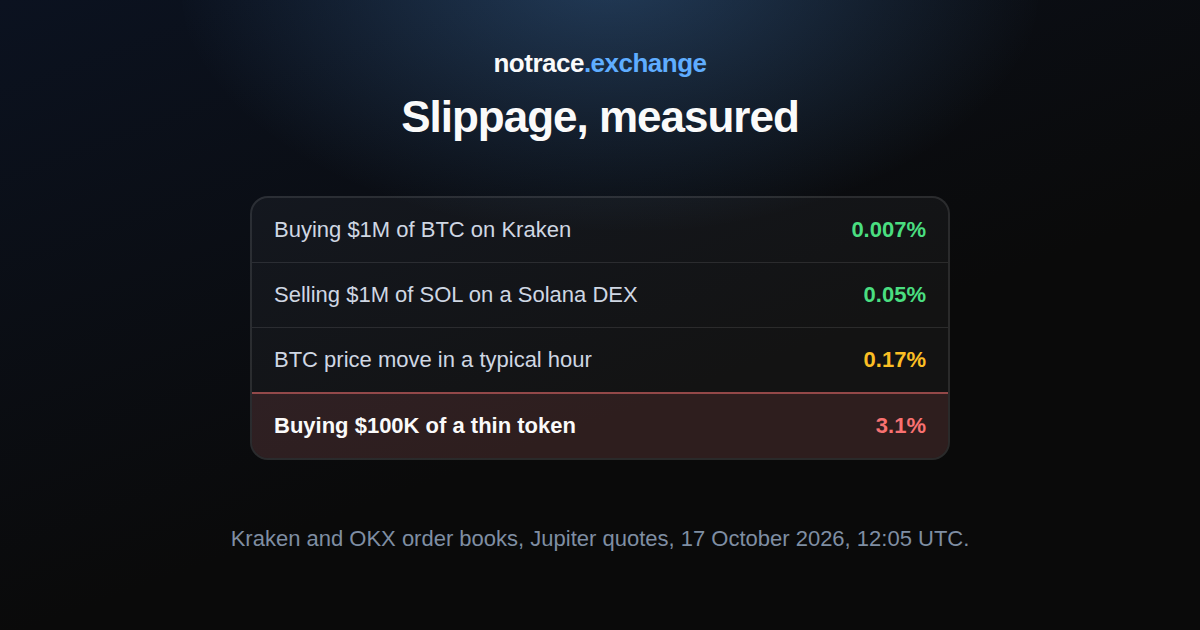
- buying $10,000 of bitcoin on Kraken filled entirely at the best ask; $100,000 cost 0.001% more, and $1 million 0.007% more, about $5.60 per bitcoin;
- on OKX, $100,000 cost 0.003% more, and $1 million 0.026%.
Jupiter quotes at the same minute:
- selling $1 million of SOL got a rate only 0.05% worse than selling $100;
- ORCA is a different story. Jupiter listed its market value at $114 million, but the liquidity behind it at $0.31 million. Buying $1,000 of it cost 0.04% more per token than buying $100; $10,000 cost 0.39% more, and $100,000 3.1% more.
Then time. Over 15–17 October, by Kraken's five-minute candles, bitcoin moved 0.07% in a median 10 minutes and 0.17% in a median hour; the biggest move within an hour was 2.5%. For SOL: 0.13% and 0.29%, and up to 3.9% in an hour.
So for bitcoin, a typical hour of waiting moved the price about 24 times more than a $1 million order did. For a thin token it is size that costs you, and market value says nothing about depth.
Slippage tolerance
On a DEX you choose how much worse a price you will accept, say 0.5%. The interface turns it into a "minimum received": if the trade would give less, the transaction fails and you lose only the network fee. Our $10,000 quote for ORCA promised 5,308.5 tokens and, at 0.5%, no fewer than 5,281.9.
Set it too wide and someone else collects the difference. A bot that watches pending transactions can buy just before a large trade and sell right after it. Ethereum's documentation calls this sandwich trading: "Users who are sandwiched face increased slippage and worse execution on their trades" (ethereum.org). How DEX trades work is in what is a DEX.
How to keep slippage down
- Trade pairs with deep liquidity, and check liquidity, not market value.
- Split a large order, or place a limit order on an exchange order book: it fixes the price, though it may not fill.
- Keep the tolerance tight. For major pairs 0.5% leaves room to spare: by our numbers a $1 million SOL sale needed 0.05%.
- Avoid the minutes after big news, when prices jump.
Quick answers
What is a good slippage for crypto? For BTC, ETH or SOL, 0.1–0.5% is plenty. A thin token may need more, and that extra is the price of trading it.
Is high slippage good or bad? A high tolerance makes a trade more likely to go through, and more expensive when it does.
Does slippage happen on a CEX? Yes, with market orders. The difference between the two kinds of venue is in what is a DEX.
Where we stand
The notrace.exchange form takes BTC, ETH, SOL and TRX, and USDT and USDC on several networks. Before you pay, the order shows the least you will receive.
- The payout leaves as two transfers to two addresses of yours, each with its own delay of 0 to 6 hours. If you want the coin and the amount to change too, choose a payout in another coin.
- While a delay runs, the funds are held by the service: section 8 of the terms says so.
- The order offers a letter signed with our PGP key stating what you send and the least you will receive.
- Our fee on 17 October 2026 was 0.5%; the current figure is on the FAQ page.
The bitcoin mixer page opens the form in BTC with the live minimum.