
What is a DEX? DEX vs CEX explained
Published: October 17, 2026
Also available in:EspañolРусский繁體中文
What is a DEX? A decentralized exchange: a program on a blockchain that lets you trade one token for another straight from your own wallet. Nobody opens an account for you, and no company holds your coins. A CEX, a centralized exchange such as Binance, Coinbase or OKX, works the other way round: you sign up, deposit coins, and the platform keeps them on its own books. On 17 October 2026 we compared the volume of the two and read 50 Ethereum blocks to see what a DEX trade leaves behind.
How a DEX works
- Pools. Users deposit pairs of tokens, say ETH and USDC, into a contract. A formula sets the price from the ratio of the two, and every trade pays a fee to those who filled the pool. Uniswap, PancakeSwap and Orca work this way. The standard pool fees on Uniswap v3 are 0.05%, 0.3% and 1% (Uniswap docs).
- Aggregators. They look for the best price across many pools and split one trade between them: 1inch on Ethereum, Jupiter on Solana.
The steps of a trade, and the approval that comes before it, are in what is DeFi.
DEX vs CEX
- Who holds the coins. On a CEX, the platform does, from the moment you deposit. On a DEX they stay in your wallet until the trade, and the result comes back to it. The same line for wallets is drawn in custodial vs non-custodial.
- Account. A CEX asks you to register and usually to prove who you are. A DEX asks you to connect a wallet.
- What others see. Trades on a CEX live in the platform's own database; the blockchain sees only deposits and withdrawals. A trade on a DEX is a public transaction: address, tokens, amounts and time.
- Which tokens. Anyone can open a pool on a DEX, fake copies of popular tokens included, so check the contract address. A CEX chooses what it lists.
- When something goes wrong. A CEX has support, and it can also freeze your account. A DEX has neither: a sent transaction cannot be undone, and contracts do get hacked.
- Fees. On a DEX you pay the pool fee plus the network fee; on a CEX, a trading fee and a withdrawal fee.
What the numbers show
On 17 October 2026:
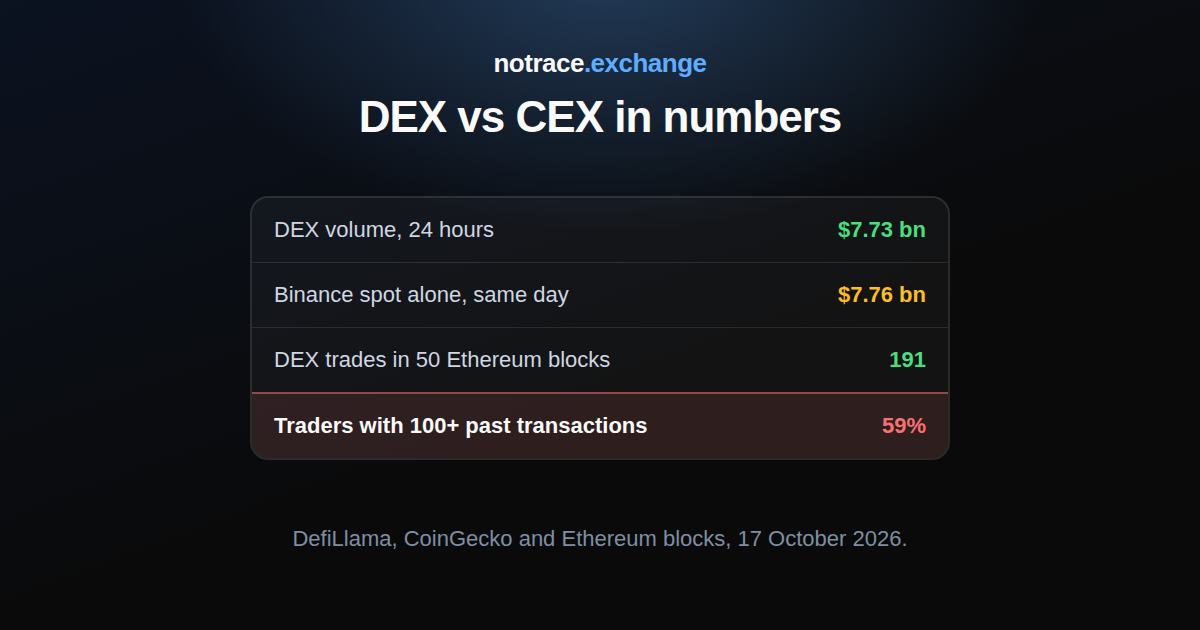
- DefiLlama counted $7.73 billion traded on DEXs in 24 hours and $267.8 billion in 30 days, leaving out the off-chain prediction markets it lists with them. Solana carried 29.5% of the day, Ethereum 14.7%, BNB Chain 13.5% and Base 12.6%. The largest entry, Uniswap V4, had 12.7%.
- CoinGecko put Binance alone at about $7.76 billion of spot trading over the same 24 hours. All DEXs together came to roughly one large CEX.
- In 50 Ethereum blocks (26,212,117 to 26,212,166, from 11:56 to 12:06 UTC), 191 of 11,518 transactions were trades through the Uniswap and 1inch routers, sent from 135 addresses. The median address had already sent 428 transactions before; 59% had sent more than 100, and only 12% fewer than 10.
A DEX does not ask your name, but every trade joins the history of the address, and most people trade from addresses with a long one. If that address ever received coins from a platform that knows you, the link is there.
Is a DEX anonymous?
No. It spares you an account, and that is all. The DEX website is an ordinary website: it sees your IP address and the wallet you connect. The trade itself is public, and while a large one waits among pending transactions, bots can see it before it lands. What that costs is in what is slippage in crypto.
Quick answers
Is Binance a CEX or a DEX? A CEX: you have an account, and Binance holds the coins.
Is Uniswap a DEX? Yes. Its V4 version alone handled 12.7% of the day's DEX volume.
Which is safer? The risks differ. A CEX can fail or freeze your account; on a DEX the risks are your own mistakes and the contract's code. The usual traps are in crypto scams.
Where we stand
The notrace.exchange form takes BTC, ETH, SOL and TRX, and USDT and USDC on several networks. There is no account: you come back to an order by its saved link.
- The payout leaves as two transfers to two addresses of yours, each with its own delay of 0 to 6 hours. If you want the coin and the amount to change too, choose a payout in another coin.
- While a delay runs, the funds are held by the service: section 8 of the terms says so.
- Before you pay, the order offers a letter signed with our PGP key stating what you send and the least you will receive.
- Our fee on 17 October 2026 was 0.5%; the current figure is on the FAQ page.
The bitcoin mixer page opens the form in BTC with the live minimum.