
Bitcoin Core 32.1 released: what changes
Published: November 19, 2026
Also available in:EspañolРусский繁體中文
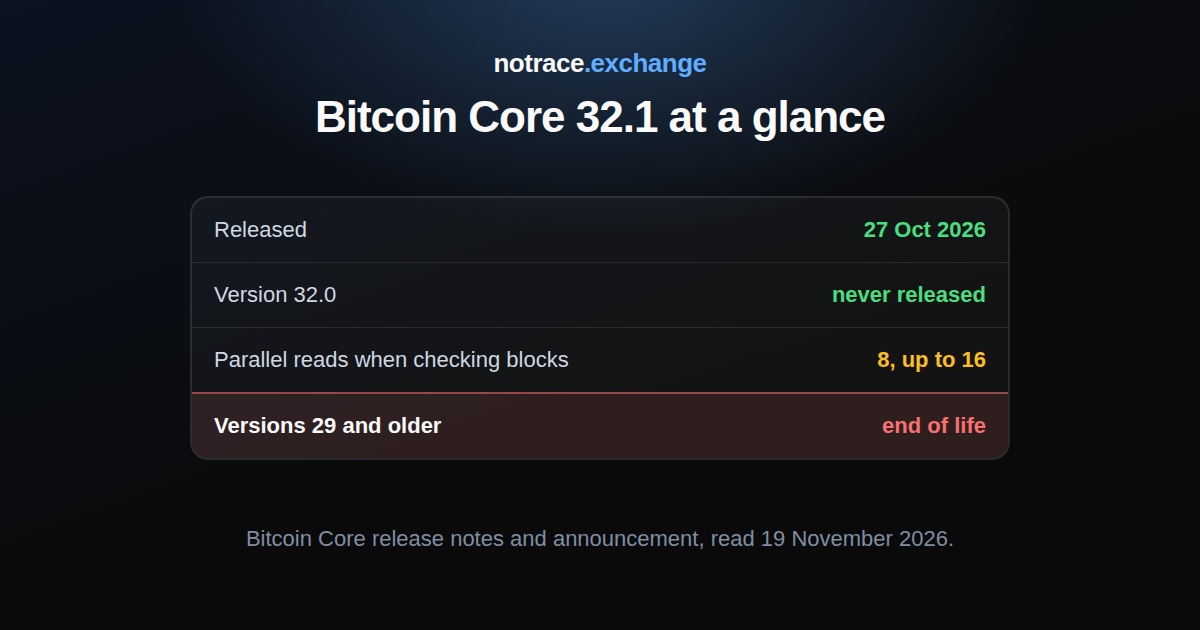
Bitcoin Core 32.1 was released on 27 October 2026 (the announcement). There is no 32.0 to install: the release notes say that 32.0 was tagged but, "due to last-minute issues", never fully announced or released, so 32.1 is the first public version of the 32 series. Versions 29 and older are now end-of-life. On 19 November 2026 we read the notes in the project's repository and picked out what matters beyond the node operator's desk.
What it changes for ordinary use
- Fee estimates. The
estimatesmartfeecall now combines two estimators: the old one, based on recent blocks, and a new one that reads the current mempool. It returns the lower of the two, so the new one can only reduce the suggested fee, never raise it. - PSBT version 2 by default. Partially signed transactions, the format wallets pass to each other and to hardware devices, are now created in version 2 unless you ask for another. Software that reads PSBTs from Core may need an update.
- Watch-only export. A new
exportwatchonlywalletcommand writes a wallet file with the public descriptors and no private keys, ready to restore on another node.
If you only use a wallet app and never run a node, none of this asks anything of you.
Faster block checks
When a node verifies a block, it can now fetch the inputs from disk in parallel: 8 threads by default, up to 16, off with -prevoutfetchthreads=0. The notes say it helps when the data has to come from disk rather than from memory.
Privacy: private broadcast
Bitcoin Core has an optional mode, -privatebroadcast, that sends a transaction through Tor so that the sender's IP address is not what the network sees. Version 32.1 closes a gap in it. If a connection under the newer P2P protocol (v2) failed, the retry on the old protocol could be made directly, around Tor, and reveal the sender's address. The notes list four conditions that must all hold, among them a node set up for Tor but connecting to IPv4 and IPv6 peers directly. The queue of such transactions is now capped at 10,000, and each gets at most 1,000 send attempts.
Security and defaults
A flaw in the -walletnotify option is fixed: on systems other than Windows, a caller with RPC access allowed to create wallets could run commands on the node's machine by choosing a wallet name. Wallet names with .. in the path, and the name /, are no longer accepted. The default number of connections goes from 125 to 200, with at most half of the inbound slots for peers that relay transactions. Support for the old ElGamal encryption in I2P goes no later than version 34.
What we checked
We compared the release notes in the repository with the announcement of 27 October. Some news coverage in the weeks before wrote that 32.0 would ship on 10 October and then spoke of it as released; the notes say it never was.
Where we stand
The notrace.exchange form takes BTC, and nothing in a node release changes it: the deposit counts once the network confirms it.
- The payout leaves as two transfers to two addresses of yours, each after its own delay of 0 to 6 hours.
- While a delay runs, the funds are held by the service: section 8 of the terms says so.
- Before you pay, the order offers a letter signed with our PGP key stating what you send and the least you will receive.
- Our fee is on the FAQ page.
The Bitcoin mixer page opens the form in BTC with the live minimum. More: what is Bitcoin, how long a bitcoin transaction takes, the bitcoin halving and is Bitcoin traceable.