
Bitcoin halving: what it is and when next
Published: October 28, 2026
Also available in:EspañolРусский繁體中文
What is the bitcoin halving? Every 210,000 blocks, roughly every four years, the reward for a new block is cut in half. The rule is written into the code, so past halvings are known to the minute and the next one can be worked out from the block height. On 28 October 2026 we read the chain and counted when the fifth halving will come and what it will change.
How the halving works
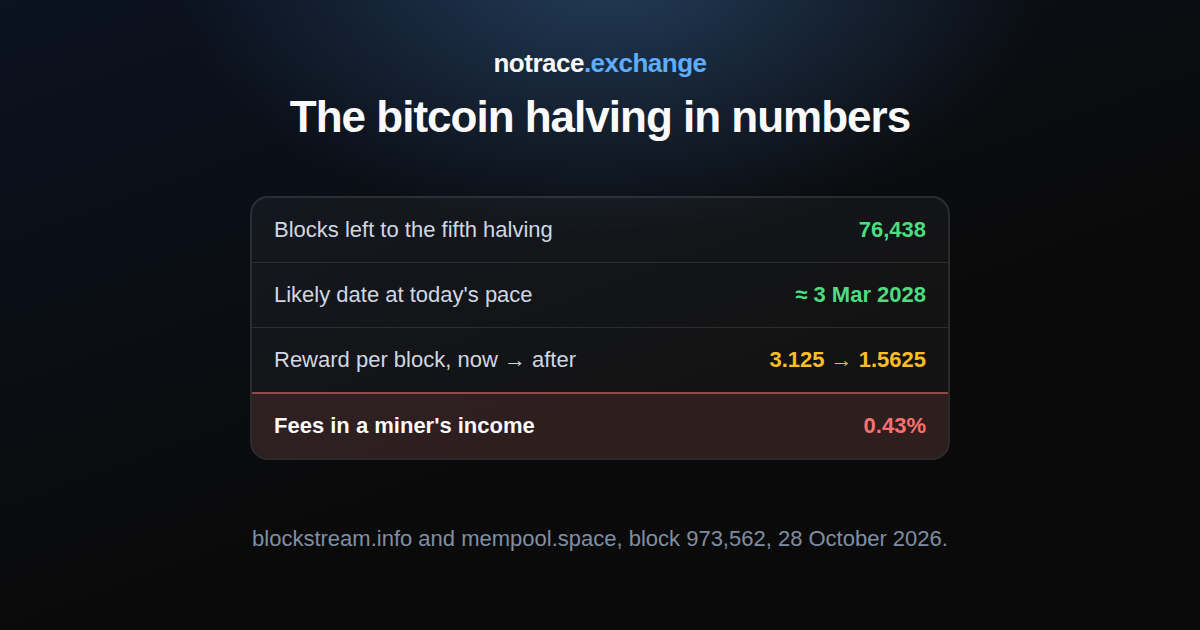
- The reward. Whoever finds a block gets new coins for it. It started at 50 BTC in 2009; today it is 3.125 BTC, and after the next halving it will be 1.5625.
- By height, not by date. Halvings fall on blocks 210,000, 420,000 and so on. A block comes about every ten minutes, hence "every four years", but the exact day depends on how fast blocks are found.
- The cap. Because the reward keeps halving, the total supply approaches 21 million and never reaches it. From block 6,930,000, around the year 2140, the reward will be zero, and miners will live on fees alone.
The four past halvings, by the blocks' timestamps:
- block 210,000 — 28 November 2012, from 50 to 25 BTC;
- block 420,000 — 9 July 2016, from 25 to 12.5 BTC;
- block 630,000 — 11 May 2020, from 12.5 to 6.25 BTC;
- block 840,000 — 20 April 2024, from 6.25 to 3.125 BTC.
What we measured
On 28 October 2026, 14:00 UTC, through the public explorers blockstream.info and mempool.space:
- the chain stood at block 973,562, with 76,438 blocks left to the fifth halving at block 1,050,000;
- over the last 1,008 blocks a block came every 9.27 minutes. At that pace the halving falls around 3 March 2028; at exactly ten minutes, around 11 April 2028. Two weeks earlier, at 9.47 minutes a block, the same sum gave 14 March: the date moves with the pace;
- by the schedule, 20,104,884 BTC had been issued, 95.7% of the 21 million; the remaining 895,116 will take more than a century;
- miners were receiving about 485 new BTC a day (155 blocks of 3.125); after the halving it will be about 243;
- in the 15 latest blocks, fees averaged 0.0135 BTC a block, or 0.43% of what a miner earned for it. The rest is new coins, exactly what the halving cuts;
- block 840,000, the last halving, paid 37.6 BTC in fees, twelve times its new coins: that day the Runes token protocol launched, and people paid to get into the first block.
What the halving changes
- For miners: income per block falls almost by half overnight. Older machines stop paying for their electricity and some get switched off. Until the next difficulty retune, up to two weeks later, blocks can come more slowly.
- For transfers: nothing in the rules. Block time and fees work as before (how long a bitcoin transaction takes).
- For the price: the date is known years ahead, so it is no secret to the market. After the 2024 halving, bitcoin set a high of $126,080 on 6 October 2025, and on 28 October 2026 it stood 36% below it, at $80,396. Four halvings are too few to call it a rule.
Risks
- Halving scams. Around the date, fake "giveaways" promise to double any bitcoin you send. Nobody sends back more than they received (crypto scams).
- Buying mining hardware. The same machine earns about half as much the day after the halving, at the same price and difficulty.
- Living on fees. As new coins run out, paying miners falls to fees, and today fees are 0.4% of their income.
FAQ
When is the next bitcoin halving? At block 1,050,000: between early March and mid-April 2028, depending on how fast blocks come.
How many halvings will there be? The 33rd, at block 6,930,000 around 2140, brings the reward to zero.
Do other coins have halvings? Yes, Litecoin and Zcash among them. Zcash's next one is expected around November 2028.
Where we stand
The notrace.exchange form takes BTC, and a halving changes nothing about it: the deposit counts once the network confirms it.
- The payout leaves as two transfers to two addresses of yours, each with its own delay of 0 to 6 hours. If you want the coin and the amount to change too, choose a payout in another coin.
- While a delay runs, the funds are held by the service: section 8 of the terms says so.
- Before you pay, the order offers a letter signed with our PGP key stating what you send and the least you will receive.
- Our fee on 28 October 2026 was 0.5%; the current figure is on the FAQ page.
The Bitcoin mixer page opens the form in BTC with the live minimum. More about the coin itself: what is bitcoin.