
How to send crypto anonymously
Published: October 15, 2026
Also available in:EspañolРусский繁體中文
How to send crypto anonymously? On Bitcoin, Ethereum or Tron you cannot hide the transfer itself: the sending address, the receiving address, the amount and the time all go into a public ledger. What you can do is cut the links that tie that transfer to you. On 15 October 2026 we read six Bitcoin blocks to see how often senders leave those links themselves.
What ties a transfer to you
- An account with your name. If the coins came from a platform that verified you, it knows the address it paid.
- Address reuse. Receiving, or sending change, to an address you used before connects all of those payments.
- Merged coins. A transaction that spends several inputs tells everyone they most likely have one owner.
- Your connection. The node your wallet talks to sees your IP address.
- Amounts and timing. The same amount leaving right after it arrived links the two ends.
What six blocks showed
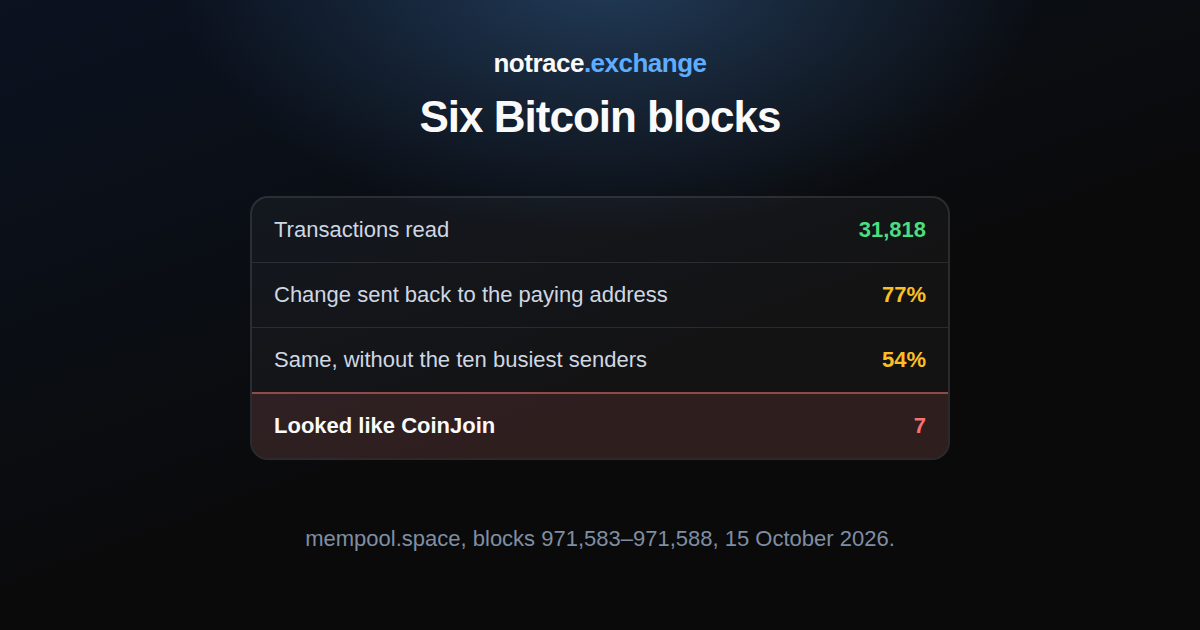
We read blocks 971,583 to 971,588 (14:06 to 15:09 UTC) through the public mempool.space explorer:
- 31,818 transactions, not counting miners' rewards;
- 24,645 of them (77%) sent part of the money back to an address that was paying in the same transaction, the plainest link there is;
- half of all the transactions came from just ten addresses, clearly automated; without them, 8,310 of 15,456 (54%) still sent change back to the paying address, and 2,645 (17%) merged two or more inputs;
- only 7 looked like CoinJoin (at least five inputs and five outputs of the same value).
Privacy is not the default. Most senders leave these links themselves.
What helps
- A new address for every payment. Most wallets make one for you; use it instead of the old one. More in what is a wallet address.
- Do not merge coins of different origin. A wallet with coin control lets you choose which coins a payment spends.
- Keep identified coins apart. Coins withdrawn from a platform that knows you stay linked to you, so keep them away from the rest.
- Hide your connection. Use your own node, or Tor, so that a stranger's node does not see your IP address.
- Break the trail on the chain. CoinJoin, privacy coins and mixers each cut the links in a different way.
- Change the amount and the timing. Do not pass the same amount on right after it arrives.
What does not help
- A new wallet app. The coins bring their history with them.
- Converting on a platform that knows you. The record stays with the platform. A 2018 study tracked money across conversions between eight blockchains.
- Stablecoins. USDT and USDC transfers are public, and the issuer can freeze the coins; see what is USDT.
Quick answers
Can you send Bitcoin anonymously? Not completely. You can make a transfer much harder to link to you; see is Bitcoin traceable.
Does a hardware wallet make me anonymous? No. It protects your keys, not your history; see hot wallet vs cold wallet.
Where we stand
The notrace.exchange form takes BTC, ETH, SOL and TRX, and USDT and USDC on several networks.
- The payout leaves as two transfers to two addresses of yours, each with its own delay of 0 to 6 hours. If you want the coin and the amount to change too, choose a payout in another coin.
- While a delay runs, the funds are held by the service: section 8 of the terms says so.
- Before you pay, the order offers a letter signed with our PGP key stating what you send and the least you will receive.
- Our fee on 15 October 2026 was 0.5%; the current figure is on the FAQ page.
The bitcoin mixer page opens the form in BTC with the live minimum.