
What is a 51% attack? How it works
Published: November 19, 2026
Also available in:EspañolРусский繁體中文
What is a 51% attack? If one party controls more than half of a proof-of-work network's computing power, it can build its own chain faster than everyone else and make the network accept it. That lets it reverse its own recent payments, a double spend, and keep other people's transactions out of blocks for a while. It cannot take coins from anybody else's address, forge a signature or change the rules.
How the attack works
The attacker mines a second chain in secret, while the public one carries on. Meanwhile it pays a merchant or an exchange on the public chain and waits to be credited. Then it publishes the secret chain. If it holds more than half of the power, its chain is the longer one by then, the network switches to it, and the payment on the old chain never happened. The attacker has the goods or the other asset and the coins as well.
What it cannot do
It cannot spend coins it has no key for, because the nodes check every signature and reject a block with an invalid one. It cannot issue more coins than the rules allow, or change the rules: nodes follow their own rules, not the heaviest chain of any kind. It can only reorder and replace the latest blocks, which is why waiting for more confirmations is the defence (how long a bitcoin transaction takes).
What it would take on Bitcoin
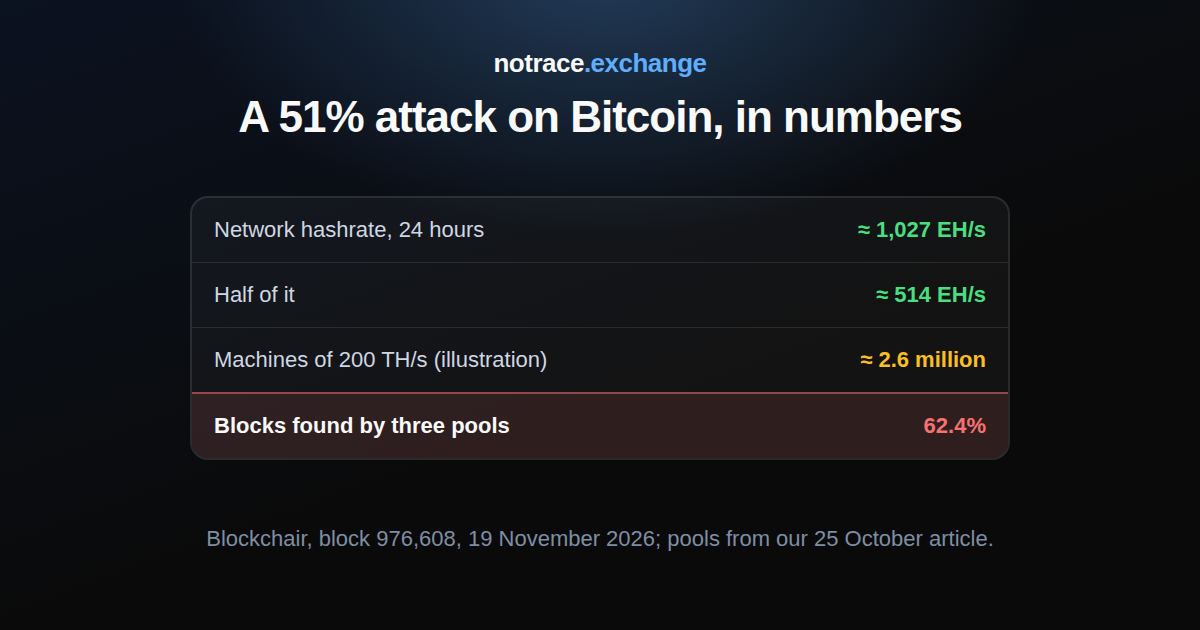
Blockchair put the network's 24-hour hashrate on 19 November 2026 at about 1,027 exahashes per second, at block 976,608. Half of that is about 514. If a modern machine did 200 terahashes a second, which is an illustration and not a measurement, matching half would take about 2.6 million of them, plus the electricity to run them. Buying that is a different problem from coordinating it: in our mining article of 25 October, three pools found 62.4% of the blocks (what is crypto mining). The pools' miners can leave a pool that misbehaves, which is the practical limit on a coordinated attempt.
Where it has happened
Small proof-of-work coins with little computing power behind them. Ethereum Classic and Bitcoin Gold are among those that have been attacked more than once. The smaller the network, the cheaper it is to outweigh, and the longer exchanges and merchants should wait before counting a payment (what are altcoins).
Not a proof-of-stake problem in the same way
A network that runs on locked coins has no "51% of the computing power". Ethereum's validators need a third of the stake to stall finality and two thirds to finalise conflicting chains, and misbehaviour is punished by losing part of the deposit (proof of work vs proof of stake).
FAQ
Can a 51% attack steal my coins? Not from your address. It can reverse a payment you received if you accepted it too early.
Is it the same as a hack? No. Nothing is broken; the attacker plays by the rules with more power than everyone else.
How many confirmations are enough? For a large amount on a small network, more than the usual six.
Where we stand
The notrace.exchange form takes BTC, and a deposit counts when the network confirms it. The form's other coins are ETH, SOL, TRX, USDC and USDT.
- The payout leaves as two transfers to two addresses of yours, each after its own delay of 0 to 6 hours.
- While a delay runs, the funds are held by the service: section 8 of the terms says so.
- Before you pay, the order offers a letter signed with our PGP key stating what you send and the least you will receive.
- Our fee is on the FAQ page.
The Bitcoin mixer page opens the form in BTC with the live minimum.