
Proof of work vs proof of stake
Published: November 19, 2026
Also available in:EspañolРусский繁體中文
Proof of work and proof of stake are two ways for thousands of computers to agree on one history of transactions with nobody in charge. In proof of work, miners spend electricity on a guessing race and the winner writes the next block. In proof of stake, validators lock coins as a deposit, are chosen to write blocks, and lose part of the deposit if they cheat. Bitcoin uses the first, Ethereum the second.
Proof of work, in Bitcoin
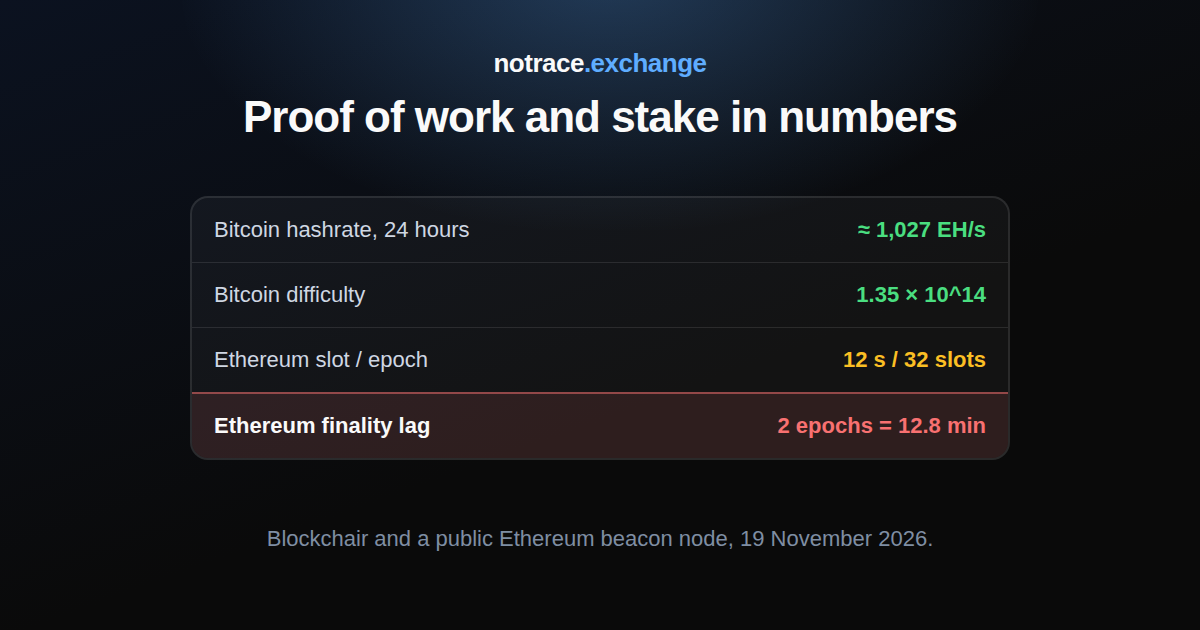
Miners hash candidate blocks over and over until one hash falls below a target. The race costs hardware and electricity, and that cost is the protection: rewriting history would mean redoing the work. The target moves every 2,016 blocks, about two weeks, to keep blocks about ten minutes apart. On 19 November 2026, at block 976,608, Blockchair put the 24-hour hashrate at about 1,027 exahashes per second, or 1.03 × 10^21 guesses a second, and the difficulty at 1.35 × 10^14. How mining works and who does it: what is crypto mining.
Proof of stake, in Ethereum
A validator locks 32 ETH. Time is cut into 12-second slots, 32 of them make an epoch, and in each slot one validator proposes a block while others vote on it. A block is final when two epochs have passed over it. We read a public beacon node at slot 15,690,300, epoch 490,321: the last finalized epoch was 490,319, two behind, which is 12.8 minutes. A validator that signs contradictory blocks is "slashed" and loses part of the deposit. More: what is staking and what is Ethereum.
What each one costs
Proof of work is paid for outside the system, in energy and machines, and an attacker has to outspend honest miners. Proof of stake is paid for in locked capital, and an attacker has to buy and risk a large share of the coins. Neither is free. Work burns real resources every block, and stake favours those who already hold the most.
Which coin uses what
- Proof of work: Bitcoin, Zcash and Monero.
- Proof of stake: Ethereum, and Solana, whose finality changed with Alpenglow (Solana drops its beta label).
- Delegated proof of stake: Tron, where holders vote for 27 producers (what is Tron).
- Tokens: USDT and USDC have no consensus of their own; they inherit the network they sit on.
What it means when you send money
The consensus decides how long you wait. On Bitcoin a block comes about every ten minutes and six confirmations are the usual wait (how long a bitcoin transaction takes). On Ethereum a transaction lands in the next 12-second slot and becomes final after about 13 minutes.
FAQ
Which one is more secure? They defend against different things, and the cost of attacking each is counted in different units, energy against locked coins. Neither number tells the whole story.
Can proof of stake coins be mined? No. They are validated, not mined; mining is the word for proof of work.
Where we stand
The notrace.exchange form takes BTC, which is proof of work, ETH, SOL and TRX, which are proof of stake in its different forms, and USDC and USDT, which follow the network they are sent on.
- The payout leaves as two transfers to two addresses of yours, each after its own delay of 0 to 6 hours.
- While a delay runs, the funds are held by the service: section 8 of the terms says so.
- Before you pay, the order offers a letter signed with our PGP key stating what you send and the least you will receive.
- Our fee is on the FAQ page.
The Bitcoin mixer page opens the form in BTC with the live minimum.