
What is crypto mining? How it works
Published: October 25, 2026
Also available in:EspañolРусский繁體中文
What is crypto mining? It is the work a cryptocurrency network pays for with new coins. A miner gathers fresh transfers into a block and tries number after number until it finds a suitable hash. Whoever finds one first adds the block to the blockchain and collects the reward. Bitcoin, Litecoin, Dogecoin, Monero and Zcash all work this way. On 25 October 2026 we pulled bitcoin network statistics from mempool.space and worked out what mining earns today.
How mining works
- Transfers not yet in a block wait in a shared queue. A miner picks the ones paying the highest fees.
- It packs them into a block and computes the block's hash, changing one spare number each time. The hash has to come out below a threshold the network sets. There is no way to guess it, only to keep trying — trillions of times a second.
- The first to find a suitable hash broadcasts the block. Everyone else checks it in a fraction of a second and moves on to the next one.
- Every 2,016 blocks, roughly every two weeks, the network resets the difficulty so that a block comes out about every 10 minutes, however many machines are running.
The reward is the new coins plus the fees of every transfer in the block. Bitcoin now issues 3.125 BTC per block, and in 2028 that will halve. How issuance adds up over time is covered in what is bitcoin.
What we measured
From mempool.space on 25 October 2026 at 05:40 UTC:
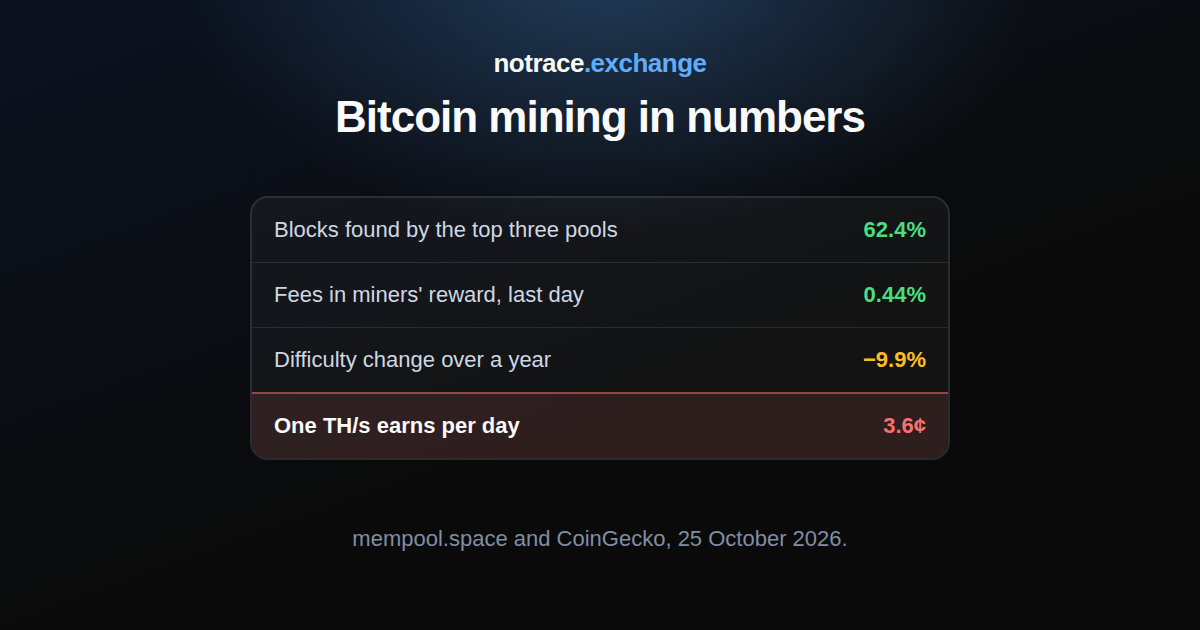
- over the last 144 blocks (972,882–973,025, about one day) miners received 451.97 BTC; fees were 1.97 BTC of that, or 0.44%, and the rest was new coins;
- those blocks held 704,167 transfers, 4,890 per block on average;
- difficulty stood at 140.6 trillion, 9.9% lower than a year earlier; the whole network was trying about 1,000 EH/s, or 10²¹ hashes a second;
- in the current two-week epoch a block came out every 9 minutes 33 seconds on average — ahead of schedule — and mempool.space expects the next reset to raise difficulty by about 4.8%.
Who finds the blocks
Mining alone is close to pointless: the chance of finding a block is too small. So miners join pools and split the reward by the work each puts in. In the week to 25 October 2026, 1,072 blocks came out, found by 15 pools:
- Foundry USA — 27.5%;
- AntPool — 19.7%;
- F2Pool — 15.2%;
- the top eight pools together — 91.5%.
Three pools found 62.4% of the blocks. Whoever builds a block decides which transfers go into it, so in practice a handful of companies decide. The transfers themselves are public: a miner sees in them what any outsider sees.
What mining earns
Miner income is counted per terahash, a trillion hashes a second. At the difficulty and reward of 25 October 2026, one TH/s earns 44.9 satoshis a day, about 3.6 cents at a price of $80,650. A year earlier, at a difficulty of 156 trillion and a price of about $110,750, the same terahash made about 4.5 cents — 19% more.
An example: the Antminer S21 is rated by its maker at 200 TH/s and about 3,500 W. Today it would earn roughly $7.20 a day while burning 84 kWh. It only runs at a profit if a kilowatt-hour costs less than 8.6 cents, and that is before the price of the machine itself.
Risks
- Coin price. Income arrives in bitcoin while costs are in money. Bitcoin fell 27.2% over the year, and income per terahash fell with it.
- Difficulty. When new machines join the network, difficulty rises and each one earns less.
- Halving. In 2028 issuance drops to 1.5625 BTC per block, and fees today make up less than half a percent of the reward.
- Cloud mining. "Renting hash power" with a promised return is a common scam bait: nobody has seen the machines you are paying for (crypto scams).
FAQ
Can you mine bitcoin on a computer? Technically yes, but there is no point. A computer trying tens of millions of hashes a second would, at today's difficulty, find a block once in hundreds of millions of years on average. Monero, by contrast, is designed to be mined on ordinary processors (is Monero traceable).
Is ether still mined? No. Since September 2022 Ethereum blocks are produced by validators who post a deposit, which is staking. More in what is Ethereum.
Can a miner see who sent a transfer? It sees what everyone sees: addresses, amounts and times. There are no names in a block, but addresses link up with each other — see is crypto anonymous.
Where we stand
The notrace.exchange form takes BTC, ETH, SOL and TRX, and USDT and USDC on several networks.
- The payout leaves as two transfers to two addresses of yours, each with its own delay of 0 to 6 hours. If you want the coin and the amount to change too, choose a payout in another coin.
- While a delay runs, the funds are held by the service: section 8 of the terms says so.
- Before you pay, the order offers a letter signed with our PGP key stating what you send and the least you will receive.
- Our fee on 25 October 2026 was 0.5%; the current figure is on the FAQ page.
The bitcoin mixer page opens the form in BTC with the live minimum.