
What is a crypto wallet and how it works
Published: November 19, 2026
Also available in:EspañolРусский繁體中文
What is a crypto wallet? It is a program or a device that keeps your private keys and uses them to sign transfers. The coins are never "in" the wallet: they are entries on the blockchain, and the wallet is the proof that you may move them. Lose the keys and the coins stay on the chain for good; hand them over and anyone can spend them.
What a wallet really holds
A wallet starts from a random number, the private key. One-way maths turns it into a public key and then into an address, the string you give to someone who wants to pay you. The way back does not exist, and guessing a key is hopeless: there are about 10^77 of them, the exact figure depends on the curve. To send coins the wallet signs a transaction and the network checks the signature against the address. The key never leaves the wallet; only the signature does.
Most wallets create a seed phrase instead, 12 or 24 words from a list of 2,048, and derive every key from it, so one backup restores everything (seed phrase vs private key). Whoever has the words has the wallet, so the usual risk is not mathematics but a stranger asking for them (seed phrase safety).
Kinds of wallet
Two questions describe almost every wallet, and the answers combine freely: a phone app can be non-custodial and hot.
- Who holds the keys? In a non-custodial wallet, you do. In a custodial one, such as an exchange account, the company does and you hold a claim on it (custodial vs non-custodial).
- Is the key online? A hot wallet lives in a phone app, a browser extension or on a computer: convenient, and exposed to malware. A cold wallet keeps the key on a separate device that signs offline, such as a hardware wallet (hot vs cold).
One seed, many networks, different addresses
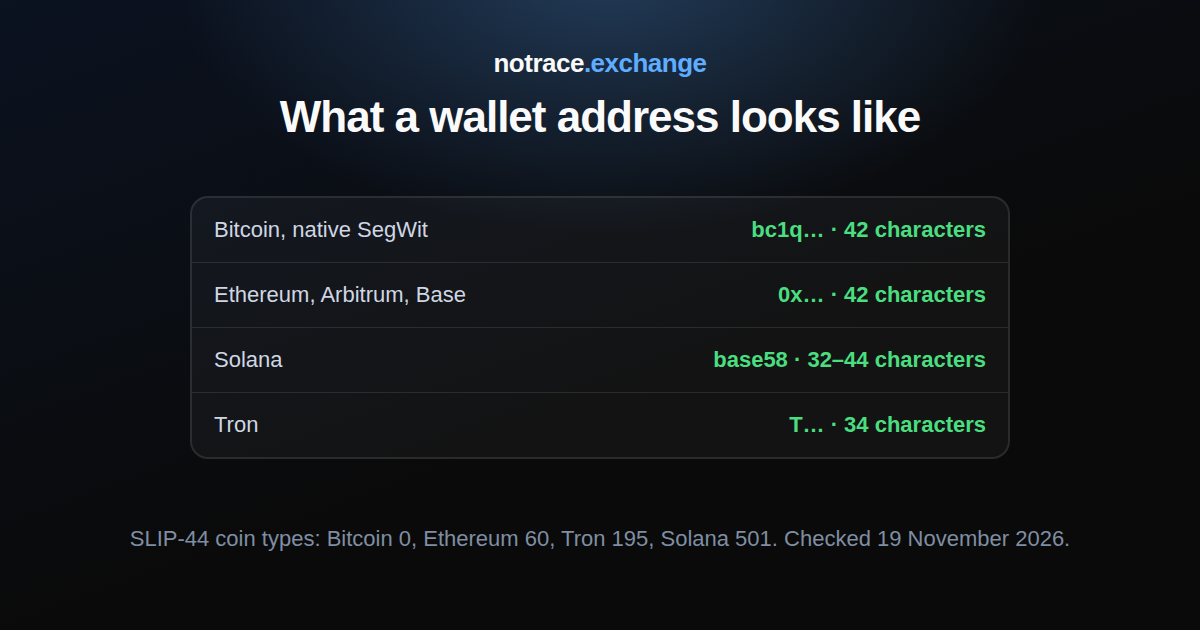
The same seed phrase can serve several networks, because each network gets its own branch of keys, picked by a registered coin-type number from the SLIP-44 list: Bitcoin 0, Ethereum 60, Tron 195, Solana 501. That is why one backup can hold all four, and why a Bitcoin address cannot receive Ethereum.
Addresses look different too. On 19 November 2026 the formats are:
- Bitcoin, native SegWit, the usual kind: starts with bc1q, 42 characters. Taproot addresses start with bc1p and have 62;
- Ethereum, Arbitrum and Base: 0x and 40 hexadecimal digits, 42 characters in all;
- Solana: letters and digits in base58, 32 to 44 characters;
- Tron: starts with T, 34 characters.
The trap is that Ethereum, Arbitrum and Base share one format. The address is valid on all three, so the wallet cannot warn you if you pick the wrong one: the coins arrive on a network where the receiver is not looking. With your own keys they can still be reached; with an exchange's deposit address they often cannot.
What to check before choosing
- Networks. USDT alone lives on Ethereum, Solana and Tron, and in practice these are three different tokens (TRC20 vs ERC20).
- The fee coin. A transfer is paid in the network's own coin: ETH on Ethereum, Arbitrum and Base, SOL on Solana, TRX on Tron. A wallet that holds USDT and no TRX cannot send it on Tron.
- Where the app came from. Fake wallet apps are common; install from the project's own site, not from an ad.
- Privacy. A wallet is not anonymous: addresses and balances are public (what a wallet address reveals, is crypto anonymous).
FAQ
Can a wallet be hacked? The chain cannot be; the device and the person can. Malware, fake apps and phishing take far more than broken cryptography ever has.
Do I need a separate wallet for each coin? No. Most wallets hold several networks under one seed phrase. Check the list of networks before you rely on it.
Where we stand
The notrace.exchange form pays out to two addresses of yours, so you need two receiving addresses, in one wallet or in two. The wallet has to support the network of the coin you pick. The form takes BTC, ETH, SOL, TRX, USDC on Arbitrum, Base, Ethereum and Solana, and USDT on Ethereum, Solana and Tron. TON, BNB and Monero are not accepted.
- Each payout leaves as its own transfer, after its own delay of 0 to 6 hours.
- While a delay runs, the funds are held by the service: section 8 of the terms says so.
- Before you pay, the order offers a letter signed with our PGP key stating what you send and the least you will receive.
- Our fee is on the FAQ page.
The Bitcoin mixer and USDT mixer pages open the form with the live minimum.