
Is crypto anonymous? What others can see
Published: October 20, 2026
Also available in:EspañolРусский繁體中文
Is crypto anonymous? Mostly not. Bitcoin, Ethereum, Tron and Solana are pseudonymous: there are no names in the ledger, but every address, amount and time is public and stays there for good. A name gets attached to an address the first time it touches a platform that knows you, and from then on the address's whole history is yours. On 20 October 2026 we checked how much history addresses carry in Bitcoin and Ethereum.
Anonymous or pseudonymous
Anonymous means nothing links a payment to a person. Pseudonymous means it links to an address instead of a name. Bitcoin's own site puts it plainly under the heading "Bitcoin is not anonymous": "anyone can see the balance and transactions of any Bitcoin address. However, the identity of the user behind an address remains unknown until information is revealed during a purchase or in other circumstances" (bitcoin.org).
What each network shows
- Bitcoin: every address, amount and time. Wallets can use a fresh address for each payment, which helps only if you let them.
- Ethereum, Tron, Solana: the same, and more. One address usually serves for everything, so its balance, every transfer and every contract call sit on one page.
- USDT and USDC: public like their network, and the issuer can freeze tokens at any address; see what is USDT.
- Monero: hides amounts, the recipient and which of 16 possible inputs was really spent; see is Monero traceable.
- Zcash: hides only what moves through its shielded pools; on 15 October 18.4% of transactions were fully shielded, see what is Zcash.
How much history an address carries
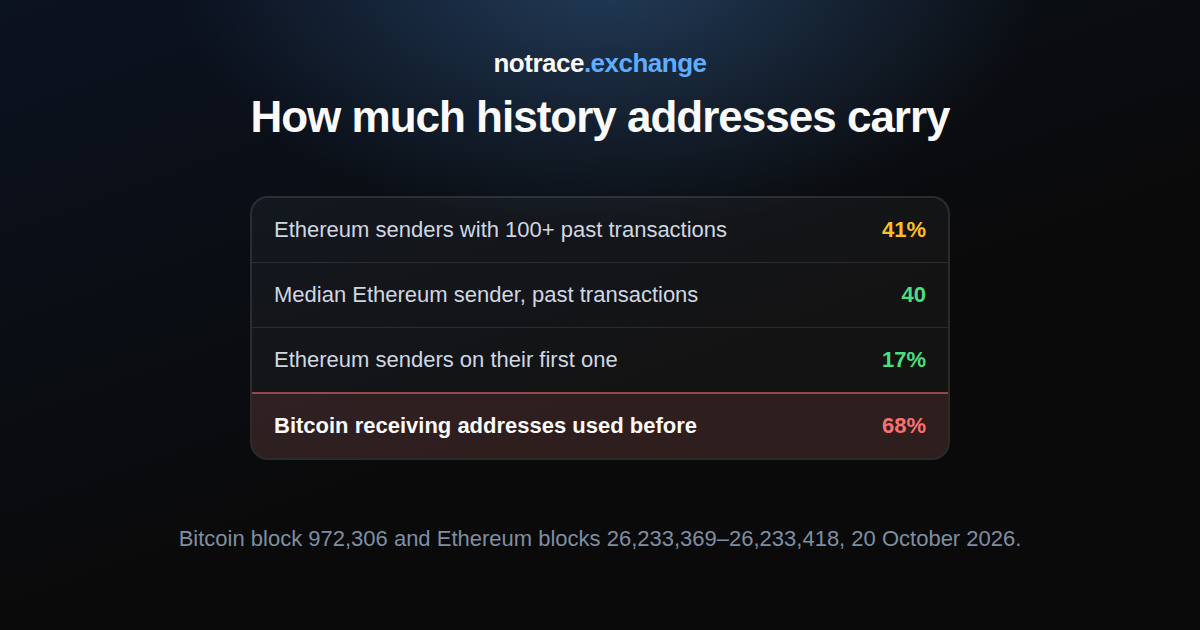
- Bitcoin. Block 972,306 (10:33 UTC) paid 9,023 outputs to 7,664 addresses. We looked up 300 of them at random: 204 (68%) had received coins more than once, and 83 (28%) a hundred times or more. The ten busiest addresses took only 3.8% of the outputs, so this is not a handful of bots.
- Ethereum. 50 blocks (26,233,369 to 26,233,418, 11:02 to 11:12 UTC) carried 12,909 transactions from 6,466 addresses. The median address had already sent 40 transactions; 41% had sent 100 or more, and only 17% were sending their very first. The ten busiest senders accounted for 8.3% of the transactions.
So most payments go to and come from addresses that already have a past. Link one of them to a name, and the past comes with it.
Where the names come from
- Platforms that know you. A deposit to or withdrawal from an account with your name ties the address to you.
- Your own habits. Reusing addresses and merging coins in one transaction join payments together; more in how to send crypto anonymously.
- The connection. The node your wallet talks to sees your IP address.
- What you publish. An address in a profile, an invoice or a donation page is a name tag.
- Analytics. Firms group addresses into clusters and label them; how this works is in is Bitcoin traceable.
Quick answers
Can cryptocurrency be traced? In public networks, yes: the ledger keeps every payment.
Can anyone track your crypto account? Anyone with your address can see its balance and history. Putting a name to it takes information from outside the chain.
Which crypto is the most private? Those built to hide amounts and addresses; the whole category is compared in what are privacy coins.
Where we stand
The notrace.exchange form takes BTC, ETH, SOL and TRX, and USDT and USDC on several networks.
- The payout leaves as two transfers to two addresses of yours, each with its own delay of 0 to 6 hours. If you want the coin and the amount to change too, choose a payout in another coin.
- While a delay runs, the funds are held by the service: section 8 of the terms says so.
- Before you pay, the order offers a letter signed with our PGP key stating what you send and the least you will receive.
- Our fee on 20 October 2026 was 0.5%; the current figure is on the FAQ page.
The bitcoin mixer page opens the form in BTC with the live minimum.