
What is a UTXO? How bitcoin counts coins
Published: November 19, 2026
Also available in:EspañolРусский繁體中文
What is a UTXO? It is an unspent transaction output: a piece of bitcoin that some transaction created and nobody has spent yet. Bitcoin does not keep account balances. It keeps a set of these pieces, each locked to an address, and your balance is the sum of those your keys can unlock. A wallet is closer to a pocket of banknotes and coins than to a bank account.
How a transaction uses UTXOs
- Inputs. A transaction points at existing outputs and spends each one whole. There is no spending half of an output.
- Outputs. It creates new ones: one for the recipient and, usually, one that returns the change to the sender.
- The fee. It is not written anywhere. It is what is left when the outputs are subtracted from the inputs.
Pay 0.001 BTC from a 0.0015 BTC output and the wallet spends all 0.0015, creates 0.001 for the recipient and about 0.0005 of change for you, less the fee.
Why the number of UTXOs shows up in fees
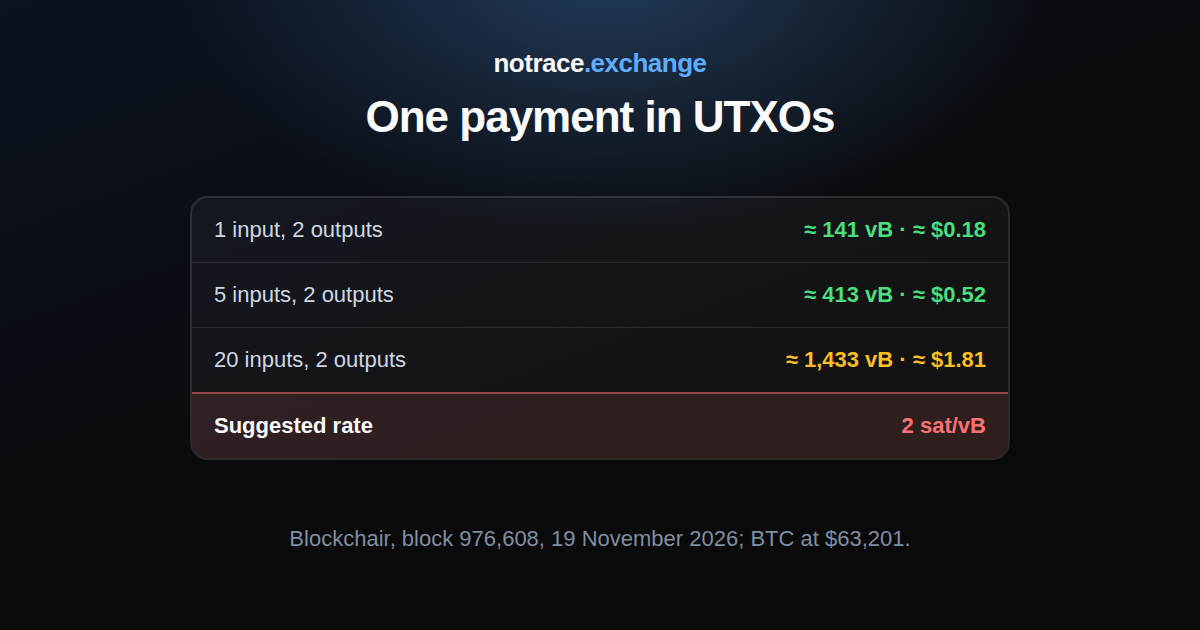
Fees are charged by the size of a transaction in virtual bytes, not by the amount. With native SegWit addresses each input adds about 68 virtual bytes and each output about 31, on top of about 10.5 of overhead. A payment with one input and two outputs is therefore about 141 virtual bytes, one with five inputs about 413, one with twenty about 1,433.
On 19 November 2026 at 16:32 UTC Blockchair showed a suggested rate of 2 satoshis per virtual byte, with bitcoin at $63,201. That makes about 281, 825 and 2,865 satoshis for the three cases, or $0.18, $0.52 and $1.81. The total sent is the same; a wallet made of many small pieces pays more to move it. What a satoshi is: what is a satoshi.
UTXOs and privacy
When a transaction spends several inputs at once, an observer assumes one owner behind all of them. It is the most basic heuristic of chain analysis, and it means that spending two UTXOs together links them. It is also the trap in dust: a tiny output sent to you by a stranger links itself to your coins the moment you spend it with them (crypto dusting attack). How much of the trail anyone can read, and what CoinJoin does to the assumption: is Bitcoin traceable and what is CoinJoin.
The chain in numbers
At block 976,608 (19 November 2026, 16:32 UTC) Blockchair counted 4,024,111,733 outputs created since 2009, and 652,757 transactions in the last 24 hours over 153 blocks, about 4,270 a block. Most of those outputs have been spent. The ones that have not are the UTXO set, which every full node keeps in fast storage to check new transactions against.
FAQ
Do Ethereum, Solana and Tron use UTXOs? No. They keep a balance for each account, like a bank, not a set of pieces.
Can I spend part of a UTXO? No. It is spent whole and the rest comes back to you as change.
Where can I see my UTXOs? In a wallet that offers coin control, or in a block explorer by address.
Where we stand
The notrace.exchange form takes BTC among its coins. Each of its two payouts reaches your wallet as a separate transaction, so you receive two new outputs, one after each delay.
- The payout leaves as two transfers to two addresses of yours, each after its own delay of 0 to 6 hours.
- While a delay runs, the funds are held by the service: section 8 of the terms says so.
- Before you pay, the order offers a letter signed with our PGP key stating what you send and the least you will receive.
- Our fee is on the FAQ page.
The Bitcoin mixer page opens the form in BTC with the live minimum. More: how long a bitcoin transaction takes and what is Bitcoin.