
GENIUS Act: OCC's final stablecoin rule
Published: November 19, 2026
Also available in:EspañolРусский繁體中文
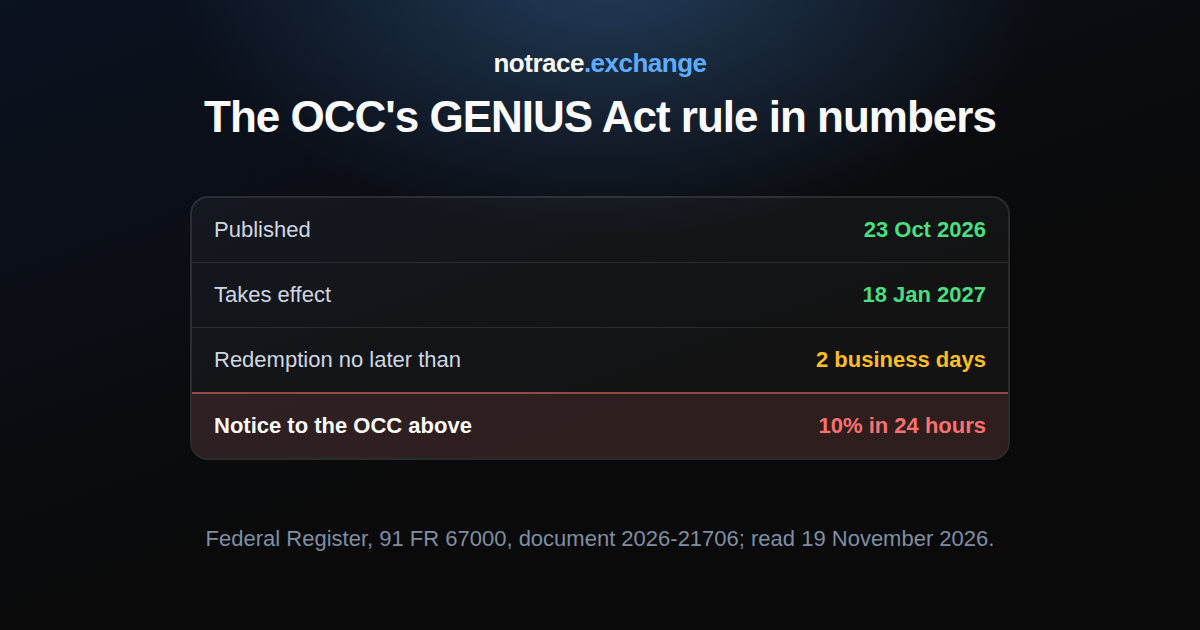
On 23 October 2026 the US Office of the Comptroller of the Currency, the OCC, published its final rule implementing the GENIUS Act, the stablecoin law signed on 18 July 2025 (the Federal Register notice). It takes effect on 18 January 2027. It is a rule for stablecoin issuers, not for people who hold stablecoins. On 19 November 2026 we read the notice, 195 pages in the Federal Register, and list what it fixes.
Whom it covers
Issuers of payment stablecoins that fall under the OCC's jurisdiction: permitted issuers, among them subsidiaries of insured national banks, federal qualified issuers and certain nonbank issuers qualified by a state, and foreign payment stablecoin issuers. The rule also reaches certain custody activities of firms the OCC supervises.
What it asks of an issuer
- Redemption. Timely redemption may not take longer than two business days after the request (section 15.12(c)(1)).
- Waves of redemptions. An issuer must tell the OCC within 24 hours if redemption requests in a single 24-hour period exceed 10 percent of the outstanding amount of any one brand of stablecoin (section 15.12(d)(1)).
- No yield for holding. An issuer may not pay a holder interest or yield solely for holding, using or retaining the stablecoin.
- Reserves. The OCC approves in advance repurchase agreements in which the Treasury bills sold mature in 93 days or less.
What is not in it
Rules on money laundering and sanctions are not in this notice. The OCC says the comments it received on them will be handled in a separate rulemaking.
What it means for someone who holds stablecoins
Nothing is asked of a holder: the rule is addressed to issuers. Which stablecoins fall under it depends on who issues them and under whose supervision, and that is a question for the issuers and their lawyers; we do not answer it here. The date of 18 January 2027 is when the rule starts to apply, not a date by which a holder must do anything. How the coins themselves work is in what is a stablecoin, what is USDT and what is USDC.
What we checked
We read the full text of the notice (91 FR 67000, document 2026-21706) and found each provision above in it; the section numbers are from the text. The OCC's own press release could not be opened from our network, so we rely on the notice itself. Some summaries also mention a ruling on "wrapped" stablecoins; we did not find that wording in the text and do not repeat it.
Where we stand
We do not issue stablecoins, and a rule for issuers does not change how the form works. The notrace.exchange form takes USDT on Ethereum, Solana and Tron and USDC on Arbitrum, Base, Ethereum and Solana, among its coins.
- The payout leaves as two transfers to two addresses of yours, each after its own delay of 0 to 6 hours.
- While a delay runs, the funds are held by the service: section 8 of the terms says so.
- Before you pay, the order offers a letter signed with our PGP key stating what you send and the least you will receive.
- Our fee is on the FAQ page.
The USDT mixer page opens the form in USDT with the live minimum. More on the networks: TRC20 vs ERC20.