
What is USDC and who can freeze it
Published: October 1, 2026
Also available in:繁體中文
USDC is a token issued by Circle, and by Circle's own statement it is worth one dollar and can be redeemed for one US dollar. Technically it is a record in a smart contract: an address and a number. In substance it is a liability of a company, just as USDT is a liability of Tether; what differs is who stands behind it, where the reserves sit and how much the issuer is prepared to tell you. On 1 October 2026 about 74 billion USDC were in circulation by CoinGecko's count, roughly two fifths of USDT's 184 billion.
We covered the other one in what USDT is and who controls it; this is its sibling. We run notrace.exchange, a mixing service whose form lists USDC on five networks, so we read Circle's pages, the laws and the contracts themselves, and every figure below carries a date. Where we measured something ourselves, the method is stated.
Why so many people ask
According to Ahrefs on 1 October 2026, "what is usdc" is searched about 3,400 times a month in the United States, 800 in the United Kingdom, 600 in Canada and 350 in India, and the US figure has stayed between 3,100 and 3,900 for two years. In Taiwan the Chinese-language "usdc是什麼" is searched about 1,800 times a month. That is an everyday question, not a spike.
What you are actually holding
Circle announced USDC on 15 May 2018 and launched it that September through a consortium called Centre, a joint venture with Coinbase; in August 2023 the two dissolved Centre, which gave Circle full governance over USDC (this from Wikipedia). On its own USDC page, read on 1 October 2026, Circle says USDC is "100% backed by highly liquid cash and cash-equivalent assets, with holdings that equal or exceed the amount in circulation", and that "USDC is redeemable 1:1 for US dollars."
As with USDT, the price is held up by that promise and by the reserves behind it, not by anything in the network. If the promise stopped being kept, the contract would still show the same balances.
Where the dollars are
Circle's transparency page, as of 24 September 2026, describes the reserve as short-dated US Treasuries and overnight Treasury repurchase agreements, held mostly in the Circle Reserve Fund (USDXX), an SEC-registered government money market fund managed by BlackRock, plus cash at a handful of large banks. It says monthly third-party assurance reports come from a Big Four accounting firm under AICPA attestation standards. When we read the page it showed no figures, so the amounts here come from elsewhere: CoinGecko put USDC's market capitalisation at 74.16 billion dollars at 16:35 UTC on 1 October 2026, against 183.81 billion for USDT. We have not checked the reserves ourselves; we are repeating what Circle says about them.
The history that matters is short. On 11 March 2023 Circle disclosed that 3.3 billion dollars, about 8% of its reserves, were at Silicon Valley Bank, and USDC fell to roughly 87 cents (Decrypt); it regained the peg on 15 March. The previous article recorded USDT's low of 88 cents in October 2018. Neither episode is a verdict. They are the reason the answer to "how stable is it" lives in the reserves and the reporting, not in the word "stable".
Two laws now frame it. Circle's French entity received an electronic money institution licence on 1 July 2024, which made USDC compliant with the EU's MiCA rules (PYMNTS). And the US GENIUS Act, signed on 18 July 2025, requires reserves of at least one to one, monthly public disclosure of reserve composition and, in its words, "the technological capability to comply with lawful orders to block, seize, freeze, burn, or prevent the transfer of outstanding stablecoins" (Greenberg Traurig's summary). That last clause matters for the freezing section below.
One coin, 38 networks, and one it left
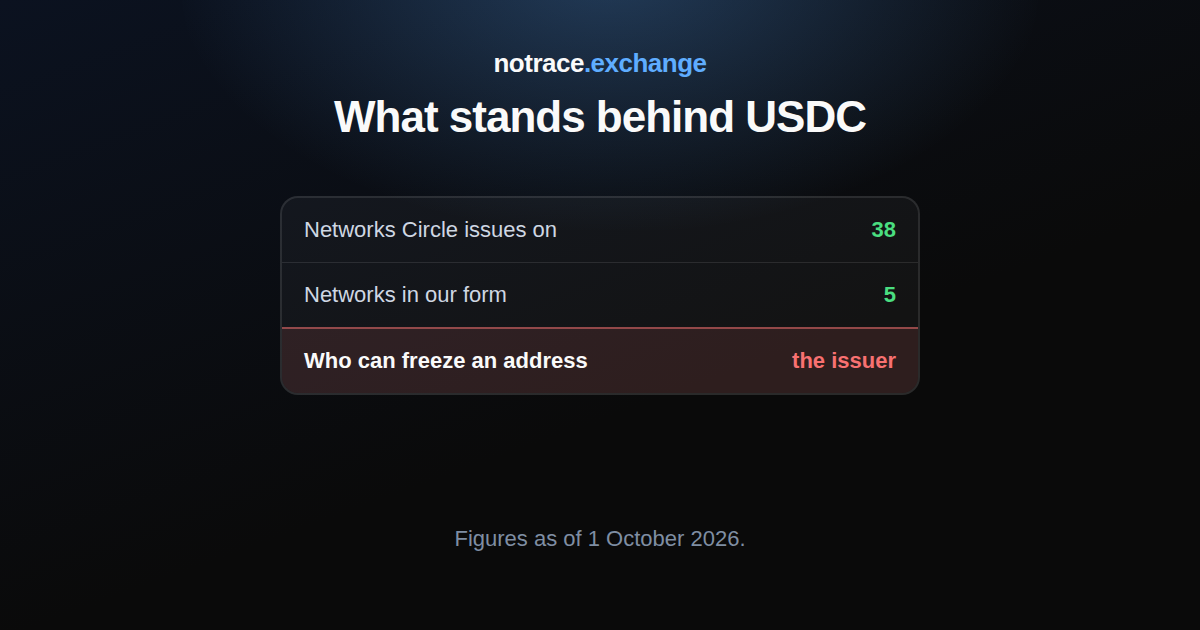
Circle says USDC is natively supported on 38 networks as of 16 September 2026, from Arbitrum, Base and Ethereum to Solana, Stellar and Sui; the full list is on its USDC page. Tron is not on it. On 21 February 2024 Circle announced that "effective immediately we will no longer mint USDC on TRON", citing an enterprise-wide review involving compliance, and it supported transfers off Tron until February 2025 (Circle). So the network where most USDT lives, and which we compared with Ethereum in TRC20 vs ERC20: which USDT network, has no Circle-issued USDC at all.
What we measured ourselves. Between 16:33 and 16:37 UTC on 1 October 2026 we read totalSupply from Circle's USDC contracts on the five networks our form lists:
- Ethereum,
0xA0b86991c6218b36c1d19D4a2e9Eb0cE3606eB48: 49.28 billion, about 66% of CoinGecko's total; - Solana, mint
EPjFWdd5AufqSSqeM2qN1xzybapC8G4wEGGkZwyTDt1v: 7.89 billion, about 11%; - Base,
0x833589fCD6eDb6E08f4c7C32D4f71b54bdA02913: 4.32 billion, about 6%; - Arbitrum,
0xaf88d065e77c8cC2239327C5EDb3A432268e5831: 2.72 billion, about 4%; - Polygon,
0x3c499c542cEF5E3811e1192ce70d8cC03d5c3359: 0.63 billion, under 1%.
Together that is 64.84 billion, about 87% of the 74.16 billion above; the remaining 9.3 billion sits on the other 33 networks. The two sources count differently, so treat the percentages as rough.
Be careful with the word "USDC" on Polygon and Arbitrum, because each network holds two tokens that call themselves USDC. On Polygon there is the native token above and a bridged one at 0x2791Bca1f2de4661ED88A30C99A7a9449Aa84174 with 1.01 billion in supply; on Arbitrum the bridged token at 0xFF970A61A04b1cA14834A43f5dE4533eBDDB5CC8 has 48 million. Both bridged contracts return the symbol "USDC" when asked. Only the contract address tells the two apart, so compare it with Circle's list before sending anything.
Who can freeze USDC
The contract has a role for it. On Ethereum, calling blacklister() on the USDC contract returned 0x0a06be16275b95a7d2567fbdae118b36c7da78f9 on 1 October 2026, and isBlacklisted(address) is public, so anyone can check any address; for 0x…0001 it answered false. Two dated cases show the role in use:
- on 8 August 2022 Cointelegraph reported that Circle had frozen more than 75,000 USDC at 44 addresses of the Tornado Cash mixer that the US Treasury had just put on its sanctions list (Cointelegraph); the article describes the legal background rather than quoting Circle's own explanation;
- on 23 March 2026 Circle froze 16 business wallets in connection with a sealed civil case in a New York court, and by 26 March one wallet holding about 130,966 USDC had been unfrozen; Circle has shared no details, citing the sealed proceedings (Yahoo Finance, which relies on blockchain analyst ZachXBT).
We found no public running total for USDC comparable to the BlockSec figure for USDT quoted in the previous article, and our attempt to count the contract's blacklisting events failed on the range limits of public nodes, so we give none. One thing is not in doubt: for US issuers under the GENIUS Act, being able to freeze is a requirement, not an option.
USDC and USDT, side by side
The comparison people search for is not a verdict either, so here it is as facts with dates:
- Issuer: Circle for USDC, Tether for USDT.
- Size on 1 October 2026: about 74.2 billion against 183.8 billion dollars (CoinGecko).
- Networks: 38 supported natively by Circle on 16 September 2026, against 14 on Tether's own page.
- Reporting: Circle describes monthly assurance by a Big Four firm; Tether publishes a quarterly attestation, which for the second quarter of 2026 we could read only as relayed by Decrypt.
- Freezing: both issuers can do it and both have done it; the examples above are Circle's, the figures in the previous article are Tether's.
What the chain shows
USDC lives on public networks, so an address and its whole history can be read in an explorer with a single lookup, and a frozen balance stays visible. What a stranger's address gives away on its own is covered in what a wallet address is. On our order page each of the two payout transfers gets a link to the explorer of its network.
Where we stand
Our form lists USDC on five networks: Ethereum, Polygon, Base, Arbitrum and Solana. On 1 October 2026 Arbitrum and Solana could be chosen only on the sending side; a payout in USDC could be taken on Ethereum, Polygon or Base. There is no separate USDC page: the form is the same one that opens on the Ethereum mixer and USDT mixer pages, where tokens are separate assets with their own minimum and withdrawal cost. The minimum is about 30 USDC on all five.
- The deposit has to arrive on the network of the asset chosen on the left; both receiving addresses have to be addresses on the network of the asset chosen on the right.
- The payout leaves in two transfers to two addresses of yours, each with a delay; on 1 October 2026 each could be set from 0 to 6 hours in steps of one hour.
- While a delay runs, the funds are held by the service: section 8 of the terms states plainly that for that time the service is the custodian.
- Before you pay, the order offers a letter signed with our PGP key, and our fee on 1 October 2026 was 0.5%; the current figure is always on the FAQ page.
- A freeze by Circle after a payout is a property of the token. We can neither influence it nor undo it.
Where to start
If the question is whether USDC is safe, read Circle's own reserve reports and what independent analysts write about them, and start from the contract address rather than the name. If the question is which of the two dollar tokens to hold, the honest answer is that they share the same weak point, an issuer who can stop your balance, and differ mostly in who audits whom and under which law. And if you are choosing where to send coins from an address that is already known, the checks in how to choose a bitcoin mixer are worth running against us as well as against anybody else.