
What is a stablecoin? Types and risks
Published: October 24, 2026
Also available in:EspañolРусский繁體中文
What is a stablecoin? It is a cryptocurrency whose price is pegged to an ordinary currency, most often the US dollar: one token is meant to be worth one dollar. Technically it is a token, a smart contract on Ethereum, Tron, Solana or another network, and it moves like any other coin. On 24 October 2026 we took a snapshot of the stablecoin market from CoinGecko and checked which of the big ones can be frozen in code.
How a stablecoin holds its price
- Backed by money. The issuing company mints a token for every dollar it holds in bank accounts and US Treasury bills, and redeems tokens back. USDT, USDC and PYUSD work this way.
- Backed by crypto. Tokens are minted against other coins put up as collateral, and there is more collateral than tokens. DAI works this way.
- Synthetic. USDe holds its price with an opposite position on exchanges: a bet on the fall covers the fall of the collateral.
- Algorithmic. Only a mint-and-burn rule holds the peg. The best known of them, Terra's UST, lost its peg in May 2022 and fell almost to zero.
What we measured
According to CoinGecko on 24 October 2026 at 10:31 UTC:
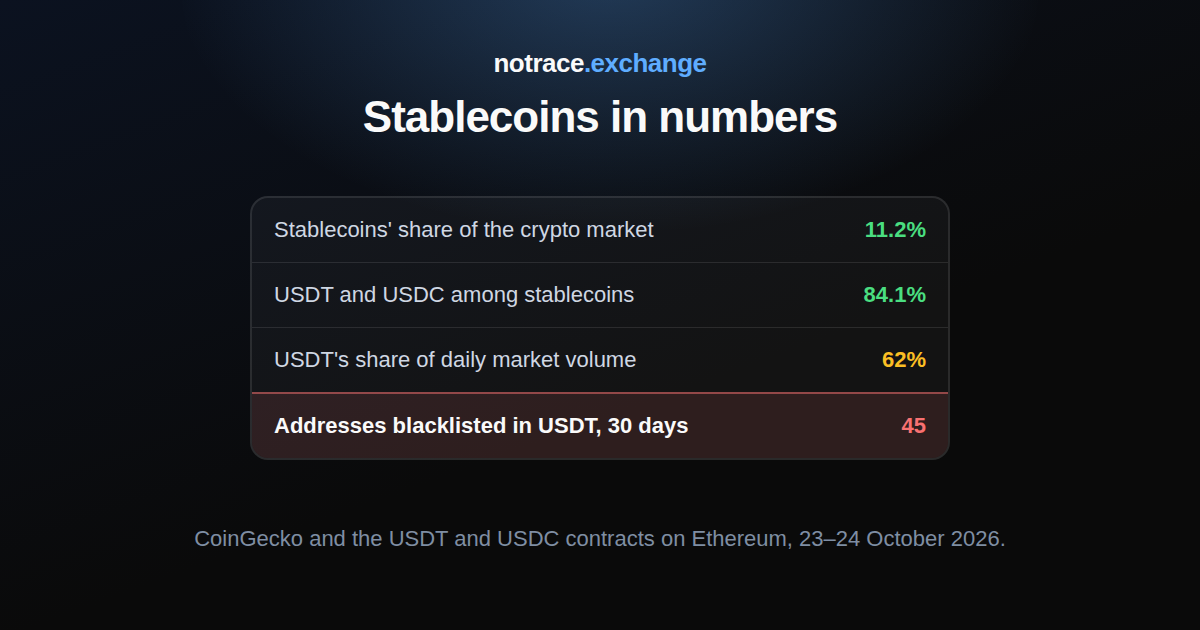
- the 40 largest stablecoins were worth $302 billion together, 11.2% of the whole crypto market ($2.69 trillion);
- USDT held 60.4% of that ($182.5 billion) and USDC 23.7% ($71.6 billion), followed by USDS ($10.1 billion), USDe ($4.6 billion) and DAI ($4.5 billion);
- USDT's 24-hour volume was $38.7 billion, 62% of the whole market's daily volume as CoinGecko counts it;
- of the 34 tokens in the top 40 pegged one to one to the dollar, 31 traded within 0.5% of $1, and the weakest was at $0.9875.
Two tokens hold 84% of the stablecoin market, and their issuers can freeze both.
Who can freeze a stablecoin
- USDT and USDC: the issuer. Both contracts have a blacklist. In the 30 days from 23 September to 23 October 2026, Tether added 45 Ethereum addresses to it and 18 times destroyed the funds on them, 3.08 million USDT in all. Circle blocked 18 addresses in USDC over the same period. More in what is USDT and what is USDC.
- DAI: no one. On 24 October we read the code of the DAI contract on Ethereum: it has 22 functions, covering transfers, approvals, minting and burning. None of them is a blacklist like the ones in USDT and USDC.
Risks
- Losing the peg. Besides UST: on 11 March 2023 USDC dropped to about $0.87 when it emerged that part of Circle's reserves sat in the failed bank SVB. The peg came back two days later.
- A freeze. Once the issuer blacklists an address, the tokens on it can no longer move.
- The network. USDT on Tron and USDT on Ethereum are different tokens, and the recipient's address must be on the same network as the transfer: see TRC-20 vs ERC-20.
- Fakes. Anyone can deploy a token called "USDT", so check the contract address, not the name.
FAQ
Is a stablecoin a cryptocurrency? Yes, it is a token on a blockchain whose price is tied to a currency. Formally stablecoins are also altcoins, though they are usually counted separately.
Does a stablecoin pay interest? Plain USDT or USDC does not: the interest on the reserves goes to the issuer, not the holder. DeFi protocols offer yield, with their own risks (what is DeFi).
Can a stablecoin transfer be traced? Yes: a USDT or USDC transfer is a public transaction with addresses and an amount. What else shows is covered in is crypto anonymous.
Where we stand
The notrace.exchange form takes USDT and USDC on several networks, and BTC, ETH, SOL and TRX.
- The payout leaves as two transfers to two addresses of yours, each with its own delay of 0 to 6 hours. If you want the coin and the amount to change too, choose a payout in another coin.
- While a delay runs, the funds are held by the service: section 8 of the terms says so.
- Before you pay, the order offers a letter signed with our PGP key stating what you send and the least you will receive.
- Our fee on 24 October 2026 was 0.5%; the current figure is on the FAQ page.
The USDT mixer page opens the form in USDT with the live minimum.