
What is Ethereum? How it works and fees
Published: October 25, 2026
Also available in:EspañolРусский繁體中文
What is Ethereum? It is a blockchain that runs programs, called smart contracts, as well as transfers. Its coin is ether, or ETH, and every action on the network is paid for in it. According to CoinGecko, on 25 October 2026 ether was worth $2,356 and all of it together $288 billion: 10.6% of the crypto market and second only to bitcoin. On the same day we read the network through a public node and worked out what people actually pay for a transfer.
How Ethereum differs from bitcoin
- Programs. Bitcoin mostly moves coins. On Ethereum, contracts run tokens such as USDT and USDC, DEXs, lending and stablecoins. By our count on 23 October, 66% of the network's transactions call a contract.
- Accounts instead of coins. An Ethereum address has a balance, like a bank account, and its whole history piles up on one address. In bitcoin, coins sit as separate "outputs", and a wallet usually takes a new address for change.
- Staking instead of mining. Since September 2022 blocks have been produced not by miners but by validators who posted ETH as a deposit — that is staking. On 23 October, 36.2% of all ether was staked.
- No supply cap. There will never be more than 21 million bitcoins, while there were 122.2 million ether on 25 October and supply is growing, by about 0.86% a year as measured on 23 October. Part of every fee is burned, so under heavy load more coins can disappear than appear.
- A block every 12 seconds rather than every 10 minutes.
What we measured
On 25 October 2026, 05:40–05:45 UTC, through a public Ethereum node:
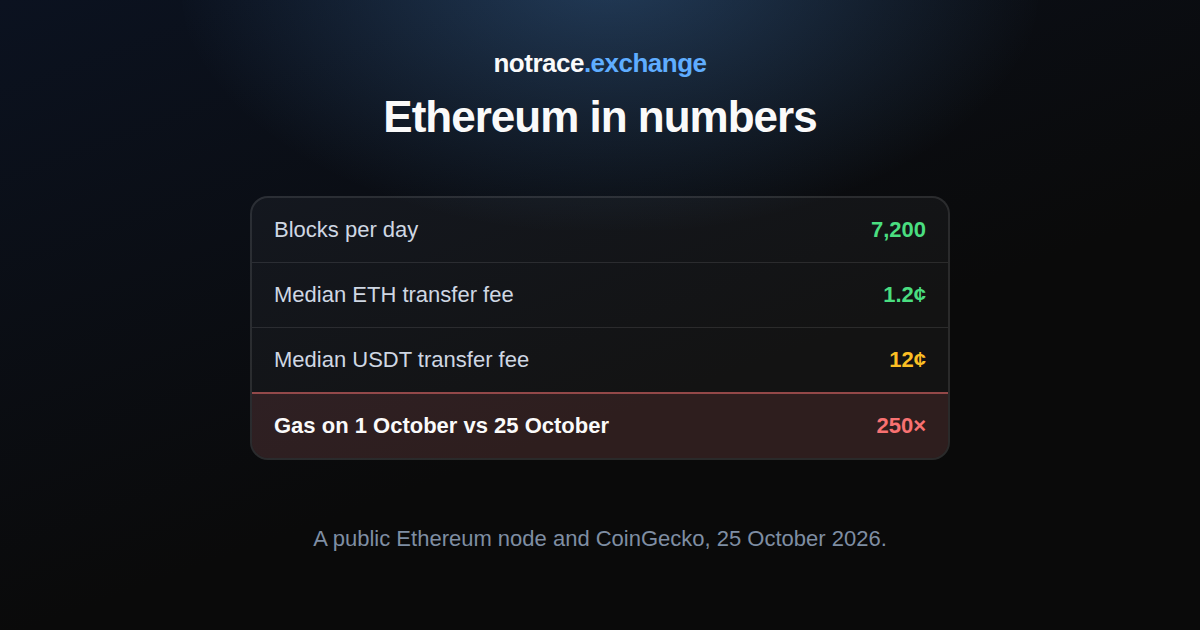
- 7,200 blocks came out over the last day — one every 12 seconds;
- a block held 225 transactions on average, about 1.6 million a day; blocks were roughly half full;
- the base gas price over the last 1,024 blocks ranged from 0.027 to 0.063 gwei (a gwei is a billionth of an ETH);
- five blocks taken 1,500 apart held 216 plain ETH transfers and 173 USDT transfers. The median ETH transfer cost 0.0000049 ETH, about 1.2 cents, and the median USDT transfer 0.00005 ETH, about 12 cents;
- at the base price alone, an ETH transfer would have cost 0.2 cents and a USDT transfer 0.4 cents. The rest is a tip to the validator that wallets add on their own.
Gas moves by hundreds of times. On 1 October 2026 at 16:17 UTC the base price was 8.75 gwei — 250 times higher than on 25 October — and the median USDT transfer then cost $1.33 (TRC-20 vs ERC-20).
What Ethereum shows
The same as any public blockchain: addresses, amounts, times and the contract called. Because of the account model, one address usually collects its whole history: on 20 October the median Ethereum sender had 40 earlier transactions (is crypto anonymous). Approvals given to contracts are public too, and they stay in force until revoked (what is DeFi).
Risks
- Price. Ether fell 39.7% over the year, more than bitcoin's 27.2%.
- Gas only in ETH. To send USDT, the address needs some ether: without it the token will not move.
- Network. Tokens with the same names exist on Arbitrum, Base and other networks, and USDT on Tron as well. A transfer on another network will not arrive where it is expected, so check the network with the recipient.
- Approvals. Signing an approval for an unfamiliar contract can hand it the right to spend your tokens.
- Fakes. Anyone can issue a token called "USDT", so check the contract address, not the name.
FAQ
Are ether and Ethereum the same thing? Ethereum is the network and ether (ETH) is its coin. In everyday talk they are often used interchangeably.
Can ether be mined? No. Since 2022 blocks come only from staking.
Is ether an altcoin? Yes, the largest one: on its own it is worth more than a third of all altcoins.
Where we stand
The notrace.exchange form takes ETH, as well as BTC, SOL and TRX, and USDT and USDC on several networks.
- The payout leaves as two transfers to two addresses of yours, each with its own delay of 0 to 6 hours. If you want the coin and the amount to change too, choose a payout in another coin.
- While a delay runs, the funds are held by the service: section 8 of the terms says so.
- Before you pay, the order offers a letter signed with our PGP key stating what you send and the least you will receive.
- Our fee on 25 October 2026 was 0.5%; the current figure is on the FAQ page.
The Ethereum mixer page opens the form in ETH with the live minimum.