
What is a blockchain explorer?
Published: November 19, 2026
Also available in:EspañolРусский繁體中文
What is a blockchain explorer? It is a website that reads a blockchain and shows it as pages you can search. Paste an address, a transaction hash or a block number and you see the public record behind it. An explorer only reads: it holds no coins, never signs anything and cannot undo a transaction; it displays what the chain already contains. Each chain has its own, such as mempool.space and Blockstream for Bitcoin, Etherscan for Ethereum, Solscan for Solana and Tronscan for Tron.
What you can look up
- A transaction. By its hash: status, number of confirmations, amount, fee, and where the coins came from and went.
- An address. Its balance and every transaction that has touched it.
- A block. Its height, time, how many transactions it holds and who produced it.
- A token or contract. On chains with smart contracts: the supply, the holders and the calls made (what is a smart contract).
A real transaction, read on 19 November 2026
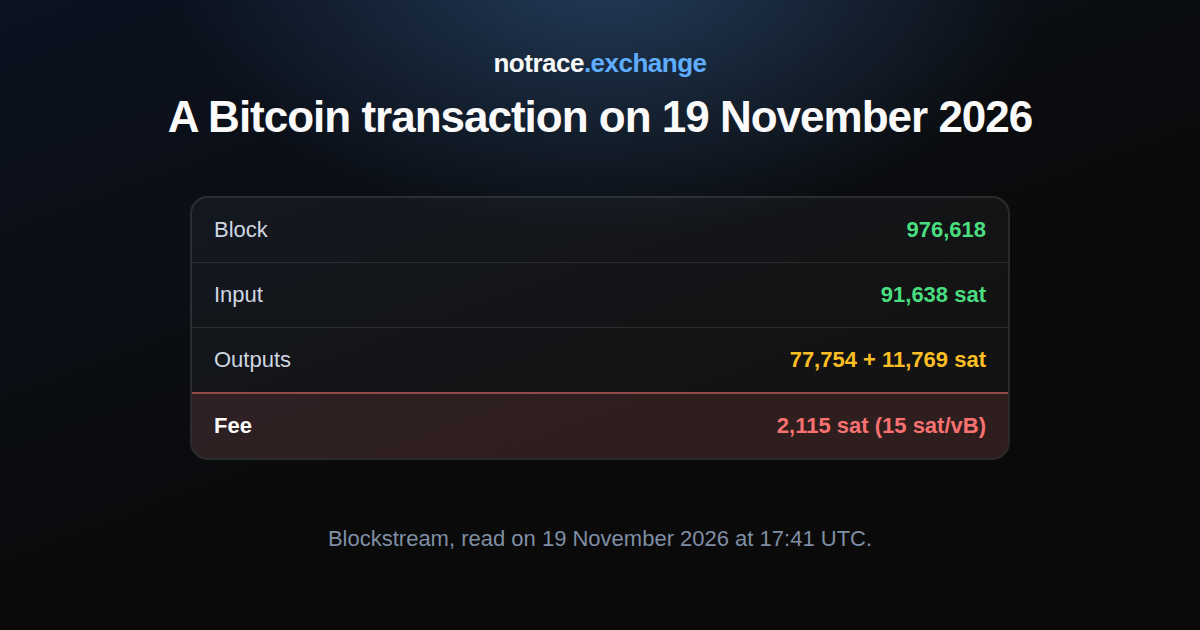
At 17:41 UTC the newest Bitcoin block was 976,618, found at 17:31 UTC with 6,324 transactions in it. We opened one of them, 10ae74c6…6e74, the way an explorer shows it:
- Status. Confirmed, in block 976,618, the newest block at the time: one confirmation, about ten minutes old. How confirmations add up: how long does a bitcoin transaction take.
- Input. One, of 91,638 satoshis, spent whole.
- Outputs. Two, of 77,754 and 11,769 satoshis. One probably went to the recipient and the other came back to the sender as change, but the page cannot say which (what is a UTXO).
- Fee. 2,115 satoshis, which is 91,638 minus 77,754 minus 11,769. At 141 virtual bytes that is 15 satoshis per virtual byte, about $1.33 at $62,920.
The page names nobody. It shows addresses, amounts and hashes, and the transaction's own identifier is a hash (what is a hash).
Everything it shows is public
Because the record is open, anyone who has an address can read its whole history. The address that received the first block's reward, 1A1zP1…DivfNa, is the famous example: at 17:41 UTC an explorer showed 67,565 transactions touching it and 83,542 outputs received, worth 57.7 BTC in total, none of them ever spent. The same page exists for every address, including yours. What that means for privacy: is Bitcoin traceable and what is a wallet address.
Using an explorer safely
- An explorer never needs your seed phrase or private key. A page that asks for one, or for a wallet connection to "verify" a transaction, is a scam (seed phrase safety).
- Type the address yourself or use a bookmark: look-alike sites with near-identical names exist.
- Check the chain. USDT on Tron and USDT on Ethereum are separate tokens on separate chains, and each chain has its own explorer (TRC-20 vs ERC-20).
FAQ
Can I see a transaction before it is confirmed? Yes. Explorers usually list unconfirmed transactions waiting in the mempool and mark them as such.
Is an explorer a wallet? No. A wallet keeps your keys and signs; an explorer only reads.
Why can't I find my transaction? Check that you are on the right chain and that the hash is complete. A transaction that was never broadcast does not appear anywhere.
Where we stand
The notrace.exchange form takes BTC, ETH, SOL, TRX, USDC and USDT, and each of those chains has an explorer like the ones above. Each part of a payout is a normal transfer on its own chain, so once it is sent you can follow it there by its hash.
- The payout leaves as two transfers to two addresses of yours, each after its own delay of 0 to 6 hours.
- While a delay runs, the funds are held by the service: section 8 of the terms says so.
- Before you pay, the order offers a letter signed with our PGP key stating what you send and the least you will receive.
- Our fee is on the FAQ page.
The Bitcoin mixer page opens the form in BTC with the live minimum.