
What is a smart contract? How it works
Published: October 23, 2026
Also available in:EspañolРусский繁體中文
What is a smart contract? It is a program stored on a blockchain at its own address. A transaction calls it, every node on the network runs it the same way, and the result is written to the blockchain, where it cannot be undone. Tokens, DEXs, liquidity pools and staking are all smart contracts. On 23 October 2026 we went through 50 Ethereum blocks and read the USDT and USDC contracts.
How a smart contract works
- Code at an address. A developer publishes the code in a transaction, and the contract gets an address that looks like a wallet's. There is no key to it: only the code decides what the contract does.
- Calls. To make a contract do something, you send it a transaction naming a function and its inputs, such as "send 100 USDT to this address". The sender pays the network fee (gas).
- State. A contract stores data. Your USDT balance is not coins in your wallet but a line in the USDT contract's table.
- No outside world. A contract does not know the dollar price and sees nothing beyond its own blockchain. Outside data is brought in by oracles.
Ethereum is the main home of smart contracts; on Solana they are called programs, and USDT on Tron (TRC-20) is a contract too. Bitcoin has only simple scripts.
What we measured
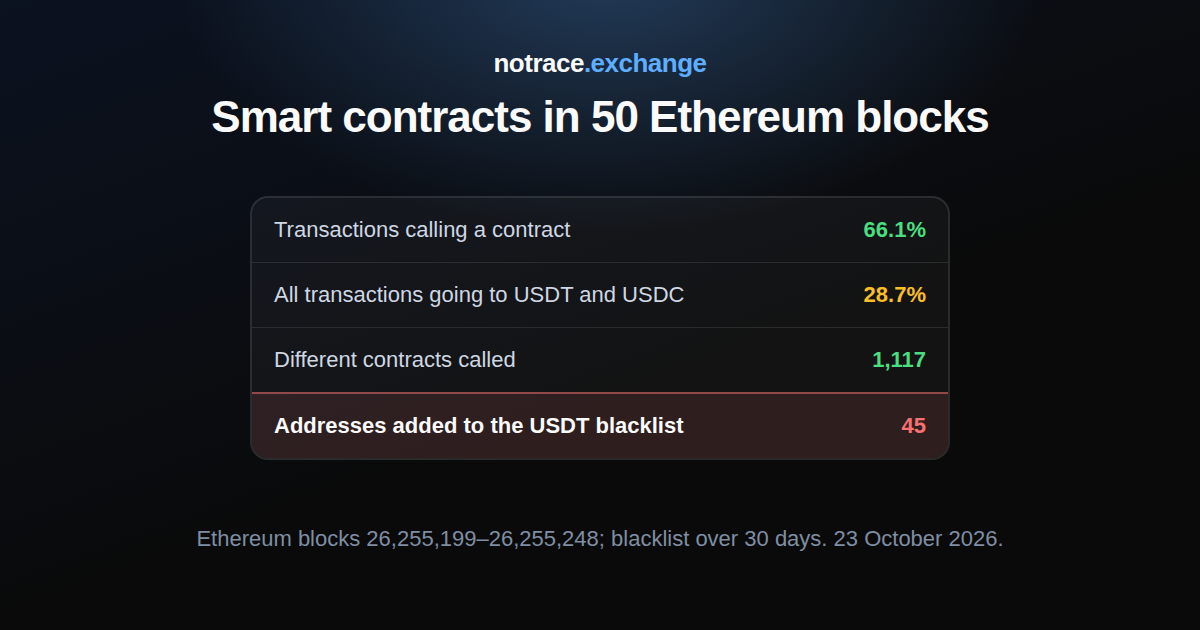
Ethereum blocks 26,255,199 to 26,255,248, from 12:03 to 12:13 UTC, held 13,915 transactions:
- 66.1% called contracts, and 29.3% were plain ETH transfers between wallets;
- 3.0% went to wallets that had attached contract code to themselves, which has been possible since May 2025 (EIP-7702);
- 20 transactions created new contracts;
- 1,117 different contracts were called, but 18.7% of all transactions went to just one, USDT, and another 10.0% to USDC.
More than a quarter of the transactions on the biggest smart-contract network are two stablecoins.
"Code is law"? Not always
Published code cannot be changed, unless the code itself says who may change what.
- USDC is an upgradeable proxy. The contract's address stays the same, but an admin can replace the code behind it. On 23 October the admin slot was set, and the proxy pointed to code at 0x4350…02dd.
- USDT has a blacklist. In the 30 days from 23 September to 23 October, Tether added 45 Ethereum addresses to it, removed none, and 18 times destroyed the funds held at such addresses, 3.08 million USDT in all. Circle blocked 18 addresses in USDC over the same period. More in what is USDT and what is USDC.
Some contracts can be changed by no one: that is why the Tornado Cash pools kept working after the 2022 sanctions (Tornado Cash).
Risks
- A bug is forever. A transaction cannot be reversed. According to DefiLlama, DeFi protocols lost $1.35 billion in 240 incidents in the year to 14 October 2026 (what is DeFi).
- Approvals. For a DEX to take your token, you grant it an approval, often an unlimited one.
- Fakes. Anyone can deploy a contract called "USDT", so check the contract address, not the name.
- The admin. If a contract is upgradeable, its owner can change the rules.
FAQ
Is a smart contract a cryptocurrency? No, it is a program. Tokens like USDT are contracts, and ETH pays for running them.
How do smart contracts work on a DEX? A pool holds two tokens and sets the price by a formula; see what is a DEX.
Can people see who called a contract? Yes: every call is a public transaction with the sender's address. What else shows is covered in is crypto anonymous.
Where we stand
The notrace.exchange form takes BTC, ETH, SOL and TRX, and USDT and USDC on several networks.
- The payout leaves as two transfers to two addresses of yours, each with its own delay of 0 to 6 hours. If you want the coin and the amount to change too, choose a payout in another coin.
- While a delay runs, the funds are held by the service: section 8 of the terms says so.
- Before you pay, the order offers a letter signed with our PGP key stating what you send and the least you will receive.
- Our fee on 23 October 2026 was 0.5%; the current figure is on the FAQ page.
The USDT mixer page opens the form in USDT with the live minimum.