
What is DeFi and how does it work
Published: October 14, 2026
Also available in:EspañolРусский繁體中文
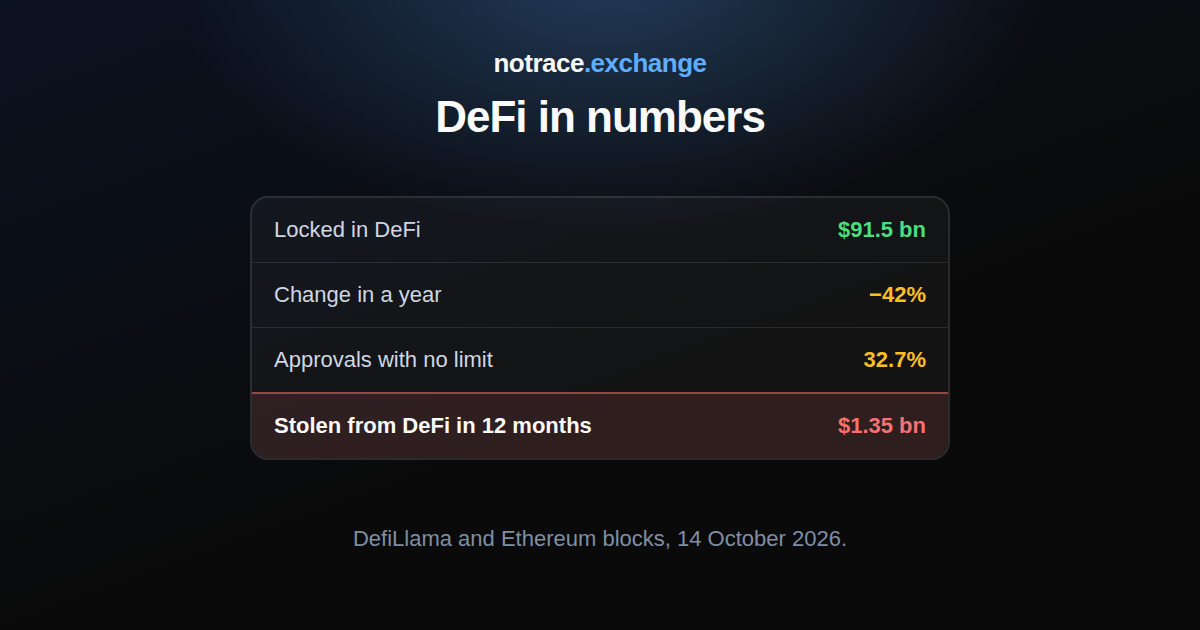
What is DeFi? Decentralized finance: lending, borrowing and trading crypto through programs on a public blockchain instead of through a company. Nobody opens an account for you. You connect your own wallet, sign a transaction, and a smart contract does the rest by rules anyone can read. The figures below are from 14 October 2026, taken from DefiLlama and from Ethereum blocks we read ourselves.
What DeFi actually is
A smart contract is a program stored at an address on a blockchain. It holds tokens and moves them only as its code says: no clerk, no office hours, nobody who can make an exception. DeFi is the set of such contracts that do financial jobs:
- decentralized exchanges (DEX): you trade one token for another against a pool that other users filled;
- lending: you deposit tokens and earn interest, or borrow against collateral; if the collateral drops in price, the contract sells it;
- liquid staking: you stake coins and receive a token that stands for them;
- bridges: they lock a token on one network and issue a copy on another.
What they share: the money sits in a contract rather than with a company, and you reach it from your own wallet. A centralized platform keeps your coins on its own books instead; the same line for wallets is drawn in custodial vs non-custodial. DeFi is not a coin. It is software built on top of coins, and most of it runs on Ethereum and networks built like it.
DeFi in numbers
On 14 October 2026 at 10:26 UTC, DefiLlama counted $91.5 billion locked in DeFi contracts, the figure known as TVL (total value locked):
- the peak was $177.5 billion on 9 November 2021; a year earlier it was $158.9 billion, so the total fell 42% in twelve months;
- Ethereum holds 56% of it, then Base 6.8%, Solana 6.6%, Tron 6.1% and BNB Chain 5.9%;
- the largest protocols were Lido ($24.3 billion, liquid staking) and Aave V3 ($17.5 billion, lending);
- decentralized exchanges handled $9.5 billion in 24 hours and $289.5 billion in 30 days.
TVL moves with prices. When ether falls, the dollar figure falls even if nobody withdraws, so read it as a size, not a score.
How a trade on a DEX works
- You open the DEX site and connect your wallet. The site sees your address and balances; it does not get your keys.
- Approval. For the contract to take a token from your wallet, you sign a separate transaction,
approve, naming the contract and an amount. - The trade. You sign a second transaction. The contract pulls your token, sends the other one from the pool and leaves a fee in the pool. Either all of it happens or none of it does.
- Both transactions stay in the public ledger for good.
This is now most of what Ethereum does. In the hour from 09:29 to 10:29 UTC on 14 October, 300 blocks carried 79,988 transactions, and 67% of them called a contract. Plain transfers of ether were the other third.
What an approval hands over
Step 2 is the one people click through. The ERC-20 standard describes approve like this: "Allows _spender to withdraw from your account multiple times, up to the _value amount" (EIP-20). Multiple times, with no further signature from you, until the amount runs out or you change it.
And the amount is often everything. The format allows a number as large as 2^256 − 1, far beyond any real balance, and many interfaces ask for exactly that so you never have to approve again. In that same hour we counted 2,209 approve transactions from 1,541 addresses:
- 722, or 32.7%, granted exactly the maximum, an approval with no limit and no expiry;
- 327 (14.8%) set the allowance to zero: either a revocation, or the reset to zero that USDT on Ethereum requires before a new amount.
An unlimited approval is safe exactly as long as the contract behind it is. If that contract is malicious from the start, or is later hacked or changed by whoever controls it, it can take the approved token from your wallet at any moment, without asking again. Many wallet drainers work this way: they never see your seed phrase, one approval is enough. The other schemes are in crypto scams.
What helps:
- approve the amount you are about to use, if the interface lets you edit it;
- check your open approvals now and then: block explorers have an approval checker, and a revocation costs one network fee;
- keep long-term savings in a wallet that never connects to DeFi sites.
How often DeFi breaks
DefiLlama keeps a list of hacks. In the 365 days to 14 October 2026 it recorded 240 incidents against DeFi protocols, with $1.35 billion taken. Across every kind of incident it lists returned funds in 8 cases, $5.7 million in total.
The money did not leave through one door. Outside centralized platforms, the largest classes over the year were bridges and cross-chain messaging ($700 million), errors in how tokens and shares are counted ($387 million), access control ($377 million) and compromised keys ($316 million). An audit lowers the odds; it does not make a contract safe. There is no deposit insurance and nobody to call.
What anyone can see
DeFi runs in public. Every trade shows the address, the tokens, the amounts and the time. Every loan shows its collateral, and anyone can work out the price at which it will be sold. An address can be followed from contract to contract, and analytics firms label the large ones.
Stablecoins add one more party: the issuers of USDT and USDC can freeze the tokens at any address, a DeFi contract's included. See what is USDT and what is USDC. The best-known privacy contract on Ethereum, and what became of it, is in Tornado Cash.
Quick answers
Is DeFi the same as crypto? No. Crypto is the money; DeFi is programs that do things with it.
Is DeFi safe? It removes the company and keeps the risks of code: bugs, approvals, price feeds, frozen stablecoins. The figures above are a fair measure of them.
Do I need an account? No. Your wallet is the account, and losing its keys means losing access. See seed phrase safety.
Where we stand
notrace.exchange is not a DeFi protocol. You do not connect a wallet here and you sign no approval: an order gives you a deposit address, and you send an ordinary transfer from any wallet.
- ETH, and USDT and USDC on Ethereum and other networks, are in the form alongside BTC, SOL and TRX. The payout leaves as two transfers to two addresses of yours, each with its own delay of 0 to 6 hours. If you want the coin and the amount to change too, choose a payout in another coin.
- While a delay runs, the funds are held by the service: section 8 of the terms says so.
- Before you pay, the order offers a letter signed with our PGP key stating what you send and the least you will receive.
- Our fee on 14 October 2026 was 0.5%; the current figure is on the FAQ page.
The ethereum mixer page opens the form in ETH with the live minimum; for stablecoins, see the USDT mixer.