
What is a multisig wallet? Shared keys
Published: November 19, 2026
Also available in:EspañolРусский繁體中文
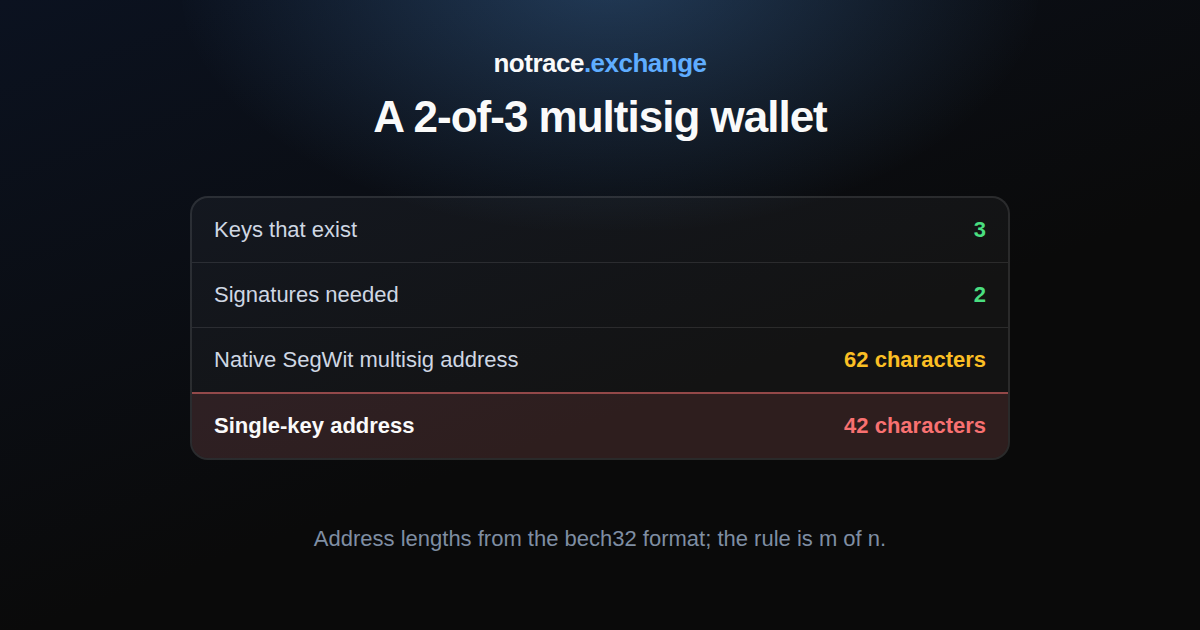
What is a multisig wallet? It is a wallet that needs more than one key to approve a payment: for example two out of three. The keys can sit on different devices or belong to different people, so that losing or leaking any single one does not hand over the money, and one person alone cannot spend it either.
How it works
- The rule. A wallet is set up as "m of n": n keys exist and m signatures are needed. Two of three is the common choice for personal savings, three of five for teams.
- The address. It is computed from all the public keys together, so it looks like any other address but belongs to the group, not to one key.
- The payment. Someone prepares it, and each signer adds a signature on their own device. The half-signed transaction travels between them in a standard format, a PSBT (Bitcoin Core 32.1 now creates version 2 by default).
What it protects against
It removes the single point of failure that one private key is. A stolen laptop, a phished phone or one lost hardware device is not enough to drain the wallet when the other keys are elsewhere. It also lets people share control without trusting any one person with everything. What it does not protect against is the approval itself: if enough signers are tricked into signing the same wrong payment, or two of three keys are lost, the money is gone. How the keys are backed up still matters (seed phrase vs private key, seed phrase safety).
On different networks
- Bitcoin. Multisig is built into the scripting. A native SegWit multisig address has 62 characters, against 42 for a single-key one, so the type is visible at a glance (what a wallet address looks like). Spending reveals the policy on the chain: how many keys and how many signatures.
- Ethereum. Multisig here is usually a smart contract wallet, such as Safe, that holds the funds and checks the signatures. It adds flexibility and also adds the risk of contract bugs (smart contracts).
- Tron. Accounts have multi-signature permissions built in, so a shared account needs no extra contract.
FAQ
Is multisig the same as two-factor login? No. Two-factor protects an account at a company. Multisig is a rule inside the network about how many keys must sign.
Is it custodial? Not by itself: the keys belong to the signers. If a service holds all of them, it is custodial (custodial vs non-custodial).
Is it safer than a hardware wallet? They solve different things. A hardware wallet protects one key; multisig spreads trust over several, and the keys can themselves sit on hardware wallets (hot vs cold).
Where we stand
A multisig address of a supported network is an address like any other from the point of view of its owners. The notrace.exchange form takes BTC, ETH, SOL, TRX, USDC and USDT, and pays out to two addresses of yours.
- The payout leaves as two transfers to two addresses of yours, each after its own delay of 0 to 6 hours.
- While a delay runs, the funds are held by the service: section 8 of the terms says so.
- Before you pay, the order offers a letter signed with our PGP key stating what you send and the least you will receive.
- Our fee is on the FAQ page.
The Bitcoin mixer page opens the form in BTC with the live minimum.