
What is a stealth address? How it works
Published: November 19, 2026
Also available in:EspañolРусский繁體中文
What is a stealth address? It is a way to receive payments at a new, one-time address each time, without handing out a new address yourself. You publish one reusable string; every sender derives from it a fresh address on the chain; only you can find those addresses and spend from them. To an outside observer the payments look like they went to unrelated accounts.
The problem it solves
Reusing an address ties all the payments to it together, and anyone can read the total. It is common: in a sample of one Bitcoin block in October, 204 of 300 recipient addresses, 68%, had received coins more than once (is crypto anonymous). The usual remedy is a fresh address for every payment, but that needs the recipient to hand out a new one each time, and often nobody is there to do it. A stealth address removes that step.
How it works, in outline
The sender and the recipient share a secret that only the two of them can compute: the sender from the recipient's public string and a key of their own, the recipient from the same string and their private key. The secret is turned into a one-time address on the chain. The recipient keeps two keys. A viewing key lets their wallet find the payments that are theirs; a spending key moves the money. In ERC-5564 the public string is called a stealth meta-address, made of one or two public keys.
Three versions
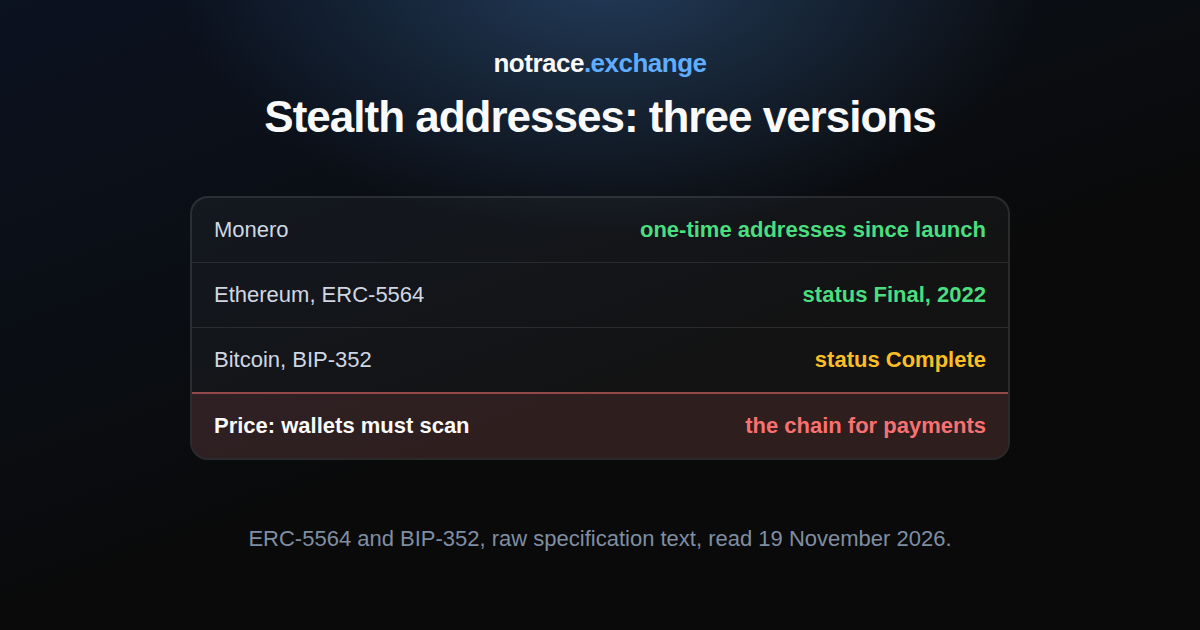
- Monero. It has worked this way since launch: each payment goes to a new one-time address, so the address you hand out never appears on the chain (is Monero traceable).
- Ethereum: ERC-5564. The standard has status Final and dates from 2022. Its abstract says it lets senders "non-interactively generate private accounts exclusively accessible by their recipients". Payments are announced through one contract so that wallets can scan for them.
- Bitcoin: BIP-352, Silent Payments. It has the status Complete. It gives a static address with no on-chain link between payments and no on-chain notification. The BIP itself states the price: wallets must scan the blockchain to detect payments, which is feasible for full nodes and hard for light clients.
What it does not hide
A stealth address hides who received, not that someone did. Amounts stay visible, the sender is known, and the recipient can link their own addresses again by how they spend: paying fees from a known address on Ethereum, or merging outputs on Bitcoin. It is one tool against reuse, not a mixer (how traceable Bitcoin is, privacy coins).
FAQ
Is a stealth address the same as a mixer? No. It changes where one payment lands. It does not break the link between a sender and a recipient or hide the amount.
Do I need a special wallet? Yes, and so does the sender: both ends must support the scheme.
Is it the same as reusing a "fresh address" from my wallet? Close in effect, different in practice. A fresh address needs your wallet to hand it out; a stealth address needs nothing from you at the time of payment.
Where we stand
The notrace.exchange form needs no stealth address: it pays out to two addresses of yours, and giving it two new ones from your wallet is the simple way to avoid reuse (what a wallet address reveals). Its coins are BTC, ETH, SOL, TRX, USDC and USDT.
- The payout leaves as two transfers to two addresses of yours, each after its own delay of 0 to 6 hours.
- While a delay runs, the funds are held by the service: section 8 of the terms says so.
- Before you pay, the order offers a letter signed with our PGP key stating what you send and the least you will receive.
- Our fee is on the FAQ page.
The Bitcoin mixer page opens the form in BTC with the live minimum. More: how to send crypto anonymously.