
What is market cap in crypto?
Published: November 19, 2026
Also available in:EspañolРусский繁體中文
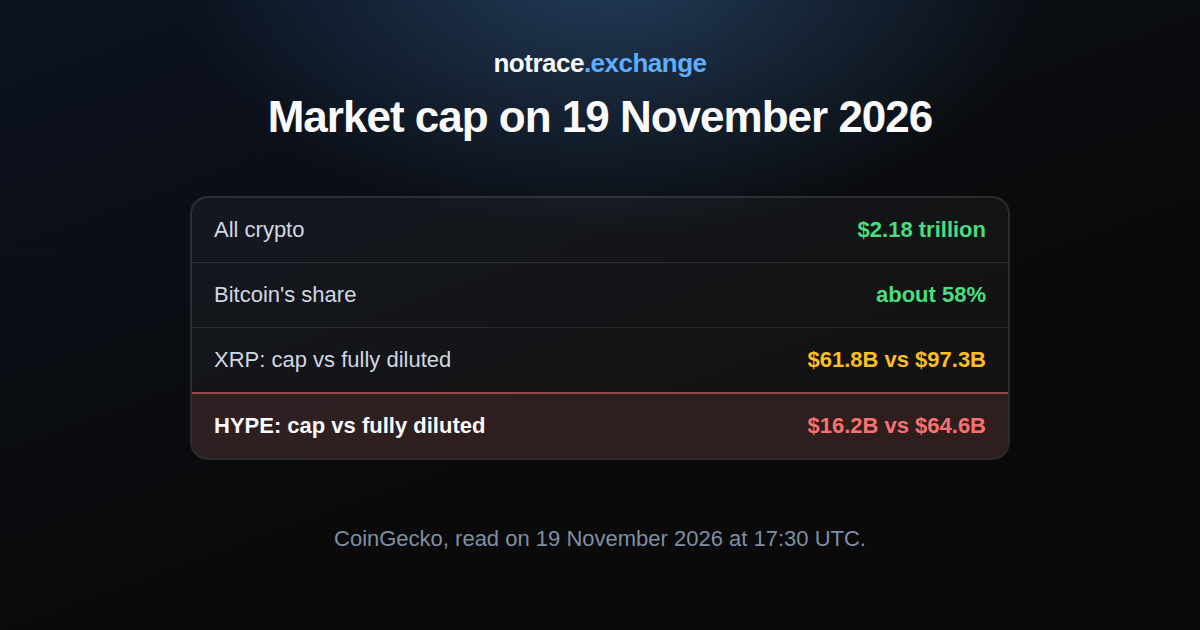
What is market cap in crypto? It is the price of one coin multiplied by the number of coins in circulation. It is a label for size, not a sum of money put in: Bitcoin's $1.27 trillion is what all its coins would be worth at the last trade price, and no one could sell them all at that price. We took the numbers below from CoinGecko on 19 November 2026.
The formula, with an example
Bitcoin had 20,113,584 coins in circulation and traded at $62,920. Multiplied, that is about $1,265.5 billion. The whole market, 21,366 coins by CoinGecko's count, came to about $2,177 billion: Bitcoin was about 58% of it, Ethereum 10% and USDT 8%. Most of those 21,000 coins are smaller still: the tenth on the list has only $16 billion. More on what the long tail is made of: what are altcoins, what are meme coins.
Circulating, total and fully diluted
The multiplier is the supply, and there are three of them. Circulating supply is what exists and can move now. Total supply includes what is locked or not yet released. Fully diluted valuation multiplies the price by the total or maximum supply, as if everything were out already.
The gap can be large. On 19 November XRP had a market cap of $61.8 billion and a fully diluted value of $97.3 billion. The coin with the ticker HYPE stood at $16.2 billion against $64.6 billion, four times as much, because only a quarter of its supply was circulating. The same gap appears at the small end: Gram, the former Toncoin, had $2.93 billion on our 16:35 UTC reading against about $5.4 billion fully diluted (5.29 billion coins at $1.02; what is TON).
Stablecoins
For a coin pegged to a dollar the price barely moves, so market cap is simply the supply. USDT stood at $175.1 billion and USDC at $68.2 billion. A rising figure means more of them exist, not that anyone made a profit (what is a stablecoin).
What market cap does not tell you
It does not say how much can be sold. A coin with a big cap can be hard to sell in size, and the last price, which the cap is built from, may come from a small trade. How price moves against an order, measured: slippage. A low price does not mean a small coin either: Solana at $73.77 had a cap of $43.7 billion, while XRP at $0.97 had $61.8 billion.
FAQ
Is market cap the price I would get if I sold everything? No. It is the last price multiplied by the supply, and selling in size moves the price.
Does a cheap coin have a small market cap? Not necessarily. Price alone says nothing without the number of coins.
Which figure should I look at, cap or fully diluted? The first for what trades today, the second to see how much more supply is still to come.
Where we stand
The notrace.exchange form takes BTC, ETH, SOL, TRX, USDC and USDT. On 19 November 2026 six of the ten biggest coins by market cap were among them: Bitcoin, Ethereum, USDT, USDC, Solana and Tron. The form does not depend on size: what it needs is that the coin and its network are supported.
- The payout leaves as two transfers to two addresses of yours, each after its own delay of 0 to 6 hours.
- While a delay runs, the funds are held by the service: section 8 of the terms says so.
- Before you pay, the order offers a letter signed with our PGP key stating what you send and the least you will receive.
- Our fee is on the FAQ page.
The Bitcoin mixer page opens the form in BTC with the live minimum. More on what these coins are: what is cryptocurrency.