
What are meme coins? A year in numbers
Published: October 27, 2026
Also available in:EspañolРусский繁體中文
What are meme coins? They are cryptocurrencies whose price rests on a joke, a picture or a famous name rather than on a product. The first, Dogecoin, appeared in December 2013 as a parody of bitcoin, with the Shiba Inu dog from an internet meme. Today anyone can launch a meme coin in a minute. On 27 October 2026 we took the 100 largest meme coins from CoinGecko and looked at what happened to them over a year.
Where meme coins come from
- Their own networks. Dogecoin runs on its own blockchain and is produced by mining, together with Litecoin.
- Tokens. Almost all the rest are tokens, records in a smart contract on someone else's network: SHIB (2020) and PEPE (2023) on Ethereum, BONK and WIF on Solana. Issuing one costs cents.
- Launch sites. Since 2024, services on Solana let anyone create a token in a minute with no code. The new coin's price is set by a liquidity pool on a DEX: whoever buys first buys cheapest.
- Celebrities. The TRUMP meme coin was launched on Solana on 17 January 2025, three days before the inauguration, and two days later it was at its all-time high.
What we measured
From CoinGecko on 27 October 2026 at 12:54 UTC:
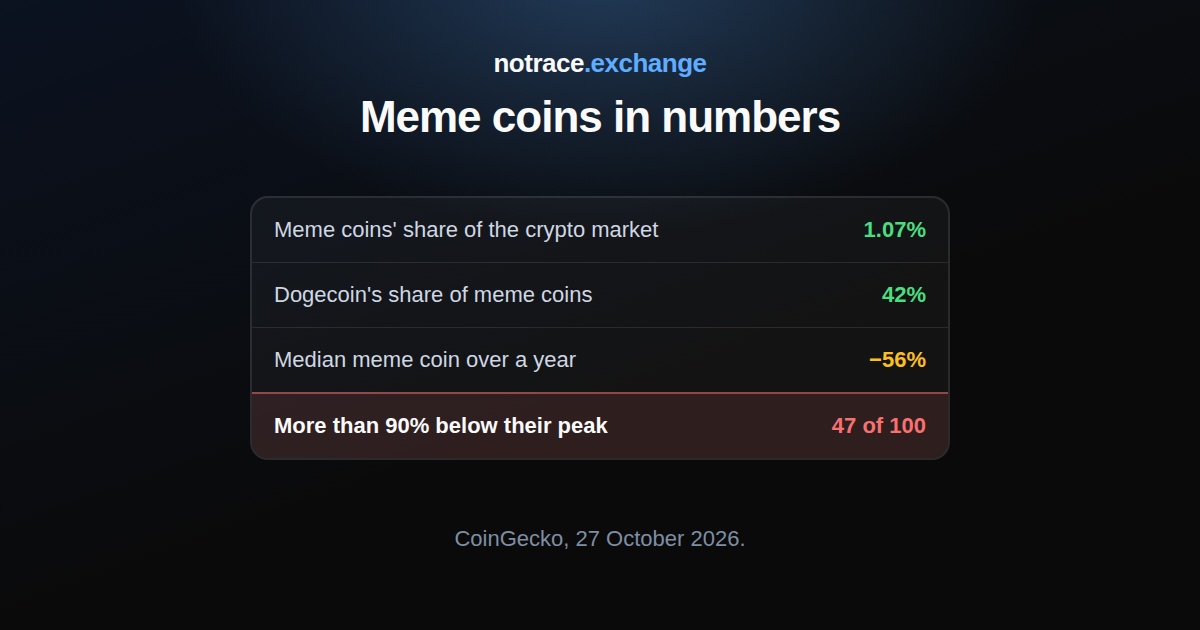
- all meme coins together were worth $29.1 billion — 1.07% of the crypto market ($2.71 trillion), with $1.59 billion traded in a day;
- Dogecoin alone ($12.2 billion) was 42% of that; Solana meme coins together were worth $2.96 billion;
- of the 100 largest meme coins, 77 have traded for more than a year. Over that year the median one fell 56%, 44 lost more than half, 10 lost more than 80%, and only 11 rose. Bitcoin lost 30.9% over the same period;
- the median meme coin in the top 100 was 89% below its all-time high, and 47 of the 100 were more than 90% below;
- TRUMP fell 73% over the year and was 97.7% below its 19 January 2025 peak; the 100th meme coin on the list was worth $15.2 million.
Even among the coins that made the top 100, a rise is the exception.
Risks
- Price. A meme coin can lose more than half its price in a year, as 44 of the 77 did.
- Pulled liquidity. A token's creator can take the money out of the pool, leaving nothing to sell into (what is a liquidity pool).
- Contract traps. A token's code can allow buying and block selling, or let the creator mint new coins. Check the contract before you sign an approval (what is DeFi).
- Fakes. Anyone can issue a token with a famous meme coin's name, so check the contract address, not the name (crypto scams).
- Thin markets. Small coins have shallow pools, and a large buy moves the price a lot (slippage).
FAQ
Is Dogecoin a meme coin? Yes, the first and the largest.
Is a meme coin an altcoin? Yes, one of the types of altcoins.
Are meme coins anonymous? No. DEX purchases are public transactions: anyone can see which address bought, when and how much. Analysts look first at who bought a token in its first seconds and whether that address links to the creator (is crypto anonymous).
Where we stand
The notrace.exchange form has no meme coins: it takes BTC, ETH, SOL and TRX, and USDT and USDC on several networks.
- The payout leaves as two transfers to two addresses of yours, each with its own delay of 0 to 6 hours. If you want the coin and the amount to change too, choose a payout in another coin.
- While a delay runs, the funds are held by the service: section 8 of the terms says so.
- Before you pay, the order offers a letter signed with our PGP key stating what you send and the least you will receive.
- Our fee on 27 October 2026 was 0.5%; the current figure is on the FAQ page.
The Solana and Ethereum pages open the form in that coin with the live minimum.