
What is P2P in crypto and how it works
Published: October 4, 2026
Also available in:Русский
P2P in crypto means buying and selling coins directly from another person rather than from a trading platform's order book. The abbreviation stands for peer-to-peer. One person posts an ad, another responds, and the platform holds the seller's coins as a deposit between them until the seller confirms that the money has arrived.
The money, meanwhile, usually does not go through the platform: it goes to the seller's details, a card or a bank account. That is where the main risks come from. You depend on someone else's terms, on a bank that sees the transfer, and on coins whose origin you know only from the seller's word. We read the help pages of the Bybit platform, took a snapshot of its live order book for USDT against rubles on 4 October 2026, re-read what the Bank of Russia says about blocked cards, and opened the law of 4 August 2026. This is neither a how-to-buy guide nor legal advice: we are looking at how the trade is built and what it leaves behind.
Where the word P2P comes from
The term is older than cryptocurrency. According to the Russian Wikipedia (in Russian), the phrase "peer-to-peer" was first used in 1984, in IBM's Advanced Peer to Peer Networking architecture, and a peer-to-peer network is one based on the equality of its participants, often with no dedicated servers. For Bitcoin the word became part of the name: its paper is titled "Bitcoin: A Peer-to-Peer Electronic Cash System", and the abstract says that a purely peer-to-peer version of electronic cash would allow online payments to be sent directly from one party to another without going through a financial institution (the paper itself).
The word has other meanings in everyday use: card-to-card transfers, loans between private persons. This article is about trading coins between people on a platform.
How a trade is built
There are two sides. The author of an ad sets the price per coin, how many coins are on offer, the minimum and maximum for one order in money, the payment methods and the time allowed to pay. The other side picks a suitable ad. The price in the list is the one the counterparties themselves set, as the Bybit help page says outright.
The buyer's steps there run like this (the page was updated on 2 September 2026):
- The buyer picks an ad, enters an amount and creates an order. If the ad's author has asked for confirmation, the buyer has to provide it: the page lists a liveness check, a photo ID, proof of payment and a bank statement.
- A timer starts. Within it the buyer pays the seller by the given details and presses "Payment Completed". If the time runs out, the order is cancelled automatically.
- The seller checks that the money has arrived and releases the coins. If that has not happened within 10 minutes, the buyer can file an appeal with the "Need Help" button; the page advises against cancelling the order until the seller has returned the money.
- The coins land in the buyer's internal balance on the platform, which the page calls the Funding account.
The seller's coins are locked on the platform from the moment the order opens: that is the deposit, or escrow (Bybit says the platform holds them until both sides confirm the deal). The result is a split: the money goes to the seller directly, as a rule, and the coins go through a custodian. How custody by a service differs from holding your own key is covered in custodial vs non-custodial wallets.
Two things follow that are rarely said aloud. The trade takes place in the platform's books, not on the blockchain: the buyer gets coins not from the seller but from an internal balance. A record on the blockchain appears when you yourself withdraw the coins to your own address, and the sender will be the platform, not the seller. That is our inference from the steps above; the platform does not phrase it that way.
And one more. The platform knows both sides: by its own help page, the name on the payment details has to match the name the account has been verified under. Otherwise the account may be blocked, the seller has the right not to release the coins, and, as the page says, the buyer risks losing them permanently.
Who sets the price: a measurement on 4 October 2026
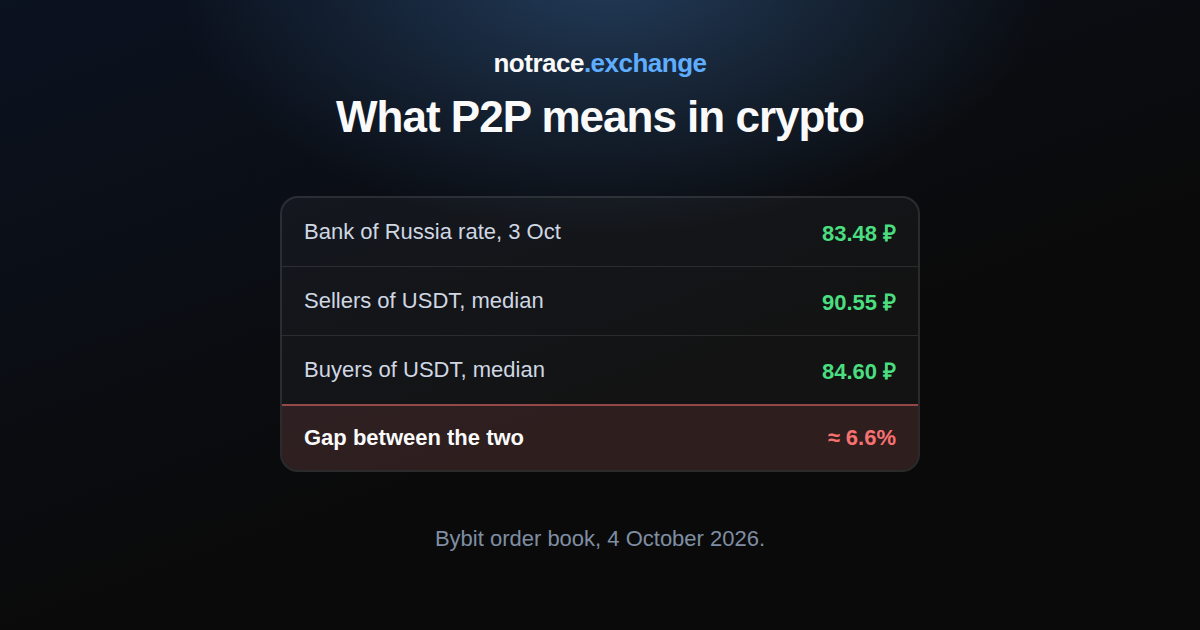
We took the public order book for USDT against rubles on Bybit on 4 October 2026, between 07:07 and 07:10 UTC. It held 735 ads from sellers of USDT and 1,363 from buyers. The book moved while we paged through it, so the calculation uses 726 and 1,347 unique ads. We compare with the official Bank of Russia rate for 3 October, 83.4839 rubles to the dollar; CoinGecko gave 83.63 rubles per USDT in the same hour.
- Sellers of USDT (the ones you buy from) ask from 82.00 to 96.28 rubles, median 90.55, which is 8.5% above the Bank of Russia rate.
- Buyers of USDT (the ones you sell to) bid from 75.35 to 96.99 rubles, median 84.60, which is 1.3% above the Bank of Russia rate.
- The gap between the medians is 5.95 rubles. Buying at the sellers' median and selling at once at the buyers' median would lose about 6.6%.
- The lowest ask, 82.00 rubles, sits on an ad for 10 USDT with a limit of 500–550 rubles. For an order of 100 USDT (about 8,350 rubles), 335 seller ads fit by remaining amount and limits, 46%; their prices run from 85.00 to 96.28, median 91.37 rubles, 9.4% above the Bank of Russia rate.
- If you are selling 100 USDT, 896 buyer ads fit, 67%; the median is 84.53 rubles.
The second part of the measurement is the conditions an ad's author sets for the counterparty.
- The condition "the counterparty has passed identity verification" is switched on in 98% of seller ads and 96% of buyer ads.
- A minimum account age is required by 36% of sellers and 21% of buyers. This is how we read the service fields of the ads; the platform's rules give no such figures.
- The time to pay is 15 minutes in 47% of seller ads, 30 minutes in 35%, 45 minutes in 17%.
- The minimum order has a median of 5,000 rubles, but in 16% of seller ads it is 500 rubles or less.
- In the free-text conditions of sellers, the word "receipt" appears in 58% of ads, a phrase like "only from…", "strictly from…" or "I accept from…" in 44%, and words about third parties or third-party payments in 15%. For buyers the same words appear in 23%, 15% and 2% of ads. This is a keyword search, so the figures are rough.
- In 6–7% of ads the share of completed orders is below 90%.
What follows from this. The price in P2P is negotiated, and a gap of 6–7% between buying and selling is the normal state of the book, not a platform fee. A cheap ad is usually a small one. And if a price stands far outside the market, that is a reason to read the conditions in full, not a stroke of luck: the same book has a bid for 100,000 USDT at 96.99 rubles, 16% above the Bank of Russia rate, and its conditions deserve particularly careful reading.
What can go wrong
The bank and the card
On 26 August 2025 the Bank of Russia stated in an information letter that if a bank has suspended operations on an account or card, it must tell the client which law and which of its provisions the decision rests on. The grounds differ: Law No. 161-FZ "On the National Payment System" is aimed at countering fraudulent transactions, while No. 115-FZ "On Countering the Legalisation (Laundering) of Criminal Proceeds and the Financing of Terrorism" is a separate law. Citing both at once without grounds for double restrictions is, in the regulator's words, an unacceptable practice.
On 25 March 2026 the Bank of Russia recommended that banks contact the client themselves right after a suspension instead of waiting to be asked, name the legal basis, explain step by step how to have restrictions lifted and how to appeal a refusal. If a person has entered the regulator's database of fraudulent transactions, they should be told how to apply to be removed.
On neither page are cryptocurrency or P2P named as a reason for a block: they are about procedure, not triggers. The Bank of Russia pages we found carry no figures on how many blocks are linked to P2P, so we give none.
One more Bank of Russia page is about droppers. At a briefing in Tula on 25 July 2024 a regulator's expert explained that a dropper, or "drop", is a front person who, knowingly or not, helps fraudsters cash out money obtained by crime. The briefing also recalled a law taking effect that day: banks must suspend a transfer for two days if the recipient is in the Bank of Russia's database of fraudulent transactions, and cut off remote banking if law enforcement reports that a client is cashing out stolen funds. A P2P seller receives money from a stranger: the name on the payment details shows who sent it, but not whose money it is. That is our reasoning, not a quotation.
The platform and the account
The platform has levers of its own. By the Bybit help page, its system assesses the risk of each trade, and if a trade is judged risky, a 24-hour withdrawal restriction is placed on the account. A mismatched name can get the account suspended. And on a law-enforcement request the platform can restrict an account or specific funds: that is how Bybit defines a freezing order, an official instruction from law enforcement to a centralized platform.
The coins and a freeze by the issuer
If you receive USDT, you hold a token whose contract lets the issuer block an address. How the freeze works we covered in what USDT is and who controls it. In P2P you do not choose whose coins you receive. The cost of a block falls on whoever holds the coins at the address at the moment of the block.
The law, if you are in Russia
On 4 August 2026 Federal Law No. 282-FZ "On Digital Currencies and Digital Rights" was signed, and it has been in force since 1 September 2026. The Bank of Russia described it on 21 July 2026, when the State Duma passed it: trades in cryptocurrency go through intermediaries; unqualified investors can, after a test, buy the most liquid cryptocurrencies within 300 thousand rubles a year through one intermediary; paying with cryptocurrency inside the country remains prohibited; market participants get a transition period until 1 July 2027.
The word "P2P" does not appear in the text of the law. Two provisions that take effect on 1 July 2027 come closest to the subject. Part 1 of Article 30: residents who do not themselves organise the circulation of digital currencies may make transactions and operations with digital currencies only through organisers of circulation or with them; there is a list of exceptions. Article 21: a bank must refuse a transfer to an organisation, an entrepreneur or a foreign person if it suspects that the recipient organises the circulation of digital currencies without having the status to do so. Private individuals are not named in Article 21. How the provisions will be applied to trades between people we do not know, and we do not undertake to decide it in a lawyer's place.
Is there P2P without a custodian
There is. The Bisq project, for example, says on its site that trades run on a network of users and in software on their own computers, that it never holds your funds (deposits sit in multisig wallets, two signatures out of two) and that no registration is required. Disputes there go through three steps: a chat between the traders, mediation and, as a last resort, arbitration (Bisq documentation). In place of a platform's support desk there are the project's mediators and arbitrators.
If payment goes by bank transfer, everything said above about the bank and the card still applies, and the coins arrive from the seller's address.
What stays on the blockchain
When coins arrive at your address, the transfer reads in an explorer like any other: sender address, recipient address, amount, time and fee are visible to anyone, and the address's whole history with them. What is written on a blockchain and how to read it we covered in what is blockchain and what it shows, what a stranger's address gives away in what a wallet address is, and how people follow a chain of transfers through the records in is Bitcoin traceable.
If the trade went through a platform, the sender will be the platform's address. If it went outside one, in a chat or in person, the coins will come from the seller's address, and you will see that address and everything that happened to it before. The seller will see your address and its history in the same way.
When withdrawing USDT you also choose a network: on Tron and on Ethereum these are two separate balances at addresses of different kinds, which we covered in TRC20 vs ERC20.
Where we stand
We are not a P2P platform. We have no ads, no human seller and no deposit held by a third party. What we have:
- The quote is calculated at the pair's rate, with our fee of 0.5% added on top (as of 4 October 2026; for the current figure see the FAQ), and the guaranteed minimum you receive is shown before you create the order.
- You do not have to transfer money to a person's card: the deposit goes to the address the order gives you, on the network of the chosen asset.
- The payout leaves in two transfers to two addresses of yours, each with its own delay of 0 to 6 hours in steps of one hour.
- While a delay runs, the funds are held by the service: section 8 of the terms states plainly that for that time the service is the custodian.
- Before you pay, the order offers a letter signed with our PGP key.
- A freeze by the issuer after a payout is a property of the token, and we can neither influence it nor undo it.
The form opens straight in the coin you need on the USDT mixer, bitcoin mixer and Ethereum pages; each shows the current minimum.
Where to start
Before any P2P trade you have three questions. Whose conditions: read the ad's text in full; in our measurement almost every ad has one. Who holds the coins while the trade runs: the platform, a multisig program or nobody, in which case you alone take the risk. And what you get along with the coins: a token that has an issuer, and a record on the blockchain that anyone can read.
For a first trade use a small amount, and pay only from an account in your own name, as the platform's rules require. Keep the order number and the hash of the withdrawal before moving the coins any further.