
What is blockchain and what it shows
Published: October 4, 2026
Also available in:Русский
A blockchain, in plain words, is a shared ledger of transfers: thousands of computers keep it at the same time, and anyone can open it and read it. The simplest picture is this: every transfer is a line, lines are gathered into pages (blocks), pages are bound in order (the chain), and each page carries a fingerprint of the one before it. That is where the name comes from. There is no shortage of explanations of what a blockchain is, so we did something different: on 4 October 2026, between 06:39 and 06:42 UTC, we took one real transfer each on Bitcoin, Ethereum and Tron and wrote down everything that can be read from them without anyone's permission. We run notrace.exchange, a mixing service, so we care about what is visible as much as how it works.
What a blockchain is made of
Three words worth telling apart. A transaction is one record: from which address, to which address, how much. A block is a batch of transactions that the network has closed and accepted. The chain is the blocks in order, each one naming the hash of the block before it. A hash is a short fingerprint of data: change a single character in a block and the fingerprint becomes a different one. So an old record cannot be edited without recalculating every block after it; the idea of a chain of blocks secured by proof of work is described in the original Bitcoin paper.
You can see this with your own eyes. The latest Bitcoin block at the time of the measurement was number 969,807, closed at 06:38:35 UTC. It holds 3,654 transactions and weighs 1.50 MB. Its header names the hash of the previous block, 00000000000000000001fdaf…ed77, and the block's own hash, 000000000000000000007f11…4f25, begins with twenty zeros: to find a fingerprint like that, miners try numbers one after another, and that search is what proof of work means.
Records do not age. The first Bitcoin block was closed on 3 January 2009 at 18:15:05 UTC, and we had no trouble reading in its coinbase field the line "The Times 03/Jan/2009 Chancellor on brink of second bailout for banks", a newspaper headline that, as the Bitcoin Wiki puts it, was probably meant as proof that the block was created on or after that date. And on 12 January 2009, block 170 holds a transaction with one input of 50 BTC and two outputs, of 10 and 40 BTC; according to the Bitcoin Wiki's history it is the first Bitcoin transaction, from Satoshi Nakamoto to Hal Finney, and Wikipedia adds that he received ten bitcoins. Seventeen years later both records are read the same way as today's.
Who keeps the copies and how they are read
A copy of the chain is kept by nodes, computers that receive new blocks and check them. A full node, as ethereum.org describes it, validates the chain block by block, downloading and verifying the body of each block. An explorer is not the blockchain itself but a website that reads the data and shows it conveniently. We read the data directly, without explorers: through open interfaces of Ethereum and Tron nodes and through Blockstream's interface for Bitcoin.
Blockchain and cryptocurrency are not the same thing
A blockchain is a way of keeping records, and a cryptocurrency is what is written in it. One network holds many tokens, and the same USDT on Ethereum and on Tron is two separate ledgers on two separate blockchains; we covered that in TRC20 vs ERC20: which USDT network. So "blockchain" without the name of a network is an incomplete answer.
Who decides which block comes next differs from network to network. On Bitcoin it is miners, who prove that they did the work. On Ethereum since 15 September 2022 it is validators who have put up a deposit, which is called proof of stake (ethereum.org). On Tron blocks are produced by 27 "Super Representatives" chosen by vote (Tron documentation).
What kinds of blockchain there are
The networks in this article are public: on a public network anyone can read the data without permission. There are also closed ones, with permissions: they are run by an organisation or a group of organisations, and only admitted participants can read and write; Wikipedia also lists hybrid and consortium chains. Everything this article says about "visible to anyone" applies to public networks specifically: Bitcoin, Ethereum and Tron.
How often networks close a block: our measurement
We compared the time of the latest block with a block in the past and divided:
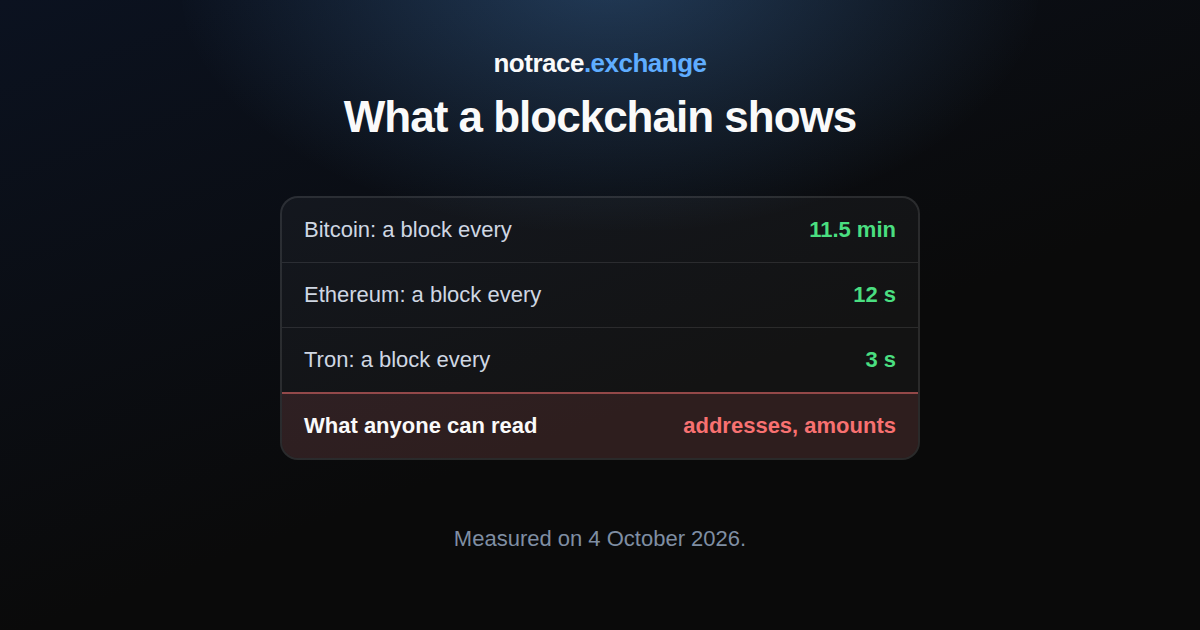
- Bitcoin: 144 blocks, from 969,663 to 969,807, took 27.7 hours, which is 11.5 minutes per block on average. In this window it came out longer than the textbook "ten minutes"; in another window it would come out differently;
- Ethereum: 7,200 blocks at an average of 12.03 seconds;
- Tron: 28,800 blocks at an average of 3.00 seconds.
Per day that is about 125 blocks on Bitcoin, about 7,200 on Ethereum and about 28,800 on Tron. Hence the different speed of "confirmation": on Bitcoin it is counted in minutes, on Tron in seconds. This is an average over a window, not a guarantee for any particular transfer.
Three real transfers
One fresh transfer on each network. We did not pick them by any criterion: on Bitcoin we took the first simple transaction in the latest block (one input, two outputs), on Ethereum and on Tron the first USDT transfer in the latest block. Below is everything an explorer shows, that is, a website that reads the same open data: Blockstream for Bitcoin, Etherscan for Ethereum, Tronscan for Tron. Addresses are shortened; the full record is found by the transaction hash.
Bitcoin, block 969,807, 06:38:35 UTC. Transaction 836b80d6…880c:
- input: one, from address
bc1qhqwp…0mgm, 0.01865127 BTC; - outputs: to
bc1qh7l5…yqyk3, 0.00390318 BTC, and tobc1qqh7h…0u2w0, 0.01428909 BTC; - fee: 0.000459 BTC (45,900 satoshis) for a size of 152 vbytes, about 301 satoshis per vbyte.
Inputs and outputs balance to the satoshi: 1,865,127 = 390,318 + 1,428,909 + 45,900. That is the whole record, and it has no names in it. On Bitcoin an input is spent whole, so one of the two outputs is usually change returned to the sender; which one, the record itself does not say.
The sender sets the fee. According to mempool.space, the median fee in this block is 2 satoshis per vbyte, with a range from 0 to 301, and our transaction sits at the top end: the start of a block usually holds the transactions with the highest fees. At CoinGecko's price of 84,979 dollars per BTC (06:38 UTC) it paid about 39 dollars, whereas at the median fee it would have paid about 305 satoshis, or 26 cents.
Ethereum, block 26,117,258, 06:40:35 UTC. The block holds 154 transactions. USDT transfer 0x57e9b3…2e12:
- a call to the USDT contract
0xdAC17F95…1ec7, functiontransfer; - sender
0x56ed…b17f, recipient0xa84f…bb52; - amount 69.10 USDT;
- 63,209 units of gas used at 1.07 gwei: 0.0000675 ETH, about 18 cents at 2,692.51 dollars per ETH (CoinGecko, 06:38 UTC).
Here the price of timing is plain. In our 1 October measurement at 16:22 UTC the median gas price for such transfers was 10.75 gwei, while today the block's base fee is 0.068 gwei and this transfer paid 1.07 gwei including the tip to the validator. The price on a network changes several-fold within days, which is why every figure in our articles carries a date.
Tron, block 86,807,796, 06:40:54 UTC. The block holds 329 transactions. USDT transfer 552800b3…e5a8:
- sender
TU4vEr…7Pvaa, recipientTHaTt6…tFZT; - amount 40.00 USDT;
- 130,285 units of energy used, of which 130,284 came out of the sender's own stock, so no TRX had to be burned for energy (it can be stocked up in advance or rented; we wrote about that in the piece on USDT networks);
- bandwidth fee: 0.345 TRX, about 12 cents at 0.335253 dollars.
All three records show the same things: the sender's address, the recipient's address, the amount, the time and the fee. All of it is open and stays that way for good.
What one address lets you read
The record has no name, but an address has a history, and it is open in full. Take the best-known Bitcoin address, 1A1zP1eP5QGefi2DMPTfTL5SLmv7DivfNa: according to the Bitcoin Wiki, the reward for the first block went to it. On 4 October 2026 Blockstream shows 66,694 confirmed transactions for it and 80,124 payments received totalling 57.48 BTC, none of which has been spent. The same lookup works for any address: paste it into the explorer's search box, no login and no permission needed.
What follows from this
- A transfer cannot be recalled. Once it is in a block the record does not change, so a mistake in the address or the network stays a mistake.
- The sender pays the fee and picks it. It depends on the size of the record in bytes, on the token and on how busy the network is that hour.
- The blockchain does not say who is behind an address. That is learned from other sources; what an address gives away on its own is covered in what a wallet address is, and how people follow a chain of transfers through the records in is Bitcoin traceable.
- Whoever holds the key decides. If the key is with a service, the record on the blockchain merely reflects that service's decisions; the difference is covered in custodial vs non-custodial wallets.
- Tokens add their own power. The USDT contract has a function that freezes an address, while the Bitcoin network has no such function; details in what USDT is and who controls it.
- Not everything that happens to coins shows on the blockchain. A trade on a P2P platform takes place in the platform's own books, and a record on the blockchain appears when the coins are withdrawn to an address; how such a trade is built is covered in what P2P is in crypto.
Where we stand
On our order page each of the two payouts gets a link to the explorer of its network: you read your own transfer the way we read other people's.
- The payout leaves in two transfers to two addresses of yours, each with its own delay; on 4 October 2026 each could be set from 0 to 6 hours in steps of one hour.
- While a delay runs, the funds are held by the service: section 8 of the terms states plainly that for that time the service is the custodian.
- Before you pay, the order offers a letter signed with our PGP key, and our fee on 4 October 2026 was 0.5%; the current figure is always on the FAQ page.
Four coins have a dedicated page that opens the form in that coin with its live minimum: the bitcoin mixer, Ethereum, Solana and USDT.
Where to start
Open a network's explorer and paste in your own address: half an hour of reading like that explains a blockchain better than any definition. Check the network, the recipient's address and the block number, use a small amount for a first transfer, and keep the transaction hash: it finds the transfer at any moment.