
How long an Ethereum transaction takes
Published: November 19, 2026
Also available in:EspañolРусский繁體中文
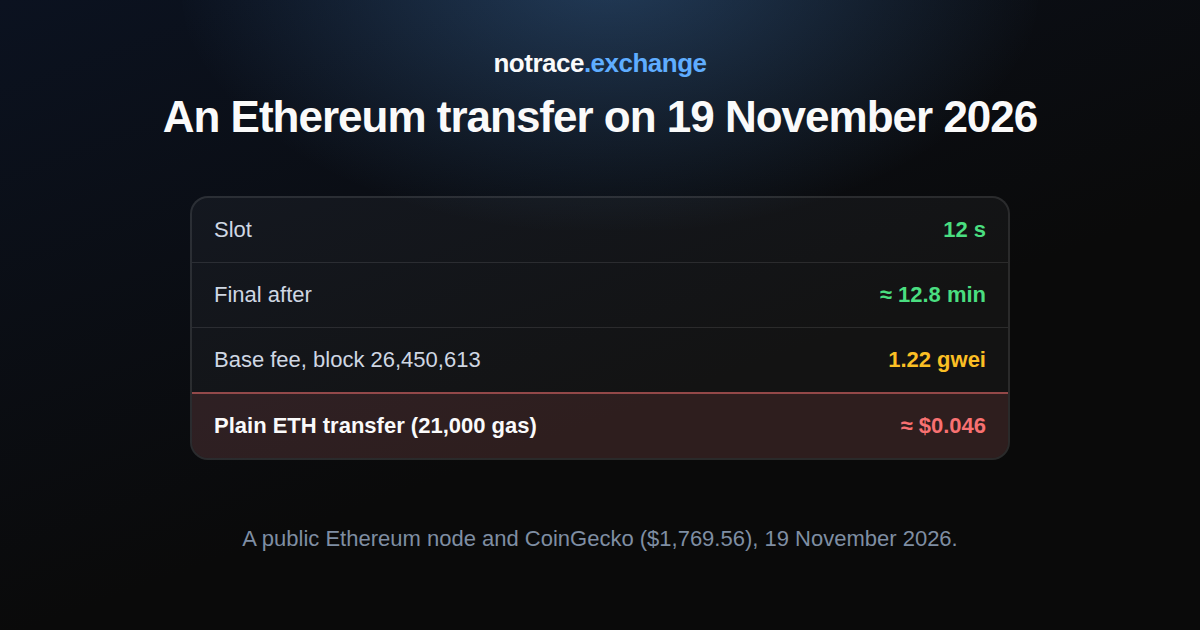
How long does an Ethereum transaction take? Usually about 12 seconds to enter a block and about 13 minutes to be final. A new block, called a slot, arrives every 12 seconds. A fee that is high enough gets a transaction into the next one; a low fee leaves it waiting. On 19 November 2026 we read the chain to put numbers on it.
Three stages
- Pending. The transaction is signed and sent, and sits in the pool of waiting transactions that every node keeps.
- Included. A validator puts it into a block. This is when wallets show it as confirmed, at the next 12-second slot if the fee was enough.
- Final. After two more 32-slot epochs the block cannot be reverted. At 17:00 UTC on 19 November 2026 we read the chain and the last finalized epoch was two behind the head, which is 12.8 minutes (proof of work vs proof of stake).
What decides the wait
The fee. Each block has a base fee that the network sets and burns, and a transaction must offer at least that much per unit of gas, plus an optional tip for the validator. At 17:26 UTC we read block 26,450,613: the base fee was 1.22 gwei, the suggested tip was practically zero, and the block used 25.2 million of its 60 million gas, so there was room for everyone.
A plain ETH transfer uses 21,000 gas. At that base fee it cost about 25,700 gwei, 0.0000257 ETH, which at CoinGecko's $1,769.56 is about 4.6 cents. Token transfers such as USDT use several times more gas (TRC20 vs ERC20 has measured costs). How fees and gas work in general: what is Ethereum.
Why a transaction stalls
- A fee below the base fee. It waits until the base fee falls or until the sender raises it.
- An earlier transaction is stuck. Transactions from one account go in order, so a stuck one holds up everything after it.
- A busy network. When blocks are full the base fee climbs and cheap offers are left behind. On 19 November it was not the case.
A stuck transaction can be replaced by sending a new one with the same sequence number and a higher fee, which is what the "speed up" and "cancel" buttons do. A transaction that fails still pays for the gas it used.
Faster and cheaper
Layer 2 networks such as Arbitrum and Base confirm in a fraction of a second and charge a fraction of the fee, but they carry risks of their own (what is layer 2). A planned change to how gas is priced, Glamsterdam, would alter the cost of some operations but not the 12-second slot, and it has no mainnet date (Ethereum's Glamsterdam upgrade on hold).
FAQ
Why does my transaction say pending for so long? The fee is below the current base fee, or an earlier transaction from the same account is stuck.
Can I cancel a pending transaction? Only by replacing it with another that has the same sequence number and a higher fee, before it is included.
Do I pay if it fails? Yes, the gas it used is spent.
Where we stand
The notrace.exchange form takes ETH on Ethereum and USDC and USDT on Ethereum, among its coins. Each of its two payouts waits for the delay you chose, 0 to 6 hours, and then travels for the network time above.
- The payout leaves as two transfers to two addresses of yours, each after its own delay of 0 to 6 hours.
- While a delay runs, the funds are held by the service: section 8 of the terms says so.
- Before you pay, the order offers a letter signed with our PGP key stating what you send and the least you will receive.
- Our fee is on the FAQ page.
The Ethereum mixer page opens the form in ETH with the live minimum.