
What is layer 2? Arbitrum and Base
Published: November 19, 2026
Also available in:EspañolРусский繁體中文
What is layer 2? It is a network built on top of Ethereum, the layer 1: it processes transactions itself, quickly and cheaply, and writes the results back to Ethereum, which keeps them safe. Arbitrum and Base are the two best-known examples, and on both of them fees are paid in ETH. They are also two of the networks on which the notrace.exchange form takes USDC. On 19 November 2026 we took three readings to see how they look today.
How a rollup works
- Execution off the main chain. A sequencer, a server run by the network, orders users' transactions and executes them. That is why a block on Base can come every fraction of a second.
- Data on Ethereum. The transaction data is posted to Ethereum, since 2024 mostly in cheap temporary "blobs", so anyone can rebuild the state of the layer 2 from it.
- Proof of correctness. Arbitrum and Base are optimistic rollups: results are accepted unless someone proves them wrong within a challenge window. Other rollups use zero-knowledge proofs instead. A withdrawal from an optimistic rollup to Ethereum through the official bridge takes about a week because of that window.
Fees and speed
On Arbitrum and Base a transfer is paid in ETH, as on Ethereum, but costs a fraction of what it does there. A wallet holding USDC on Base and no ETH cannot send it, the same trap as USDT on Tron without TRX (what is Tron). How Ethereum's own fees work: what is Ethereum.
The same coin on different networks
USDC exists on Ethereum, Arbitrum, Base and Solana as separate tokens, and the address of an Ethereum, Arbitrum or Base wallet has the same shape on all three (what a wallet address looks like). Funds sent on the wrong one are not lost on the chain, but a wallet that does not show that network will show zero. More on the coin: what is USDC.
Risks
A layer 2 inherits Ethereum's security only as far as its own contracts allow. The sequencer is run by one operator, so a stall can stop the network for a while. Upgrades are decided by keyholders, and some have no delay. Third-party trackers such as L2BEAT rate how far each network has moved from this.
What we measured on 19 November 2026
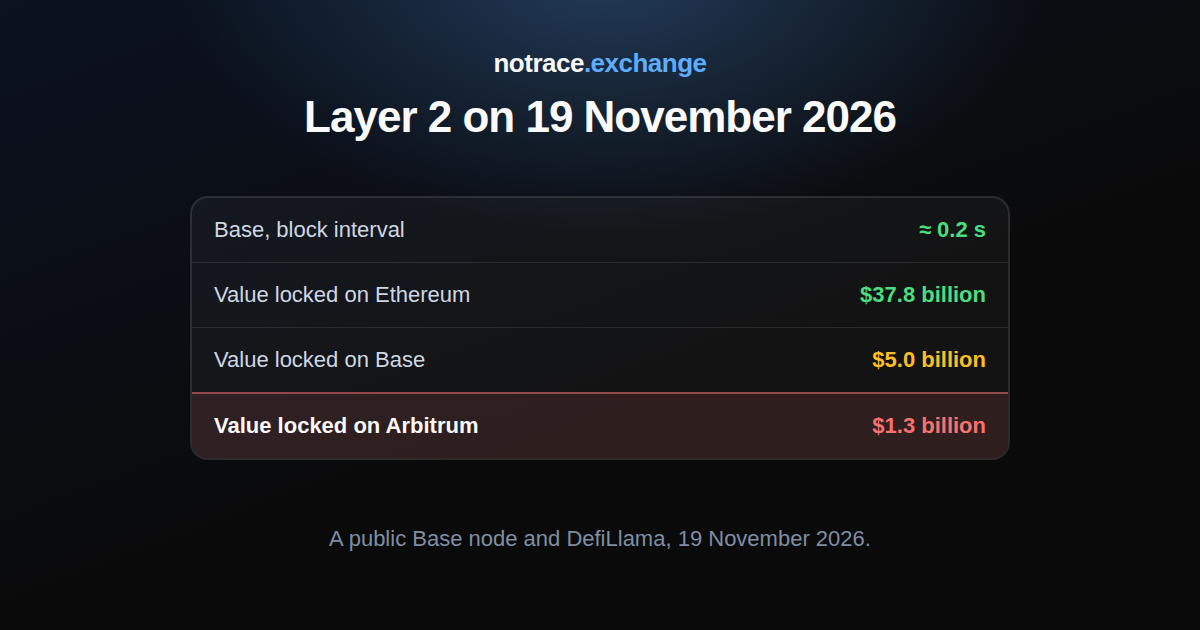
- Speed. Two reads of Base's public node, 25 seconds apart, showed blocks 59,585,339 and 59,585,462: 123 blocks, one every 0.2 seconds.
- Size. DefiLlama showed $37.8 billion locked on Ethereum, $5.0 billion on Base and $1.3 billion on Arbitrum, so Base now holds almost four times as much as Arbitrum.
FAQ
Is a layer 2 the same as a sidechain? No. A sidechain has its own security; a rollup posts its data to Ethereum and leans on it.
Do I need ETH to use Arbitrum or Base? Yes, for fees, even if your balance is in USDC.
Can I use one address on all of them? Yes: they share the Ethereum address format, but each network keeps its own balance.
Where we stand
The notrace.exchange form takes ETH on Ethereum, USDC on Arbitrum, Base, Ethereum and Solana, and USDT on Ethereum, Solana and Tron. USDT on Arbitrum or Base is not accepted.
- The payout leaves as two transfers to two addresses of yours, each after its own delay of 0 to 6 hours.
- While a delay runs, the funds are held by the service: section 8 of the terms says so.
- Before you pay, the order offers a letter signed with our PGP key stating what you send and the least you will receive.
- Our fee is on the FAQ page.
The Ethereum mixer page opens the form in ETH with the live minimum. More: what is a smart contract and what is DeFi.