
Ethereum's Glamsterdam upgrade on hold
Published: November 19, 2026
Also available in:EspañolРусский繁體中文
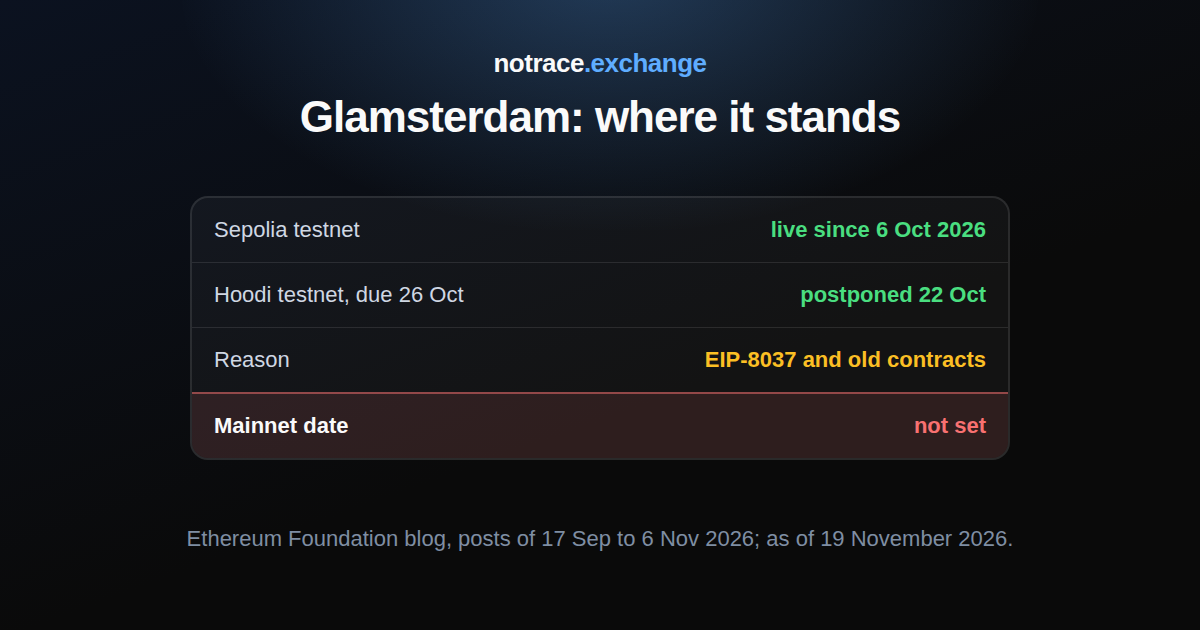
Ethereum's next upgrade, Glamsterdam, is on hold. It went live on the Sepolia testnet on 6 October 2026 and was due on the Hoodi testnet on 26 October, but on 22 October the core developers postponed that fork (the Ethereum Foundation's post). A mainnet date has not been set. This is where things stand on 19 November 2026.
What Glamsterdam is
It follows the Fusaka upgrade and joins two parts, Amsterdam for execution and Gloas for consensus. Three changes carry most of the weight (the Foundation's description):
- Enshrined proposer-builder separation (EIP-7732): the split between the validator who proposes a block and the builder who assembles it moves into the protocol itself, instead of relying on outside middleware;
- Block-level access lists (EIP-7928): each block records which accounts and storage it touched, so clients can read state and check transactions in parallel;
- New gas accounting (EIP-8037 and EIP-8038): gas, the unit that prices computation, changes for creating state and for reading it.
Why it paused
On 22 October, at the core developers' call no. 248, the Hoodi fork was postponed to look into how EIP-8037 interacts with smart contracts already on mainnet. On 6 November the Foundation gave the reason in detail (post of 6 November): the audit firm ChainSecurity found projects that rely on assumptions the new gas rules would break. The developers decided not to fork Hoodi until this is resolved, and asked contract authors to check their code against eight listed invariants.
By 9 November four reports of deployed contracts that could break had arrived. The Foundation recommends waiting for the audit findings to be public before deciding whether to change the specification or to schedule Hoodi. It lists the audit presentation for 16 November and a discussion at the call of 19 November, with no decision made in advance. What that call decides is not known at the time of writing.
What it changes for a user
Nothing to do. The Foundation's own post says no action is required from mainnet users or ETH holders. Fees and transfers follow today's rules, and new gas costs would apply only after a mainnet upgrade, which has no date. For developers it means testing contracts against the new rules, which is exactly what the pause is for.
What we checked
We read the Foundation's posts of 17 September, 16 October, 22 October and 6 November at the source, not through news summaries; the dates and epoch numbers above come from them. Some news items put the mainnet launch in early December. The posts do not: they say the date has not been decided.
Where we stand
The notrace.exchange form takes ETH, and USDC and USDT on Ethereum, among its coins. A testnet postponement changes nothing about it: the deposit counts when the network confirms it.
- The payout leaves as two transfers to two addresses of yours, each after its own delay of 0 to 6 hours.
- While a delay runs, the funds are held by the service: section 8 of the terms says so.
- Before you pay, the order offers a letter signed with our PGP key stating what you send and the least you will receive.
- Our fee is on the FAQ page.
The Ethereum page opens the form in ETH with the live minimum. More about the network: what is Ethereum, smart contracts and staking.