
What is a hard fork in crypto?
Published: November 19, 2026
Also available in:EspañolРусский繁體中文
What is a hard fork? It is a change to a blockchain's rules that is not compatible with the old ones: software that does not upgrade rejects the new blocks and stays on a chain of its own. If everybody upgrades, nothing visible happens beyond a new version number. If part of the network refuses, the chain splits in two and both versions carry on.
Hard fork and soft fork
A soft fork tightens the rules: blocks made under the new rules are still valid under the old ones, so old software keeps working and simply does not use the new features. Bitcoin's SegWit and Taproot were soft forks. A hard fork loosens or changes the rules so that old software calls the new blocks invalid, which makes upgrading compulsory for everyone who wants to stay on the new chain.
Two kinds of hard fork
- Planned upgrades. On networks that agree changes in advance, a hard fork is the ordinary way to ship an upgrade on a fixed block or date. Ethereum's next one, Glamsterdam, is such an upgrade (Ethereum's Glamsterdam upgrade on hold). Zcash's NU7 worked the same way, and its specification warns that operators who do not upgrade can follow the old rules after activation (Zcash NU7).
- Contested splits. A group disagrees with the rest and forks off, taking the history up to that day and creating a second coin. Bitcoin Cash split from Bitcoin in August 2017, and Ethereum Classic remained after Ethereum changed its history in 2016.
How a split looks years later
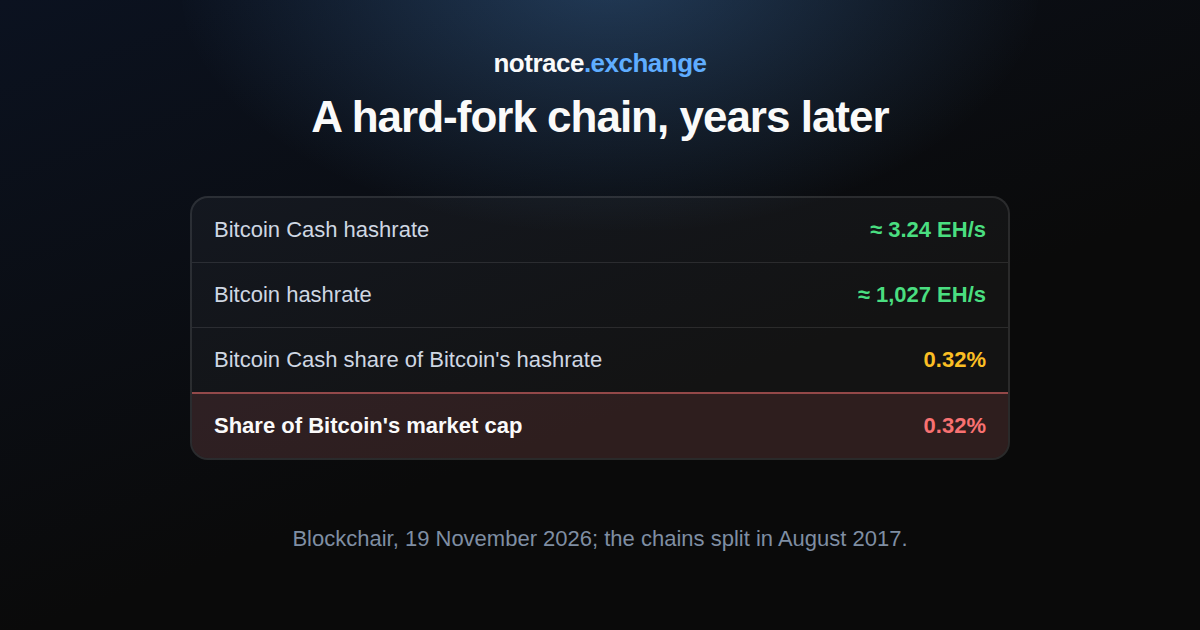
We read both chains from Blockchair on 19 November 2026. Bitcoin Cash was at block 978,053 and had a 24-hour hashrate of about 3.24 exahashes per second; Bitcoin, at 16:32 UTC, about 1,027. That is 0.32%. Bitcoin Cash's market capitalisation was $4.1 billion against $1.27 trillion, again 0.32%. The two chains share their whole history up to the split and have lived separate lives since. How a small chain is exposed to attack: what is a 51% attack.
What it means if you hold coins
At a contested split holders often end up with both coins, but the new one has its own price, its own wallets and its own risks, and whether a platform credits it is that platform's decision. Splits attract scams, for example messages that ask you to "claim" the new coin with your seed phrase, which is never needed (crypto scams, seed phrase safety). For a planned upgrade you usually do nothing beyond updating your wallet.
FAQ
Is a hard fork the same as an upgrade? Many upgrades are hard forks, but the word is used for any rule change old software will not accept.
Can a hard fork take my coins? No. Coins on the old chain stay where they are.
Which side is "the real" coin? The names are decided by the market and by wallets and platforms, not by the protocol. What Bitcoin and Ethereum are: what is Bitcoin, what is Ethereum.
Where we stand
The notrace.exchange form takes BTC, ETH, SOL, TRX, USDC and USDT. Forked coins such as Bitcoin Cash are not accepted. A network upgrade of a coin we take does not change how the form works: the deposit counts when the network confirms it.
- The payout leaves as two transfers to two addresses of yours, each after its own delay of 0 to 6 hours.
- While a delay runs, the funds are held by the service: section 8 of the terms says so.
- Before you pay, the order offers a letter signed with our PGP key stating what you send and the least you will receive.
- Our fee is on the FAQ page.
The Bitcoin mixer page opens the form in BTC with the live minimum.