
What is staking in crypto? Real yields
Published: October 23, 2026
Also available in:EspañolРусский繁體中文
What is staking in crypto? It is locking coins on a proof-of-stake network (Ethereum, Solana and others) so they back the validators that confirm blocks. In return the network pays a reward in newly issued coins and part of the fees. On 23 October 2026 we checked how much is staked today, what staking pays, and how much of that yield is left once new issuance is counted.
How staking works
- Validators put coins up as collateral, which earns them the right to propose and confirm blocks. The bigger the stake, the more often their turn comes. On Ethereum, breaking the rules burns part of the stake; this is called slashing.
- Delegation. You do not need to run a validator yourself. On Solana you move coins to a stake account and delegate it to a validator, which keeps a commission from the rewards. On Ethereum a validator needs 32 ETH, so most people stake through pools.
- Liquid staking. A pool such as Lido gives you a token (stETH, JitoSOL) that grows with the rewards and can be sold without waiting for a withdrawal. The pool is a smart contract, and its bugs are your risk.
- Staking on an exchange. The exchange stakes your coins itself and shares the reward. Meanwhile it holds the coins, as with any custodial wallet.
What staking pays
Ethereum on 23 October:
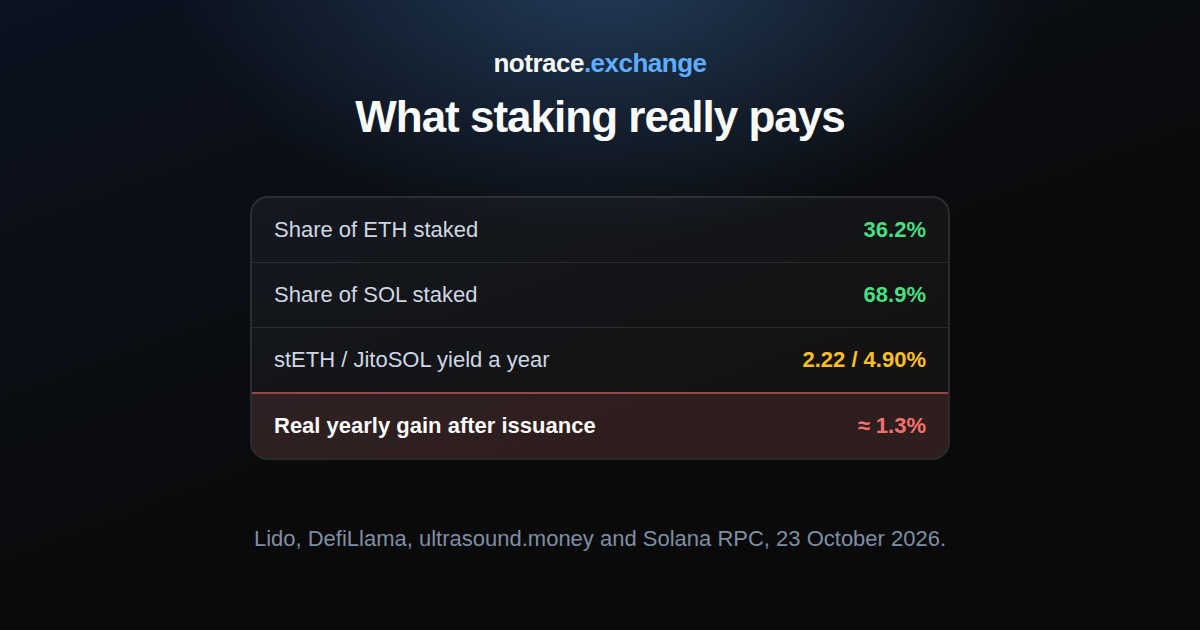
- 44.18 million ETH is staked, 36.2% of the 122.15 million supply;
- 9.67 million of it, or 21.9%, goes through Lido;
- Lido's stETH paid 2.22% a year (7-day average), Coinbase's cbETH 2.28%, Binance's wBETH 2.20% and Rocket Pool's rETH 1.81% (DefiLlama).
Solana:
- 438.3 million SOL is staked, 68.9% of the 636.3 million supply;
- the network's inflation is 3.59% a year; divided by the staked share, that is a 5.21% reward before the validator's commission (the median commission is 5%);
- JitoSOL paid 4.90%, JupSOL 5.07%, Binance's BNSOL 4.53% and Bybit's bbSOL 4.71%.
What is really left
The reward is new coins, printed for all stakers at once. So what matters is not the rate but how much faster than the supply your share grows.
- The ETH supply grew by 86,766 ETH in the 30 days from 23 September to 23 October, or 0.86% a year (2,365 ETH was burned in the same month). stETH's 2.22% therefore grows your share by about 1.3% a year.
- The SOL supply grows 3.59% a year. JitoSOL's 4.90% gives the same 1.3% or so.
If you do not stake, your share shrinks: by about 0.86% a year in ETH and about 3.5% in SOL. Rewards are counted in coins, not dollars, and the coin's price can move far more than that in a year.
Risks
- Withdrawals take time. On Solana, unstaking takes effect at the epoch boundary; an epoch is now 432,000 slots, about 25 hours. On Ethereum, exits go through a validator queue whose length depends on how many are leaving at once.
- Slashing. A validator's mistake costs part of the stake, and in a pool it falls on every member.
- Custody. Liquid staking depends on the contract's code; exchange staking depends on the exchange.
- Concentration. Solana's 18 largest validators hold more than a third of all stake, and the top ten hold 24.4%.
Staking and privacy
A stake is public. A Solana stake account records which wallet can withdraw it, an Ethereum validator shows its withdrawal address on chain, and stETH sits at an ordinary address like any token. Exchange staking is tied to your account. What else an address reveals is covered in is crypto anonymous.
FAQ
Is staking crypto safe? The network itself pays the reward, but you can still lose on the coin's price, a validator's or pool's mistake, or the exchange.
How is staking different from mining? In mining the collateral is hardware and electricity; in staking it is the coins themselves.
How is it different from a liquidity pool? A liquidity pool pays from traders' fees, not new issuance, and has its own risk, impermanent loss. See what is a liquidity pool.
Where we stand
The notrace.exchange form takes BTC, ETH, SOL and TRX, and USDT and USDC on several networks. Staking tokens such as stETH or JitoSOL are not on it.
- The payout leaves as two transfers to two addresses of yours, each with its own delay of 0 to 6 hours. If you want the coin and the amount to change too, choose a payout in another coin.
- While a delay runs, the funds are held by the service: section 8 of the terms says so.
- Before you pay, the order offers a letter signed with our PGP key stating what you send and the least you will receive.
- Our fee on 23 October 2026 was 0.5%; the current figure is on the FAQ page.
The Ethereum and Solana pages open the form in that coin with the live minimum.