
What is a liquidity pool in crypto
Published: October 20, 2026
Also available in:EspañolРусский繁體中文
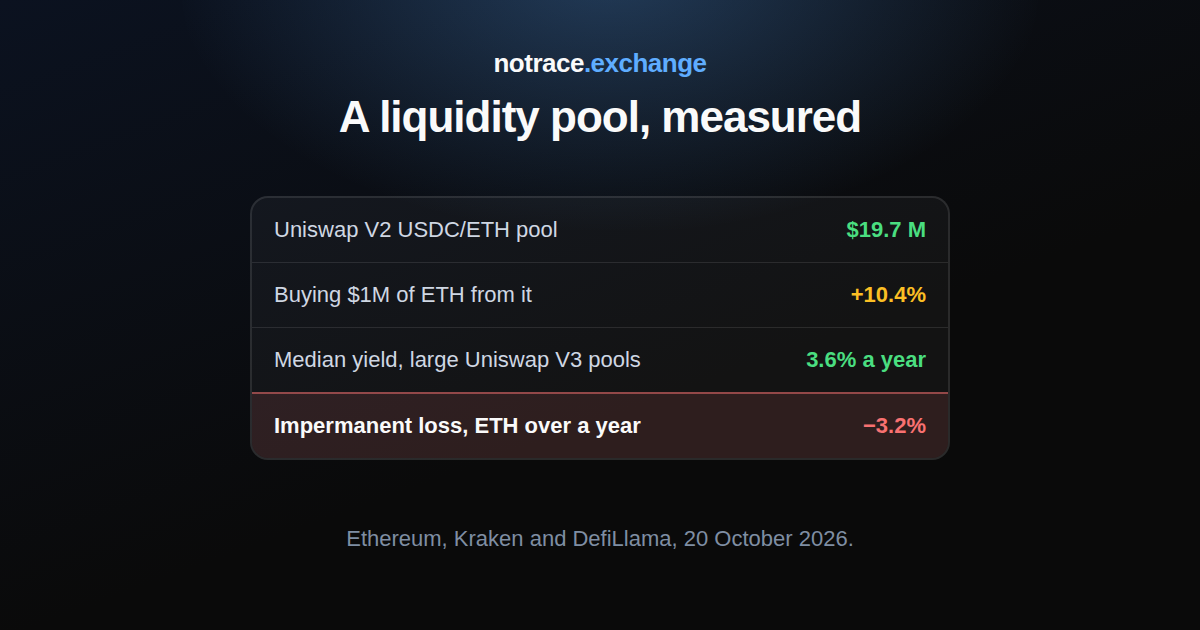
What is a liquidity pool? A smart contract that holds two tokens, say USDC and ETH. Anyone can buy one of them from the pool with the other, or deposit both and earn a share of the fee on every trade. This is what a DEX runs on. On 20 October 2026 we read a real Uniswap pool, worked out impermanent loss on the real price of ether, and took pool yields from DefiLlama.
How a pool sets the price
A Uniswap V2 pool follows one rule: the product of its two balances after a trade may not be smaller than before it, x * y = k (Uniswap docs). When you buy ether, you put USDC in and take ETH out. There is less ether left, so each next ether costs more. The bigger the trade compared with the pool, the further it moves the price.
Every V2 trade pays 0.3%: 0.25% goes to those who filled the pool and 0.05% to the protocol (Uniswap docs). In return for their tokens, providers get a share of the pool, which they can redeem at any time together with the fees it has collected.
What a real pool showed
The Uniswap V2 USDC/ETH pool at 10:46 UTC held 9.87 million USDC and 4,143 ETH, about $19.7 million in all, at $2,381.79 per ether. Buying ether from it alone:
- $1,000 cost 0.31% more than the pool price, almost all of it the fee;
- $10,000 cost 0.40% more;
- $100,000 cost 1.31% more;
- $1 million cost 10.4% more.
That is how pool depth turns into slippage; more in what is slippage in crypto. An aggregator usually splits a large trade across many pools, so in practice it costs less.
What a pool pays
DefiLlama listed 16,090 pools on 20 October.
- The 19 Uniswap V3 pools on Ethereum holding at least $10 million had a median fee yield of 3.6% a year.
- The USDC/ETH pool with a 0.05% fee ($81.8 million) yielded 7.7% a year; $34.5 million passed through it in a day.
- Across 997 pools of two or more tokens holding at least $1 million, the median was 0.9%, and DefiLlama flags 70% of them for impermanent loss risk.
These figures move every day with trading volume: a pool earns fees, not a promised rate.
Impermanent loss
When one token's price drifts from where you entered, the pool sells the token that went up and buys the one that went down. You end up with less value than if you had simply held both. For a 50/50 pool such as Uniswap V2, at Kraken prices:
- over 30 days ether fell 9.9%: a loss of 0.14%;
- over 90 days it rose 23.2%: a loss of 0.54%;
- over a year it fell 40.2%, from $3,981 to $2,382: a loss of 3.2%.
The loss is "impermanent" while the price can still come back; leave the pool now and it is an ordinary loss. In V3 pools with a narrow price range, the same move costs more.
Where pools break
- The creator takes the liquidity. Whoever opened a pool for a new token can withdraw all of it, leaving the token with nothing to sell into. That is a rug pull.
- A trap token. A token's contract can let everyone buy but only its author sell.
- Hacks and approvals. To deposit tokens you sign an approval for the contract; what it hands over and how often DeFi contracts get hacked is in what is DeFi.
Quick answers
Is a liquidity pool the same as a mining pool? They share only the word. A mining pool combines miners' computing power; a liquidity pool holds tokens for trading.
What does liquidity mean? How large a trade can go through without moving the price much.
Can you lose money in a liquidity pool? Yes: through impermanent loss, a creator pulling the liquidity, or a hacked contract.
Where we stand
The notrace.exchange form takes BTC, ETH, SOL and TRX, and USDT and USDC on several networks. Before you pay, the order shows the least you will receive.
- The payout leaves as two transfers to two addresses of yours, each with its own delay of 0 to 6 hours. If you want the coin and the amount to change too, choose a payout in another coin.
- While a delay runs, the funds are held by the service: section 8 of the terms says so.
- The order offers a letter signed with our PGP key stating what you send and the least you will receive.
- Our fee on 20 October 2026 was 0.5%; the current figure is on the FAQ page.
The bitcoin mixer page opens the form in BTC with the live minimum.